

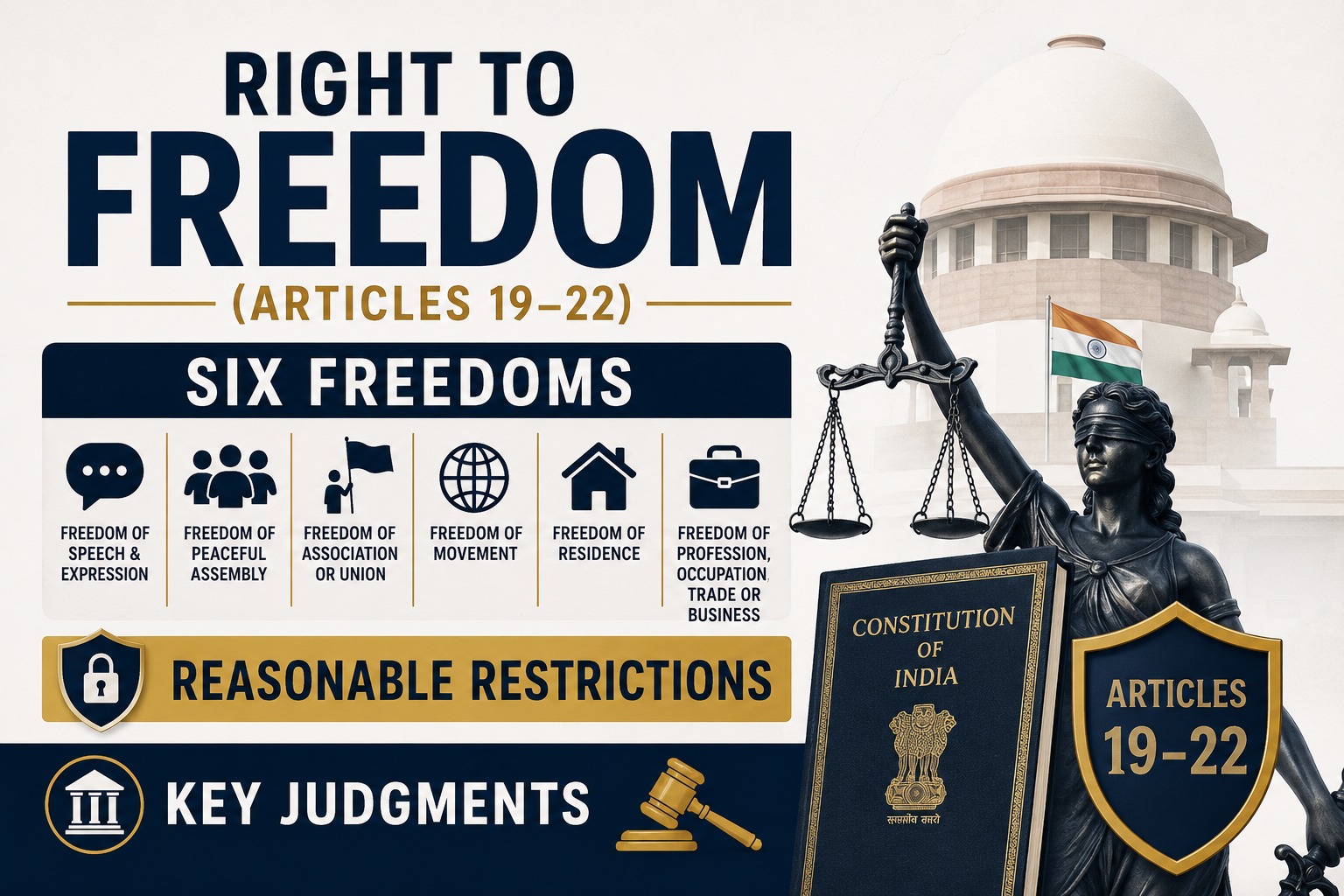
Right to Freedom (Articles 19–22): Six Freedoms, Reasonable Restrictions & Key Judgments
The Constitution of India guarantees several Fundamental Rights to ensure liberty, dignity, and democratic governance. Among these rights, the Right to Freedom under Articles 19 to 22 occupies a central position in the constitutional framework. These provisions protect individual liberty while balancing the interests of society, public order, and national security.
The Right to Freedom empowers citizens with civil liberties that are essential for democracy, including freedom of speech, movement, association, occupation, and personal liberty. These rights allow individuals to express opinions, criticize governments, form organizations, travel freely, and live with dignity.
At the same time, the Constitution recognizes that unrestricted freedom may sometimes threaten public order, morality, security, or the rights of others. Therefore, reasonable restrictions are imposed under specific circumstances.
Articles 19 to 22 collectively establish a constitutional balance between liberty and social control. They define the limits of State power and protect citizens from arbitrary action.
This article provides a detailed analysis of:
- Articles 19 to 22
- Six freedoms under Article 19
- Reasonable restrictions
- Protection in criminal laws
- Right to life and personal liberty
- Protection against arrest and detention
- Landmark Supreme Court judgments
- Contemporary relevance
Understanding the Right to Freedom
Freedom is one of the most essential conditions for human development and democracy. Without liberty, individuals cannot:
- Express ideas
- Participate in governance
- Pursue careers
- Travel freely
- Develop personality and dignity
The framers of the Constitution believed that political democracy could survive only if citizens enjoyed civil liberties.
The Right to Freedom is guaranteed under:
- Article 19
- Article 20
- Article 21
- Article 21A
- Article 22
Together, these provisions form the foundation of constitutional liberty in India.
Article 19: Six Fundamental Freedoms
Article 19 guarantees six important freedoms to citizens of India.
Originally, there were seven freedoms, including the right to property. However, the 44th Constitutional Amendment removed property from Fundamental Rights.
Today, Article 19(1) guarantees the following six freedoms:
- Freedom of Speech and Expression
- Freedom of Assembly
- Freedom of Association
- Freedom of Movement
- Freedom of Residence
- Freedom of Profession, Occupation, Trade, or Business
1. Freedom of Speech and Expression – Article 19(1)(a)
Meaning
This freedom allows citizens to:
- Express opinions
- Share ideas
- Criticize government policies
- Publish writings
- Use media platforms
- Participate in political discourse
It is considered the cornerstone of democracy.
Freedom of expression includes:
- Press freedom
- Artistic expression
- Commercial speech
- Digital communication
- Right to information
Importance of Freedom of Speech
It helps:
- Strengthen democracy
- Ensure government accountability
- Encourage public debate
- Promote intellectual growth
- Protect dissent
Without freedom of speech, democratic governance becomes impossible.
Reasonable Restrictions on Speech
The State can impose reasonable restrictions under Article 19(2) in the interests of:
- Sovereignty and integrity of India
- Security of the State
- Friendly relations with foreign States
- Public order
- Decency or morality
- Contempt of court
- Defamation
- Incitement to an offense
Restrictions must be reasonable and not arbitrary.
Landmark Judgments on Freedom of Speech
1. Romesh Thappar v. State of Madras (1950)
Romesh Thappar v. State of Madras
The Supreme Court held that freedom of speech is essential for democracy.
The judgment strengthened press freedom.
2. Shreya Singhal v. Union of India (2015)
Shreya Singhal v. Union of India
The Court struck down Section 66A of the Information Technology Act for violating free speech.
This judgment became a milestone for digital rights and online expression.
3. Bennett Coleman & Co. v. Union of India (1973)
Bennett Coleman & Co. v. Union of India
The Court protected newspaper freedom against excessive government restrictions.
2. Freedom of Assembly – Article 19(1)(b)
Citizens have the right to assemble peacefully and without arms.
This includes:
- Public meetings
- Protests
- Demonstrations
- Political gatherings
Peaceful protest is a democratic right.
Restrictions on Assembly
Reasonable restrictions may be imposed in the interests of:
- Public order
- Sovereignty and integrity of India
Violent or unlawful assemblies are not protected.
Importance of Freedom of Assembly
This freedom allows citizens to:
- Raise public issues
- Protest injustice
- Participate in democratic movements
Many historic movements in India relied on this freedom.
3. Freedom of Association – Article 19(1)(c)
Citizens can form:
- Associations
- Trade unions
- Political parties
- Clubs
- Societies
- Cooperatives
This freedom strengthens collective participation in democracy.
Restrictions on Association
Restrictions may be imposed for:
- Public order
- Morality
- Sovereignty and integrity of India
Organizations involved in terrorism or unlawful activities may be banned.
Landmark Judgment
Damyanti Naranga v. Union of India (1971)
Damyanti Naranga v. Union of India
The Court held that freedom of association includes the right to continue an association voluntarily without forced interference.
4. Freedom of Movement – Article 19(1)(d)
Citizens can move freely throughout the territory of India.
This promotes:
- National unity
- Economic opportunity
- Personal liberty
Restrictions on Movement
The State may impose restrictions:
- In the interest of the general public
- For protection of Scheduled Tribes
Restricted areas may exist for security or tribal protection.
5. Freedom of Residence – Article 19(1)(e)
Citizens can reside and settle in any part of India.
This prevents regional discrimination and strengthens national integration.
Restrictions on Residence
Restrictions may be imposed:
- For public interest
- To protect tribal culture and resources
Certain tribal areas have regulated access.
6. Freedom of Profession, Occupation, Trade, or Business – Article 19(1)(g)
Citizens have the right to:
- Choose professions
- Start businesses
- Conduct trade
- Pursue occupations
This freedom supports economic liberty.
Restrictions on Profession and Trade
The State may impose reasonable restrictions:
- In public interest
- Through professional qualifications
- By regulating dangerous industries
The government may also nationalize industries.
Landmark Judgment
Excel Wear v. Union of India (1978)
Excel Wear v. Union of India
The Supreme Court held that the right to carry on business includes the right to close business under certain conditions.
Concept of Reasonable Restrictions
The Constitution does not grant absolute freedom.
Restrictions must:
- Be lawful
- Serve public interest
- Be proportional
- Not be arbitrary
Courts determine whether restrictions are reasonable.
Article 20: Protection in Respect of Conviction for Offenses
Article 20 protects individuals accused of crimes.
It provides three important safeguards.
1. Protection Against Ex Post Facto Laws
A person cannot be punished under a law that did not exist when the act was committed.
Example:
- If an act was legal yesterday, a new law cannot punish it retrospectively.
2. Protection Against Double Jeopardy
No person can be punished twice for the same offense.
This principle prevents repeated prosecution.
3. Protection Against Self-Incrimination
An accused person cannot be forced to testify against themselves.
This protects personal liberty and fair trial rights.
Landmark Judgment
Nandini Satpathy v. P.L. Dani (1978)
Nandini Satpathy v. P.L. Dani
The Court expanded protection against self-incrimination and emphasized dignity during investigation.
Article 21: Right to Life and Personal Liberty
Text of Article 21
“No person shall be deprived of his life or personal liberty except according to procedure established by law.”
Initially interpreted narrowly, Article 21 later became the most expansive Fundamental Right.
Expansion of Article 21
The judiciary interpreted “life” to mean more than mere survival.
It now includes:
- Right to dignity
- Right to privacy
- Right to livelihood
- Right to education
- Right to clean environment
- Right to legal aid
- Right to shelter
- Right to health
Article 21 has transformed Indian constitutional law.
Landmark Judgments on Article 21
1. A.K. Gopalan v. State of Madras (1950)
A.K. Gopalan v. State of Madras
Initially, the Court interpreted personal liberty narrowly.
2. Maneka Gandhi v. Union of India (1978)
Maneka Gandhi v. Union of India
This transformed Article 21.
The Court held that laws affecting liberty must be:
- Just
- Fair
- Reasonable
This judgment expanded due process protections.
3. Justice K.S. Puttaswamy v. Union of India (2017)
Justice K.S. Puttaswamy v. Union of India
The Supreme Court declared privacy a Fundamental Right under Article 21.
This judgment became highly significant in the digital age.
Article 21A: Right to Education
Inserted by the 86th Constitutional Amendment, Article 21A guarantees free and compulsory education for children aged 6 to 14 years.
Education is essential for liberty and equality.
Article 22: Protection Against Arrest and Detention
Article 22 protects individuals against arbitrary arrest and detention.
Rights of Arrested Persons
An arrested person has the right:
- To know grounds of arrest
- To consult a lawyer
- To be produced before a magistrate within 24 hours
These safeguards prevent abuse of police powers.
Preventive Detention
Article 22 also permits preventive detention under certain circumstances.
Preventive detention means detaining a person before committing an offense to prevent potential threats.
Safeguards in Preventive Detention
The Constitution provides safeguards:
- Advisory Board review
- Limited detention period
- Communication of grounds
However, preventive detention remains controversial.
Landmark Judgment
D.K. Basu v. State of West Bengal (1997)
D.K. Basu v. State of West Bengal
The Court issued guidelines to prevent custodial torture and illegal detention.
Importance of Articles 19–22
1. Protection of Democracy
Freedom allows citizens to participate in governance and criticize authority.
2. Human Dignity
These rights ensure individuals live with autonomy and respect.
3. Limitation on State Power
Government action must remain constitutional and lawful.
4. Social Development
Freedom promotes creativity, innovation, and intellectual growth.
Relationship Between Liberty and Restrictions
The Constitution balances:
- Individual liberty
- Public order
- National security
- Social harmony
Absolute freedom may create disorder, while excessive restrictions threaten democracy.
Courts maintain this constitutional balance.
Emergency and Right to Freedom
During a National Emergency, certain freedoms under Article 19 may be suspended.
The experience of the Indian Emergency highlighted dangers of excessive executive power.
Post-Emergency amendments strengthened constitutional protections.
Modern Challenges to Freedom
1. Digital Surveillance
Technology has raised privacy concerns.
2. Hate Speech
Balancing free speech and public order remains difficult.
3. Internet Shutdowns
Restrictions on internet access affect freedom of expression and trade.
4. Preventive Detention Laws
Debates continue regarding misuse and human rights concerns.
Role of Judiciary in Protecting Freedom
The judiciary acts as the guardian of liberty by:
- Striking down arbitrary laws
- Expanding rights
- Protecting due process
- Enforcing constitutional morality
Judicial activism significantly strengthened Articles 19–22.
Constitutional Morality and Freedom
Constitutional morality requires:
- Respect for liberty
- Protection of dissent
- Rule of law
- Human dignity
Democracy survives only when freedoms are protected.
Comparative Perspective
Countries like:
- United States
- United Kingdom
- Canada
also guarantee civil liberties, though the scope and limitations differ.
India’s Constitution uniquely combines liberty with social responsibility.
Conclusion
The Right to Freedom under Articles 19 to 22 forms the heart of democratic governance in India. These provisions protect speech, movement, association, profession, life, liberty, and legal safeguards against arbitrary State action.
The Constitution recognizes that liberty is essential for human dignity and democracy, but it also acknowledges the need for reasonable restrictions in the interests of society and national security.
Over the decades, the Supreme Court has expanded these freedoms through progressive interpretations, transforming Article 21 into a powerful source of human rights jurisprudence.
From free speech to privacy rights, from protection against illegal detention to fair procedure, Articles 19–22 continue to shape India’s constitutional democracy.
In modern times, new challenges such as digital surveillance, internet regulation, hate speech, and preventive detention laws have made these freedoms even more relevant. The true strength of democracy lies not merely in elections or institutions, but in the protection of liberty, dignity, and constitutional rights for every individual.
Disclaimer:
This article is based on publicly available information, official statements, and media reports available at the time of publication. The content is intended for informational purposes only and should not be considered financial or policy advice. Readers are encouraged to refer to official sources for the latest updates.
The content is solely for educational and informational purposes. Whether it is global news, indian news, political news or any other sort of content, we do not independently verify the content or claims.
While efforts have been made to ensure accuracy, the information presented may change as new developments emerge. Readers are advised to conduct their own research and consult financial advisors before making any investment decisions.
NoCap Times does not independently verify all claims or statements and shall not be held responsible for any inaccuracies or omissions.
Stay updated with the latest and breaking news on NoCap Times. Get the latest India News, World News, Business News, Sports News, Viral News and Research Articles for various competitive Exams & UPSC Aspirants.