

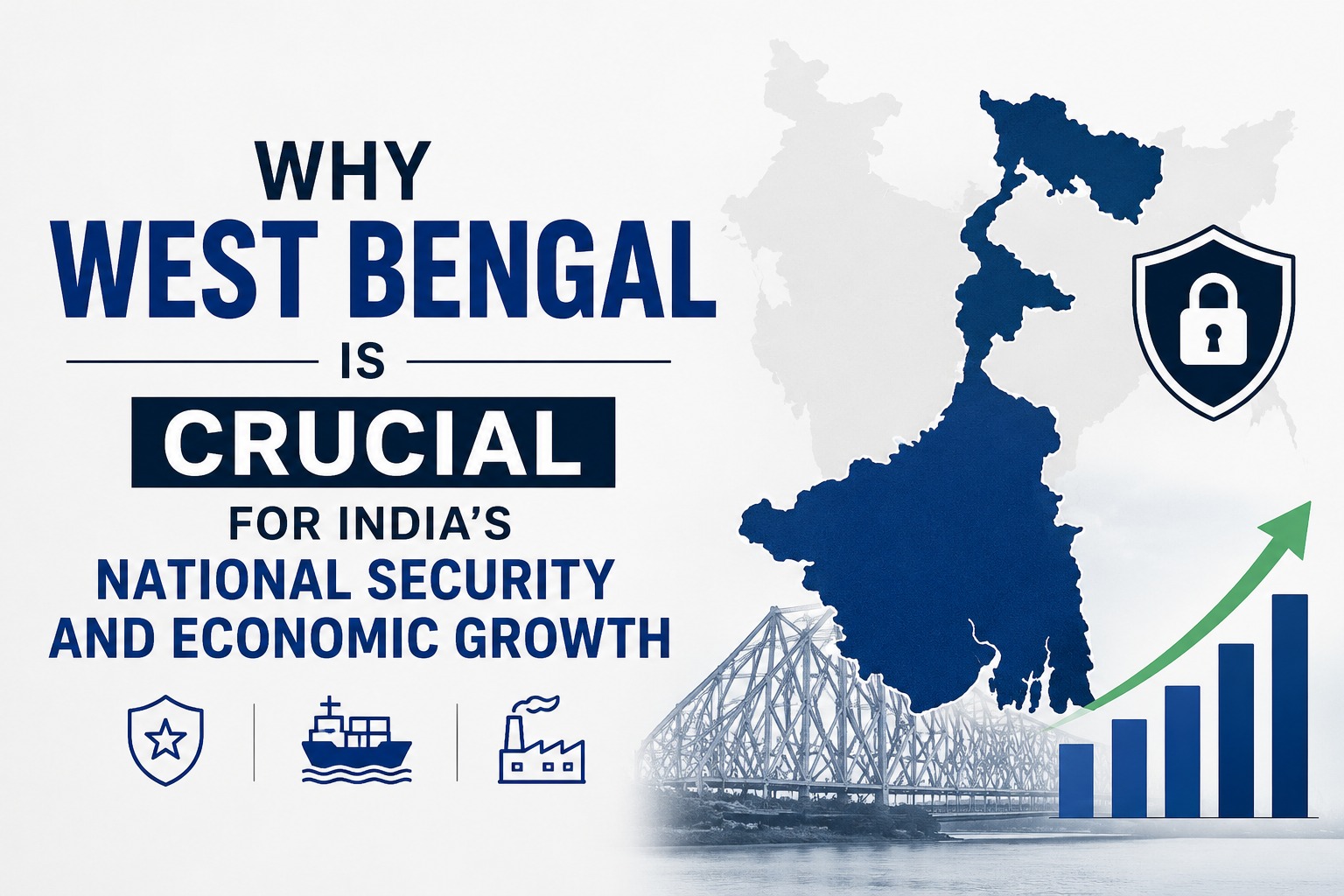
Why West Bengal is Crucial for India’s National Security and Economic Growth
India’s rise as a major global power depends not only on its economic strength and military capabilities but also on the strategic importance of key states that support the nation’s territorial integrity, trade, and geopolitical outreach. Among these states, West Bengal occupies an exceptionally critical position. Located in eastern India with Kolkata as its capital, West Bengal acts as India’s eastern gateway, connecting the Indian mainland to the Northeast, neighboring South Asian countries, and the broader Indo-Pacific region through the Bay of Bengal.
Spread across nearly 88,752 square kilometers and inhabited by more than 100 million people, West Bengal is one of India’s most densely populated and geopolitically sensitive states. Its strategic geography, long international borders, major river systems, ports, industrial zones, agricultural output, and transport infrastructure make it indispensable for both India’s national security and economic development.
The state shares international borders with Bangladesh, Nepal, and Bhutan, while also bordering several important Indian states including Bihar, Jharkhand, Odisha, Sikkim, and Assam. More importantly, West Bengal contains the strategically sensitive Siliguri Corridor, commonly known as the “Chicken’s Neck,” which serves as the only land connection between mainland India and the eight northeastern states.
Beyond security considerations, West Bengal remains one of India’s most significant contributors in agriculture, logistics, manufacturing, exports, and maritime trade. Its ports, tea gardens, steel industries, IT hubs, fisheries, and transport corridors collectively form the backbone of eastern India’s economy. Despite facing decades of industrial stagnation and a decline in its share of India’s GDP compared to the 1960s, the state continues to play a foundational role in India’s national framework.
As India strengthens its “Act East Policy,” expands maritime ambitions in the Indo-Pacific, and seeks greater regional integration with Southeast Asia, the importance of West Bengal has become even more pronounced. The state is not merely a regional entity; it is a strategic pivot that influences India’s defense preparedness, economic resilience, diplomatic outreach, and territorial unity.
Geographical Importance of West Bengal
India’s Eastern Gateway
West Bengal’s geography gives it extraordinary strategic relevance. The state stretches from the Himalayan foothills in the north to the Bay of Bengal in the south. This geographical diversity allows it to serve multiple national purposes simultaneously.
Northern West Bengal connects India with the Himalayan region and the northeastern states, while southern Bengal opens maritime access to the Bay of Bengal. The fertile plains of the Ganges delta provide agricultural prosperity, whereas the coastal region supports maritime trade and naval operations.
Its location makes West Bengal a natural bridge between South Asia and Southeast Asia. This strategic position is central to India’s ambitions of increasing regional trade and strengthening connectivity with ASEAN nations.
The state’s capital, Kolkata, has historically been one of India’s most important commercial and administrative cities. During the British colonial era, Kolkata was the capital of British India and developed into a major port city and industrial center. Even today, it remains the economic and logistical heart of eastern India.
The Strategic Importance of the Siliguri Corridor
India’s “Chicken’s Neck”
The Siliguri Corridor is perhaps the single most strategically important piece of land in eastern India. This narrow stretch of territory in northern West Bengal links mainland India with the northeastern states.
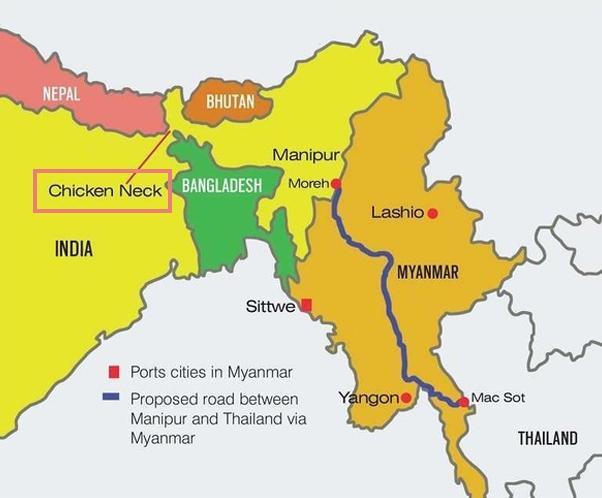
The corridor is approximately 200 kilometers long and narrows to just around 20–22 kilometers at its narrowest point near Siliguri. It is bordered by Nepal on one side, Bangladesh on another, Bhutan nearby, and lies close to China’s Chumbi Valley in Tibet.
This makes the corridor extremely vulnerable during military conflicts or geopolitical tensions.
If the Siliguri Corridor were disrupted due to war, sabotage, or blockades, India’s northeastern states could become physically isolated from the mainland. Such a scenario would severely impact military logistics, civilian movement, trade, and communication.
The significance of this region increased dramatically after:
- The Sino-Indian War
- The Doklam Standoff
- Rising Chinese strategic activity in the Himalayan region
- Expanding Chinese influence in South Asia
India has responded by significantly strengthening military infrastructure in and around the corridor.
Key measures include:
- Deployment of the Trishakti Corps
- Expansion of military bases
- Stationing of advanced missile systems
- Deployment of Dassault Rafale squadrons at Hasimara
- Infrastructure upgrades under Bharatmala
- Alternative connectivity projects through Bangladesh
The corridor is not only a military necessity but also an economic lifeline. Nearly all supplies, trade routes, energy transportation, and civilian movement to Northeast India pass through this region.
Securing the Siliguri Corridor is therefore directly tied to preserving India’s territorial integrity.
West Bengal and Border Security
The Long Border with Bangladesh
West Bengal shares India’s longest international border with Bangladesh, extending over 2,200 kilometers. Large parts of this border pass through densely populated villages, riverine terrain, and agricultural lands, making surveillance and fencing difficult.
This border has long posed complex security challenges, including:
- Illegal immigration
- Human trafficking
- Smuggling
- Counterfeit currency circulation
- Narcotics trafficking
- Cross-border radicalization
The porous nature of certain sections of the border has created concerns regarding demographic changes in border districts and increasing pressure on local resources.
The Border Security Force plays a central role in managing and securing the border. Fencing projects, surveillance systems, floodlighting, and border outposts have significantly improved security in recent years, but challenges remain.
At the same time, the border is also economically important because Bangladesh is one of India’s largest trading partners in South Asia. Stable border management is therefore essential not only for security but also for regional economic cooperation.
Maritime Importance in the Bay of Bengal
West Bengal’s southern coastline along the Bay of Bengal gives India a strategic maritime advantage.
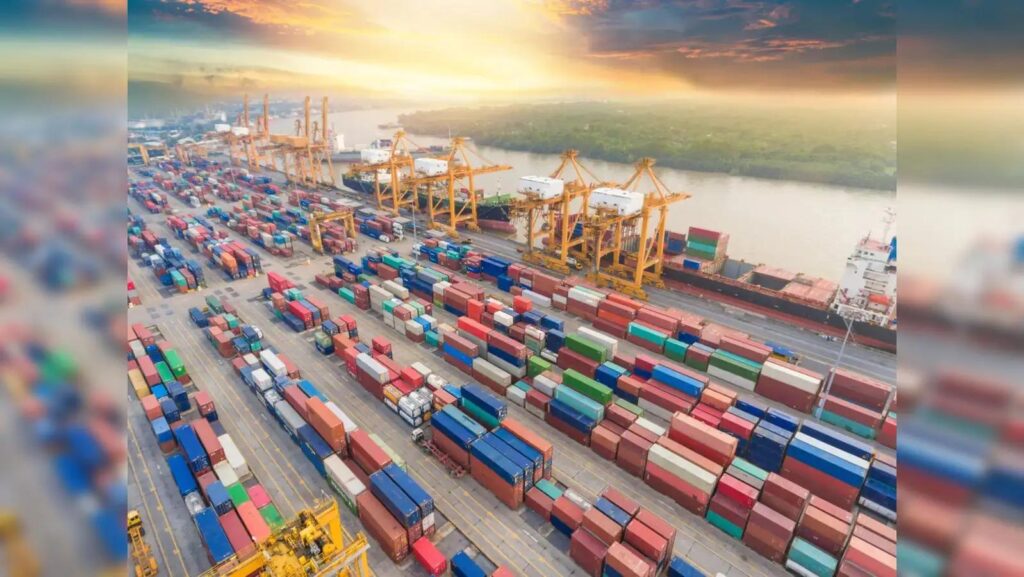
The Bay of Bengal has become increasingly important in global geopolitics due to:
- Rising Indo-Pacific competition
- China’s maritime expansion
- Energy shipping routes
- Trade connectivity with Southeast Asia
India’s eastern maritime strategy heavily depends on West Bengal’s ports and coastal infrastructure.
Major ports include:
- Syama Prasad Mookerjee Port
- Haldia Dock Complex
These ports facilitate:
- Cargo handling
- Petroleum imports
- Coal transportation
- Container trade
- Naval logistics
- Inland waterway transport
The proposed deep-sea port at Tajpur is expected to further enhance India’s maritime capabilities by enabling larger vessels to dock directly without relying heavily on foreign transshipment hubs.
West Bengal’s coastal region also supports India’s SAGAR doctrine — “Security and Growth for All in the Region” — aimed at strengthening India’s maritime influence in the Indian Ocean.
West Bengal’s Role in India’s Act East Policy
India’s Act East Policy seeks to improve connectivity, trade, and strategic partnerships with Southeast Asian countries.
West Bengal is central to this policy because it acts as the primary land and maritime gateway connecting mainland India to the Northeast and beyond.
Several regional initiatives depend heavily on West Bengal’s infrastructure:
- BBIN (Bangladesh-Bhutan-India-Nepal Initiative)
- BIMSTEC
- India-Bangladesh connectivity projects
- Multimodal transport corridors
- Northeast integration plans
Roadways, railways, inland waterways, and ports in West Bengal enable trade flows toward Southeast Asia and facilitate economic integration with neighboring countries.
Without West Bengal, India’s eastern connectivity ambitions would face severe limitations.
Agricultural Importance of West Bengal
A Pillar of India’s Food Security
Agriculture remains one of West Bengal’s strongest economic sectors.
The state is among India’s leading agricultural producers and contributes significantly to national food security.
Major Agricultural Contributions
Rice Production
West Bengal is India’s largest rice-producing state. Rice cultivation dominates the agricultural landscape and supports millions of farmers.
Its high rice output plays a major role in stabilizing India’s food supply and controlling inflation.
Jute Production
West Bengal produces the majority of India’s raw jute output. Jute remains important for:
- Packaging industries
- Eco-friendly products
- Export markets
With rising global demand for biodegradable materials, the jute industry has regained strategic economic significance.
Tea Industry
The state is globally famous for Darjeeling tea, one of the world’s most premium tea varieties.
Darjeeling tea enjoys GI-tag status and contributes substantially to India’s tea exports.
Fisheries
West Bengal is one of India’s leading fish-producing states due to its extensive river networks, ponds, and coastal access.
Fish forms a major component of regional diets while supporting livelihoods across rural areas.
Potato and Vegetable Production
The state ranks among India’s top producers of potatoes and vegetables, strengthening national food distribution networks.
Industrial Importance of West Bengal
Historical Industrial Powerhouse
Before India’s economic liberalization, West Bengal was one of the country’s largest industrial states.

The state historically led in:
- Engineering
- Steel production
- Jute manufacturing
- Shipbuilding
- Rail equipment manufacturing
Although industrial growth slowed in later decades, West Bengal still retains significant industrial capacity.
Major Industrial Centers
Durgapur and Burnpur
These regions are major steel and engineering hubs supporting India’s infrastructure and manufacturing sectors.
Haldia Petrochemical Zone
Haldia serves as a critical petrochemical and energy-processing center.
Kolkata Leather Complex
This is among Asia’s largest leather-processing hubs and contributes substantially to exports.
Chittaranjan Locomotive Works
Chittaranjan Locomotive Works remains one of India’s most important railway locomotive manufacturing facilities.
Growth of IT and Modern Industries
In recent years, West Bengal has made efforts to expand into modern sectors including:
- Information technology
- Electronics manufacturing
- Startups
- Renewable energy
- Logistics
- Fintech services
Areas like Salt Lake Sector V and New Town in Kolkata have emerged as eastern India’s IT centers.
The state’s educated workforce, lower operational costs, and strategic location offer strong advantages for future industrial growth.
Importance of MSMEs
Micro, Small, and Medium Enterprises (MSMEs) form the backbone of West Bengal’s economy.
The state has one of India’s highest numbers of MSMEs, supporting:
- Employment generation
- Rural industrialization
- Export production
- Local manufacturing ecosystems
MSMEs in textiles, handicrafts, leather, engineering, food processing, and small manufacturing collectively contribute significantly to India’s economy.
Ports and Trade Connectivity
Gateway to Eastern and Northeastern India
The ports of Kolkata and Haldia are crucial for eastern India’s logistics ecosystem.
They handle:
- Coal imports
- Petroleum products
- Iron ore
- Containers
- Fertilizers
- Industrial cargo
These ports also support landlocked neighboring countries such as Nepal and Bhutan.
West Bengal’s connectivity through inland waterways adds another strategic advantage. National Waterway 1 links the state with northern India through river transport.
This reduces transportation costs and improves logistics efficiency.
Tourism and Cultural Economy
West Bengal possesses enormous tourism potential due to its natural beauty, heritage, and cultural richness.
Major attractions include:
- Sundarbans National Park
- Darjeeling
- Colonial-era architecture in Kolkata
- Religious tourism destinations
- Himalayan tourism circuits

The globally recognized Durga Puja contributes significantly to the cultural economy and tourism sector.
Tourism generates employment across hospitality, transport, handicrafts, and retail industries.
Climate and Environmental Challenges
Despite its advantages, West Bengal faces severe environmental vulnerabilities.
Key challenges include:
- Cyclones
- Flooding
- River erosion
- Sea-level rise
- Delta degradation
The Sundarbans region is particularly vulnerable to climate change.
Environmental instability can directly impact national security by displacing populations, damaging infrastructure, and affecting food production.
Therefore, climate resilience has become an important strategic priority.
Security and Economy: A Deep Interconnection
West Bengal demonstrates how national security and economic development are deeply interconnected.
A secure border enables trade growth.
Stable logistics corridors ensure uninterrupted military supplies and commercial movement.
Economic development in border districts reduces the risks of:
- Smuggling
- Illegal activities
- Radicalization
- Social instability
Similarly, infrastructure projects improve both defense preparedness and economic efficiency.
Thus, strengthening West Bengal contributes simultaneously to India’s security and prosperity.
Future Potential of West Bengal
West Bengal’s strategic relevance is expected to grow significantly in the coming decades.
Several emerging trends support this:
- Expansion of Indo-Pacific trade
- India’s Act East ambitions
- Increased maritime competition
- Northeast economic integration
- Growth in logistics and manufacturing
- Rising demand for regional connectivity
If supported with effective governance, infrastructure investment, and industrial reforms, West Bengal could once again emerge as one of India’s strongest economic engines.
Key Recommendations for Strengthening West Bengal
Strengthening National Security
- Complete border fencing
- Improve surveillance systems
- Enhance military infrastructure
- Expand alternate Northeast connectivity routes
- Increase coastal security
Accelerating Economic Development
- Develop deep-sea ports
- Expand industrial corridors
- Improve ease of doing business
- Promote MSMEs
- Strengthen IT and manufacturing ecosystems
Building Climate Resilience
- Invest in flood management
- Protect coastal ecosystems
- Promote sustainable agriculture
- Improve disaster preparedness
Enhancing Centre-State Coordination
Strong coordination between the Union Government and the state government is essential for:
- Infrastructure development
- Security planning
- Industrial expansion
- Regional diplomacy
- Connectivity projects
Conclusion
West Bengal is far more than a regional state in eastern India. It is one of the country’s most strategically significant territories, influencing national security, economic growth, maritime power, food security, and geopolitical outreach.
From protecting the critically important Siliguri Corridor to facilitating India’s connection with the Northeast, from supporting maritime trade in the Bay of Bengal to feeding millions through its agricultural output, West Bengal plays a foundational role in the Indian national framework.
Its ports power eastern commerce, its industries support manufacturing, its borders shape regional diplomacy, and its connectivity networks sustain India’s territorial unity.
As India positions itself as a leading global power in the 21st century, the importance of West Bengal will continue to rise. A secure, prosperous, and economically dynamic West Bengal is essential not only for eastern India but for the strength, stability, and strategic future of the entire nation.
Disclaimer:
This article is based on publicly available information, official statements, and media reports available at the time of publication. The content is intended for informational purposes only and should not be considered financial or policy advice. Readers are encouraged to refer to official sources for the latest updates.
The content is solely for educational and informational purposes. Whether it is global news, indian news, political news or any other sort of content, we do not independently verify the content or claims.
While efforts have been made to ensure accuracy, the information presented may change as new developments emerge. Readers are advised to conduct their own research and consult financial advisors before making any investment decisions.
NoCap Times does not independently verify all claims or statements and shall not be held responsible for any inaccuracies or omissions.
Stay updated with the latest and breaking news on NoCap Times. Get the latest India News, World News, Business News, Sports News, Viral News and Research Articles for various competitive Exams & UPSC Aspirants.