

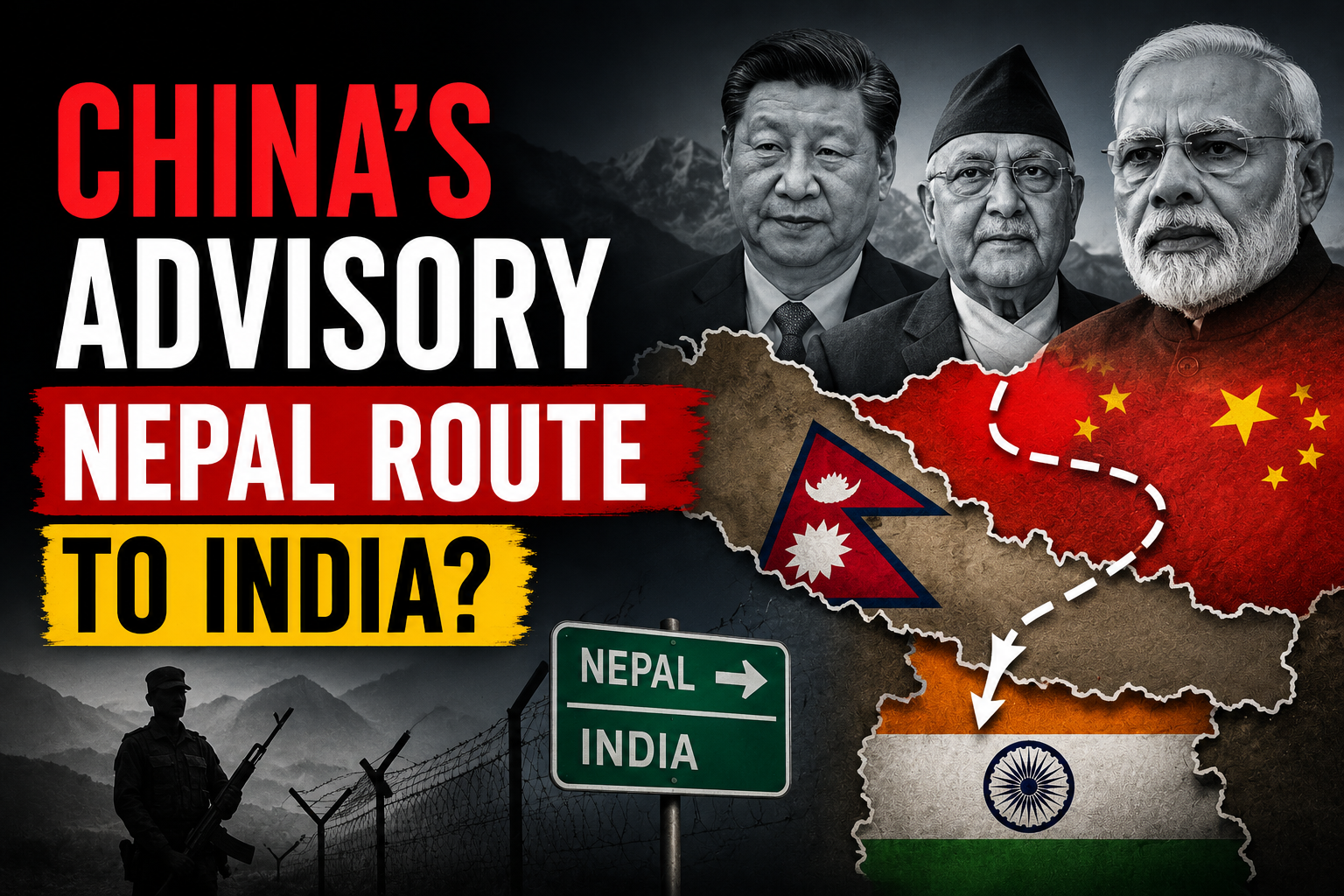
China Issues Travel Warning on Entering India via Nepal: What It Reveals About India-China-Nepal Relations and Border Security
China Issues Travel Warning News: The Chinese Consulate General in Kolkata recently issued an advisory urging Chinese citizens travelling in Nepal to avoid accidentally crossing into India without valid documentation. The warning came after a Chinese national was detained by Indian border security agencies near the India-Nepal border in Bihar for allegedly entering Indian territory illegally.
While the advisory may appear to be a routine travel caution, it reflects much deeper geopolitical realities involving India, China, and Nepal. The incident has once again brought attention to the sensitive dynamics of the open India-Nepal border, growing security concerns in South Asia, and the evolving strategic rivalry between India and China in the Himalayan region.
China Issues Travel Warning to Citizens Visiting Nepal
According to the advisory released by the Chinese Consulate in Kolkata, Chinese nationals travelling in Nepal were instructed to remain cautious while visiting areas close to the India-Nepal border. The consulate specifically advised travellers not to enter India without a valid Indian visa and other necessary permissions.
Chinese authorities highlighted that the India-Nepal border remains largely open and, in many areas, lacks extensive fencing or visible barriers. Because of this unique arrangement, travellers unfamiliar with the terrain may unknowingly cross into Indian territory.
The advisory further warned that violating Indian immigration laws — even unintentionally — could result in serious legal consequences. Chinese citizens found entering India illegally may face detention, lengthy legal proceedings, imprisonment ranging from two to eight years, financial penalties, and difficulties in securing bail.
The Chinese government also advised its citizens not to rely solely on local guides or informal routes while travelling near border areas. Travellers were reminded that certain regions inside India are categorized as restricted or protected zones, requiring additional written permissions from Indian authorities, even for individuals holding valid visas.
Arrest of Chinese National Near Bihar Border
The advisory follows the detention of a Chinese citizen near the Jogbani checkpost in Bihar’s Araria district. Security personnel from the Sashastra Seema Bal intercepted the individual during routine surveillance operations along the India-Nepal border.
Officials identified the detained person as Zhou Huan, a 41-year-old resident of Hunan province in China. According to security agencies, the individual is currently being questioned by central intelligence agencies and local police to determine the purpose of his entry, travel background, and possible connections.
Authorities are also verifying the authenticity of documents recovered during the arrest. Following preliminary interrogation, the individual was handed over to the Jogbani police station for further investigation.
Indian officials revealed that more than 40 foreign nationals attempting illegal entry through the India-Nepal border have been intercepted in 2025 so far. The increasing number of such cases has raised concerns regarding cross-border surveillance, illegal movement, and regional security vulnerabilities.
Why the India-Nepal Border Is Unique
The India-Nepal border is one of the most unique international borders in the world. Stretching over 1,700 kilometers, it allows citizens of both countries to travel freely without visas or passports under the 1950 India-Nepal Treaty of Peace and Friendship.
This open-border system has historically strengthened cultural, religious, economic, and social ties between the two nations. Millions of Nepali citizens work and reside in India, while Indian businesses and pilgrims frequently travel to Nepal.
However, the same openness that promotes connectivity also creates security challenges. Smuggling, human trafficking, fake currency networks, illegal migration, and unauthorized movement of foreign nationals have remained persistent concerns for Indian security agencies.
The increasing geopolitical competition in South Asia has further intensified scrutiny of the India-Nepal border. India now treats the region as strategically sensitive due to growing Chinese engagement in Nepal and rising security complexities in the Himalayan belt.
Background of India-China Relations
Relations between India and China have always been marked by a mixture of cooperation, competition, and mistrust. Both countries are ancient civilizations and emerging global powers, but historical disputes and strategic rivalries continue to shape their interactions.
Diplomatic ties between India and China were formally established in 1950, shortly after India recognized the People’s Republic of China. Initially, relations were friendly, symbolized by the famous slogan “Hindi-Chini Bhai Bhai.”
However, tensions escalated over border disputes in the Himalayan region, particularly concerning Aksai Chin and Arunachal Pradesh. The conflict eventually led to the 1962 Sino-Indian War, which severely damaged bilateral trust.
Although diplomatic and economic relations improved in later decades, border tensions never fully disappeared. Multiple military standoffs have occurred over the years, including the Doklam crisis in 2017 and the deadly Galwan Valley clash in 2020.
Today, India and China maintain strong trade relations despite strategic rivalry. China remains one of India’s largest trading partners, but political distrust continues due to territorial disputes, military competition, cybersecurity concerns, and China’s expanding influence in South Asia.
Current Status of India-China Relations
The current relationship between India and China can best be described as “competitive coexistence.” Both nations are attempting to balance economic cooperation with strategic caution.
After the Galwan Valley incident in 2020, India adopted a more assertive approach toward China. New Delhi strengthened border infrastructure, increased military deployment in Ladakh, and imposed restrictions on several Chinese mobile applications and investments.
India has also deepened strategic partnerships with countries such as the United States, Japan, and Australia through the Quad alliance, partly to counterbalance China’s growing regional influence.
Meanwhile, China continues expanding its Belt and Road Initiative across South Asia, including projects in Nepal, Pakistan, and Sri Lanka. Beijing views South Asia as strategically vital for connectivity, trade routes, and geopolitical influence.
Despite tensions, diplomatic and military-level talks between India and China continue regularly. Both nations understand that prolonged instability between two nuclear powers could impact regional and global economic stability.
Nepal’s Strategic Position Between India and China
Nepal occupies a highly sensitive geopolitical position between India and China. Due to its location in the Himalayas, Nepal has become strategically important for both countries.
Historically, Nepal maintained closer political, cultural, and economic ties with India. However, over the past decade, China has significantly increased its diplomatic and economic presence in Nepal through infrastructure investments, connectivity projects, and financial assistance.
China’s growing influence in Nepal is often viewed with concern in India. New Delhi worries that Beijing could use its expanding presence to reduce India’s traditional influence in the region.
At the same time, Nepal seeks to maintain balanced relations with both neighbors. Kathmandu aims to benefit economically from Chinese investments while preserving its long-standing relationship with India.
This delicate balancing act has occasionally created diplomatic friction. Border disputes, political transitions, and infrastructure competition have all contributed to changing regional equations.
Indo-China-Nepal Relations: Current Scenario
The triangular relationship between India, China, and Nepal is currently shaped by strategic competition, economic diplomacy, and regional security concerns.
India continues to remain Nepal’s largest trade partner and a major source of employment opportunities for Nepali citizens. Religious tourism, cultural connections, and historical ties further strengthen bilateral relations.
China, however, has rapidly expanded its footprint in Nepal through road projects, hydropower investments, railway proposals, and political engagement. Beijing sees Nepal as an important component of its broader Himalayan and South Asian strategy.
For India, maintaining stability along the India-Nepal border has become increasingly important due to concerns over foreign infiltration, intelligence activities, and cross-border security threats.
The recent detention of a Chinese national near the Bihar border has therefore attracted significant attention. While there is no official indication of espionage or malicious intent at this stage, Indian security agencies are likely to examine the matter carefully given the sensitive geopolitical environment.
Experts believe that incidents involving foreign nationals crossing through Nepal into India may become more closely monitored in the future as regional strategic competition intensifies.
Border Security and Regional Implications
The India-Nepal border remains a critical focus area for Indian security agencies. Organizations such as the Sashastra Seema Bal are tasked with monitoring cross-border movement while maintaining the spirit of the open-border agreement with Nepal.
However, the challenge lies in balancing security with traditional people-to-people connectivity. Excessive restrictions could impact trade, tourism, and social relations, while weak monitoring may create vulnerabilities for illegal activities.
The recent advisory issued by China also highlights how international travellers may underestimate the complexities of South Asian border regulations. Unlike Nepal’s relatively relaxed entry policies, India maintains stricter immigration and security protocols, particularly in sensitive border regions.
As geopolitical competition in Asia intensifies, border security will likely become an even more important aspect of India’s foreign and internal security policy.
Conclusion
China’s warning to its citizens regarding accidental entry into India through Nepal may appear to be a routine diplomatic advisory, but it reflects broader regional realities involving security, geopolitics, and strategic competition in South Asia.
The incident involving the detention of a Chinese national near the Bihar border has once again highlighted the complexities of the open India-Nepal border and the growing importance of surveillance in sensitive regions.
India-China relations continue to remain tense yet interconnected, while Nepal finds itself balancing between two powerful neighbors. In this evolving geopolitical landscape, border management, diplomatic coordination, and regional stability will remain crucial for all three countries.
The developments also underline the importance of lawful international travel and adherence to immigration procedures, especially in strategically sensitive border areas where even accidental crossings can lead to serious legal and diplomatic consequences.
Disclaimer:
This article is based on publicly available information, official statements, and media reports available at the time of publication. The content is intended for informational purposes only and should not be considered financial or policy advice. Readers are encouraged to refer to official sources for the latest updates.
The content is solely for educational and informational purposes. Whether it is global news, indian news, political news or any other sort of content, we do not independently verify the content or claims.
While efforts have been made to ensure accuracy, the information presented may change as new developments emerge. Readers are advised to conduct their own research and consult financial advisors before making any investment decisions.
NoCap Times does not independently verify all claims or statements and shall not be held responsible for any inaccuracies or omissions.
Stay updated with the latest and breaking news on NoCap Times. Get the latest India News, World News, Business News, Sports News, Viral News and Research Articles for various competitive Exams & UPSC Aspirants.