

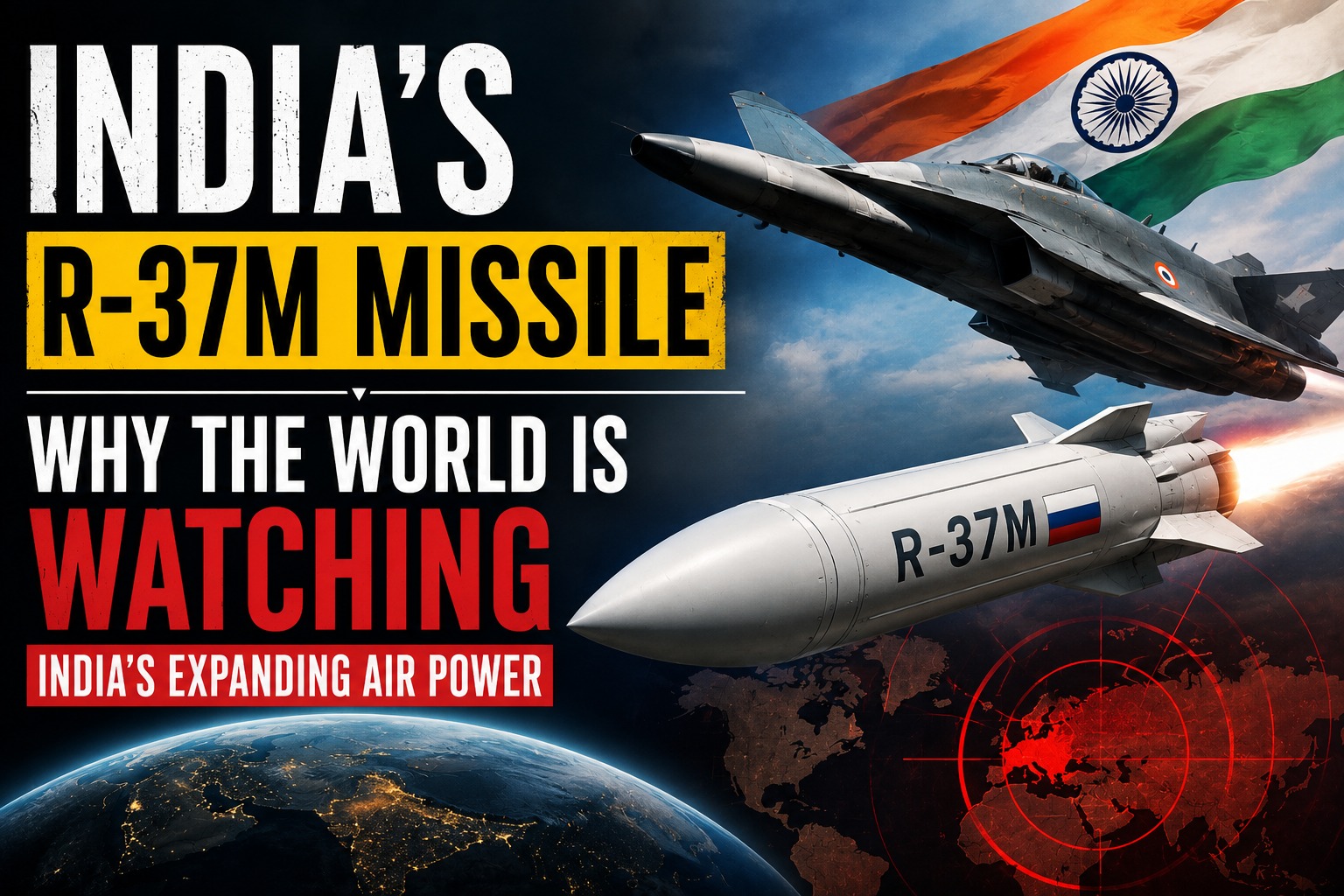
India’s Purchase of Russia’s R-37M Missile: Why the World Is Watching India’s Expanding Air Power
India is reportedly preparing to acquire one of the world’s most powerful and longest-range air-to-air missiles, the R-37M missile, from Russia in a move that could significantly enhance the striking capability of the Indian Air Force (IAF). According to multiple media reports, India’s Defence Ministry has signed a deal for approximately 300 R-37M long-range air-to-air missiles, a development that is already drawing global strategic attention.
The reported agreement, estimated at more than $1.2 billion, is expected to equip India’s frontline Sukhoi Su-30MKI fighter jets with a significantly expanded combat radius. Defence experts believe the induction of the R-37M missile could transform India’s air superiority capabilities and alter the strategic balance in South Asia.
The acquisition comes at a time when India is aggressively modernising its military infrastructure amid rising geopolitical tensions in Asia, particularly with China and Pakistan. The deal also underlines the continuing defence partnership between India and Russia, despite shifting global geopolitical alignments.
What Is the R-37M Missile?
The R-37M is a Russian-made ultra-long-range air-to-air missile developed for engaging high-value airborne targets at extreme distances. It is considered one of the most advanced beyond-visual-range (BVR) missiles in the world and has earned attention for its extraordinary engagement capability.
Designed by Russia primarily for high-speed interception missions, the missile can reportedly strike enemy aircraft, surveillance platforms, airborne warning systems, tankers, and strategic bombers from distances exceeding 300 kilometers.
The missile travels at hypersonic-like speeds, making interception extremely difficult once launched. Military analysts describe it as a “game-changing weapon” because it allows fighter aircraft to attack enemy targets before entering hostile air defence zones.
The R-37M is often compared to China’s PL-17 missile and America’s AIM-174 due to its exceptional range and advanced targeting capability. However, Russia’s export of such a high-performance missile to India highlights the depth of defence trust between the two countries.
Why India Wants the R-37M Missile
India’s decision to purchase the R-37M missile is closely linked to changing security dynamics in Asia. The Indian Air Force has been focusing on expanding its beyond-visual-range combat capability, especially after witnessing rapid military modernisation by neighboring China.
China has significantly upgraded the capabilities of the People’s Liberation Army Air Force (PLAAF), including advanced stealth aircraft, long-range missiles, and integrated air defence systems. Pakistan has also been enhancing its air combat capabilities with Chinese assistance.
In such an environment, India seeks to maintain strategic air superiority by increasing the strike range and survivability of its combat fleet.
The R-37M missile would allow Indian fighter aircraft to engage enemy assets from much greater distances than before. This means Indian pilots may be able to neutralize high-value targets such as enemy AWACS aircraft, electronic warfare platforms, and aerial refuelling tankers long before hostile fighters can retaliate.
Experts believe this capability provides a major tactical advantage in modern aerial warfare, where detecting and destroying enemy support systems can determine the outcome of conflicts.
Su-30MKI: The Backbone of India’s Air Combat Fleet
The R-37M missiles are expected to be integrated primarily with India’s Sukhoi Su-30MKI fleet. The Su-30MKI remains the backbone of the Indian Air Force and represents one of the most powerful multirole fighter platforms in Asia.
India currently operates more than 250 Su-30MKI aircraft, manufactured domestically by Hindustan Aeronautics Limited under Russian collaboration. These aircraft are capable of air superiority missions, precision strikes, maritime warfare, and strategic deterrence operations.
Over the years, the Su-30MKI has undergone continuous upgrades to remain combat-relevant in evolving warfare environments. India is now reportedly planning another phase of modernization for the aircraft in partnership with Russian defence firms.
The addition of the R-37M missile is expected to significantly enhance the aircraft’s operational effectiveness by extending its engagement range several times beyond existing missile systems.
Military analysts suggest the combination of the Su-30MKI’s maneuverability and the R-37M’s range could make the platform one of the most dangerous air combat systems in the region.
Background of India-Russia Defence Relations
India and Russia share one of the longest and most significant defence partnerships in the world. Since the Cold War era, Russia has remained a major supplier of military equipment to India.
India’s armed forces operate a wide range of Russian-origin platforms, including fighter jets, tanks, submarines, missiles, and air defence systems. Some of the most prominent examples include the Sukhoi fighter series, T-90 tanks, BrahMos missile system, and the S-400 air defence system.
Despite India’s growing defence ties with Western countries such as the United States and France, Russia continues to play a crucial role in India’s strategic military infrastructure.
The latest R-37M missile deal reflects New Delhi’s continued confidence in Russian military technology, particularly in areas related to air combat and missile systems.
At the same time, India has increasingly focused on diversifying its defence procurement strategy to avoid overdependence on any single country. However, Russia remains deeply integrated into India’s military ecosystem due to decades of interoperability and technology sharing.
Why the Missile Deal Worries Rivals
India’s acquisition of the R-37M missile is likely to attract close attention from both China and Pakistan because of its strategic implications.
1. Extended Strike Capability
The missile dramatically increases the distance at which Indian fighters can engage enemy aircraft. This means hostile aircraft may become vulnerable even before entering their own effective firing range.
Long-range engagement capability is particularly important in mountainous regions and contested airspaces, where reaction time is limited.
2. Threat to High-Value Airborne Assets
Modern air warfare depends heavily on support aircraft such as AWACS planes, electronic warfare systems, and refueling tankers. The R-37M is specifically designed to target such critical assets.
If India gains the ability to threaten these support systems from extreme distances, adversaries may be forced to alter operational strategies.
3. Psychological and Strategic Deterrence
Military capability is not only about battlefield performance but also deterrence. Possessing advanced long-range missile systems sends a strong strategic signal regarding India’s preparedness and technological capability.
Defence experts believe such acquisitions contribute to regional deterrence by increasing the potential cost of military escalation for adversaries.
4. Balance of Power in South Asia
South Asia has witnessed rapid military modernization over the last decade. China’s rise as a global military power and Pakistan’s increasing reliance on Chinese military technology have encouraged India to accelerate its own modernization efforts.
The R-37M deal could therefore become part of a broader regional arms competition focused on advanced missile systems, stealth technology, drones, and electronic warfare.
Current India-China Security Dynamics
India’s defence modernization efforts cannot be separated from the broader geopolitical environment in Asia. Relations between India and China remain tense following multiple border standoffs in the Himalayan region, including the Galwan Valley clash in 2020.
Both countries have expanded military infrastructure along disputed borders and increased deployment of advanced weapons systems.
China’s growing military presence in the Indo-Pacific region, its expanding naval capabilities, and its partnership with Pakistan have heightened Indian security concerns.
As a result, India has focused on strengthening its air force, navy, missile systems, and indigenous defence manufacturing capabilities.
The acquisition of the R-37M missile fits into this larger strategic framework aimed at improving India’s preparedness for future high-intensity warfare scenarios.
India’s Push for Military Modernization
The Indian government has been aggressively pursuing defence modernization under the broader vision of strengthening national security and achieving greater defence self-reliance.
India has invested heavily in Rafale fighter jets, indigenous Tejas aircraft, advanced drones, missile defence systems, and next-generation warships. Simultaneously, the country continues to upgrade legacy Russian-origin systems to maintain operational readiness.
The modernization of the Su-30MKI fleet with advanced avionics, radar systems, electronic warfare capabilities, and long-range missiles is considered a critical part of India’s future air combat strategy.
Defence planners believe that integrating powerful missile systems like the R-37M can provide India with a qualitative edge even when facing numerically larger air forces.
Strategic Implications for the Future
India’s reported acquisition of the R-37M missile represents more than just another defence purchase. It signals a larger transformation in the country’s military doctrine toward long-range precision engagement and network-centric warfare.
As military technology evolves, future conflicts are expected to rely heavily on long-range missiles, drones, electronic warfare, artificial intelligence, and integrated battlefield systems.
By equipping its fighter fleet with advanced long-range missiles, India aims to remain prepared for the changing nature of modern warfare.
The move is also likely to encourage neighboring countries to accelerate their own military modernization programs, further intensifying strategic competition in Asia.
Conclusion
India’s decision to acquire Russia’s R-37M long-range air-to-air missile could significantly strengthen the combat capability of the Indian Air Force and reshape the regional air power balance in South Asia.
The missile’s extraordinary range, speed, and ability to target high-value airborne assets make it one of the most formidable air combat weapons in the world today.
For India, the acquisition reflects a broader strategy focused on military modernization, strategic deterrence, and preparedness amid evolving regional security challenges involving China and Pakistan.
While the deal reinforces India’s long-standing defence relationship with Russia, it also highlights New Delhi’s determination to maintain a technological edge in an increasingly competitive geopolitical environment.
Disclaimer:
This article is based on publicly available information, official statements, and media reports available at the time of publication. The content is intended for informational purposes only and should not be considered financial or policy advice. Readers are encouraged to refer to official sources for the latest updates.
The content is solely for educational and informational purposes. Whether it is global news, indian news, political news or any other sort of content, we do not independently verify the content or claims.
While efforts have been made to ensure accuracy, the information presented may change as new developments emerge. Readers are advised to conduct their own research and consult financial advisors before making any investment decisions.
NoCap Times does not independently verify all claims or statements and shall not be held responsible for any inaccuracies or omissions.
Stay updated with the latest and breaking news on NoCap Times. Get the latest India News, World News, Business News, Sports News, Viral News and Research Articles for various competitive Exams & UPSC Aspirants.