

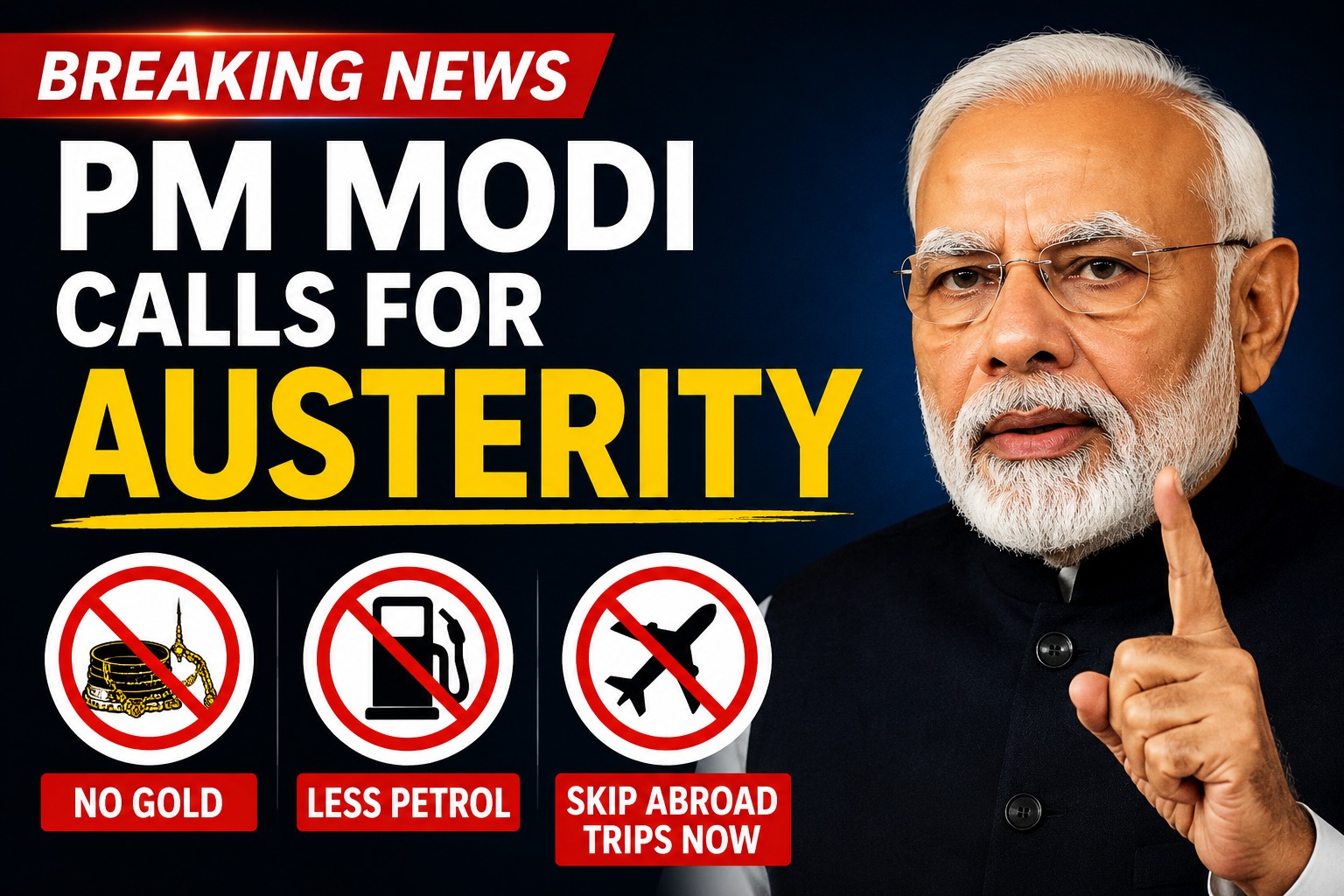
Breaking News: PM Modi Calls for Austerity – No Gold, Less Petrol, Skip Abroad Trips Now
Breaking News: In a significant address that has sparked nationwide discussion, Prime Minister Narendra Modi on Sunday called upon Indian citizens to embrace collective responsibility and adopt practical austerity steps to safeguard the country’s economy. Speaking at a public meeting in Hyderabad, Telangana, the Prime Minister highlighted the escalating tensions in West Asia and their potential ripple effects on global oil supplies, fuel prices, and India’s foreign exchange reserves.
This appeal comes at a critical juncture as the ongoing conflict in West Asia, particularly involving disruptions around key chokepoints like the Strait of Hormuz, threatens to intensify energy market volatility. With India being a major importer of crude oil, the Prime Minister stressed the need for mindful consumption and self-reliance to mitigate impacts on everyday lives and national finances.
Context of the West Asia Conflict and Its Impact on India
The West Asia region has been witnessing heightened geopolitical tensions, with recent developments raising fears of supply chain disruptions for petroleum products. Experts warn that any prolonged blockade or instability could lead to a surge in global crude oil prices, directly affecting import-dependent nations like India. India imports over 85% of its crude oil requirements, making it vulnerable to international price shocks that influence petrol, diesel, LPG, and even fertiliser costs.
Prime Minister Modi contextualised these challenges by reminding citizens that India does not have vast domestic oil reserves. “We have to import petrol, diesel, and gas in large quantities,” he noted, pointing out that the government has been absorbing significant costs to shield consumers from immediate price hikes. However, sustained global pressures necessitate broader participation from every Indian.
This is not the first time India has navigated such turbulence. The Prime Minister drew parallels with the COVID-19 pandemic, when citizens adapted remarkably through work-from-home arrangements, virtual meetings, and reduced mobility, which inadvertently helped conserve resources. He urged a revival of similar disciplined practices tailored to the current energy and forex challenges.
Key Austerity Measures Proposed by PM Modi
The Prime Minister outlined several actionable suggestions aimed at reducing unnecessary expenditure, conserving fuel, and bolstering domestic production:
- Reduce Petrol, Diesel, and Cooking Gas Consumption: Citizens are encouraged to use public transport like metros and buses, opt for carpooling, prefer railways for goods movement, and shift towards electric vehicles (EVs) wherever feasible. Even small changes, such as combining errands or using bicycles for short distances, can contribute significantly.
- Revive Work-from-Home and Virtual Engagements: Echoing pandemic-era strategies, Modi appealed for increased remote working to cut down on daily commuting and office energy use. This could ease pressure on transportation networks and lower overall fuel demand.
- Postpone Non-Essential Foreign Travel: Avoid overseas vacations, destination weddings, and unnecessary international trips for the time being. Instead, promote domestic tourism to keep foreign exchange within the country while supporting local economies.
- Temporary Pause on Gold Purchases: One of the most notable appeals was to refrain from buying gold for at least one year, especially for weddings, festivals, or other celebrations. Gold imports exert substantial pressure on India’s current account and foreign reserves. Modi framed this as a patriotic contribution that also promotes financial prudence.
- Promote ‘Made in India’ and Local Products: Shift consumption towards domestically manufactured goods to reduce import dependency across sectors, including edible oils and consumer items. Farmers were specifically urged to cut chemical fertiliser use by up to 50% through natural alternatives.
These measures are voluntary but positioned as a “national duty” during times of global uncertainty. The Prime Minister emphasised that patriotism today involves responsible living and contributing to economic stability.
Economic Implications and Potential Benefits
Adopting these austerity steps could yield multiple dividends. Reduced fuel consumption would directly lower the import bill, helping stabilise the rupee and easing inflationary pressures. According to economic analyses, even a 10-15% drop in non-essential petroleum use across households and industries could translate into substantial foreign exchange savings.
Gold, often seen as a safe-haven asset and cultural staple in India, accounts for a notable portion of imports. A one-year moratorium could free up reserves for more critical needs like energy security and infrastructure development. Moreover, boosting local manufacturing aligns with the Atmanirbhar Bharat vision, fostering job creation and self-reliance.
On the energy front, the push for EVs and renewables complements India’s long-term goals under the National Green Hydrogen Mission and solar power expansion. The government has already been investing heavily in these areas, and public participation could accelerate the transition away from fossil fuel dependency.
Public and Expert Reactions on This Breaking News
The address has elicited mixed but largely supportive responses. Many citizens appreciate the call for unity in facing global headwinds, viewing it as a proactive leadership move. Social media platforms buzzed with discussions on practical ways to implement these suggestions, from carpool apps to exploring domestic travel destinations.
Economists note that while voluntary appeals have limitations, they can shift cultural norms, especially when backed by policy incentives like EV subsidies or tax benefits for remote work infrastructure. Critics, however, caution that lower-income groups already practice restraint and emphasise the need for targeted government support to manage any price increases.
Opposition voices have raised questions about long-term energy policy, but the overarching consensus remains on the need for collective resilience amid external shocks.
Broader Strategy: Towards Energy Security and Self-Reliance
This appeal fits into India’s multi-pronged strategy for energy security. The government continues to diversify oil import sources, build strategic petroleum reserves, and accelerate renewable energy adoption. Initiatives like ethanol blending in petrol and promotion of biofuels are gaining momentum to reduce crude dependency.
Furthermore, diplomatic engagements aim to stabilise the West Asia situation while ensuring uninterrupted supplies. Domestically, schemes promoting energy efficiency in industries, buildings, and agriculture play a complementary role.
For individuals, the message is clear: small, consistent actions matter. Switching off engines at signals, using energy-efficient appliances, and rethinking consumption patterns can collectively make a difference. Families can turn these into opportunities—planning local vacations that support tourism hotspots like Kerala, Rajasthan, or the Northeast, or opting for sustainable wedding practices.
How Citizens Can Contribute Effectively
- Daily Commute: Track fuel usage with apps and set reduction targets. Explore public transport passes or EV two-wheelers.
- Household Habits: Optimise cooking gas use, reduce edible oil consumption where possible, and support local produce.
- Festivals and Events: Prioritise experiences over material imports; choose Indian craftsmanship for gifts and decor.
- Businesses and Corporates: Implement hybrid work models permanently and audit supply chains for localisation.
- Youth and Students: Innovate solutions in clean tech, awareness campaigns, and community-level conservation drives.
Long-term, these habits could foster a culture of mindful consumption beneficial beyond the current crisis, aiding climate goals and personal savings.
Conclusion: A Call for Atmanirbhar Spirit
Prime Minister Narendra Modi’s Sunday address transcends immediate crisis management—it reinforces the ethos of collective nation-building. By urging restraint in fuel use, foreign travel, and gold purchases amid the West Asia conflict, he has invited every Indian to become an active participant in economic stewardship.
As India aspires to become a developed nation (Viksit Bharat), navigating global uncertainties with unity, innovation, and self-reliance will be key. The coming weeks and months will test this resolve, but history shows that when Indians come together, challenges transform into opportunities for progress.
The government is expected to monitor the situation closely and may announce additional supportive measures, including potential incentives for compliance with these austerity goals. For now, the ball is in the citizens’ court to respond positively and contribute to a stronger, more resilient India.
Disclaimer:
This article is based on publicly available information, official statements, and media reports available at the time of publication. The content is intended for informational purposes only and should not be considered financial or policy advice. Readers are encouraged to refer to official sources for the latest updates.
The content is solely for educational and informational purposes. Whether it is global news, indian news, political news or any other sort of content, we do not independently verify the content or claims.
While efforts have been made to ensure accuracy, the information presented may change as new developments emerge. Readers are advised to conduct their own research and consult financial advisors before making any investment decisions.
NoCap Times does not independently verify all claims or statements and shall not be held responsible for any inaccuracies or omissions.
Stay updated with the latest and breaking news on NoCap Times. Get the latest India News, World News, Business News, Sports News, Viral News and Research Articles for various competitive Exams & UPSC Aspirants.