

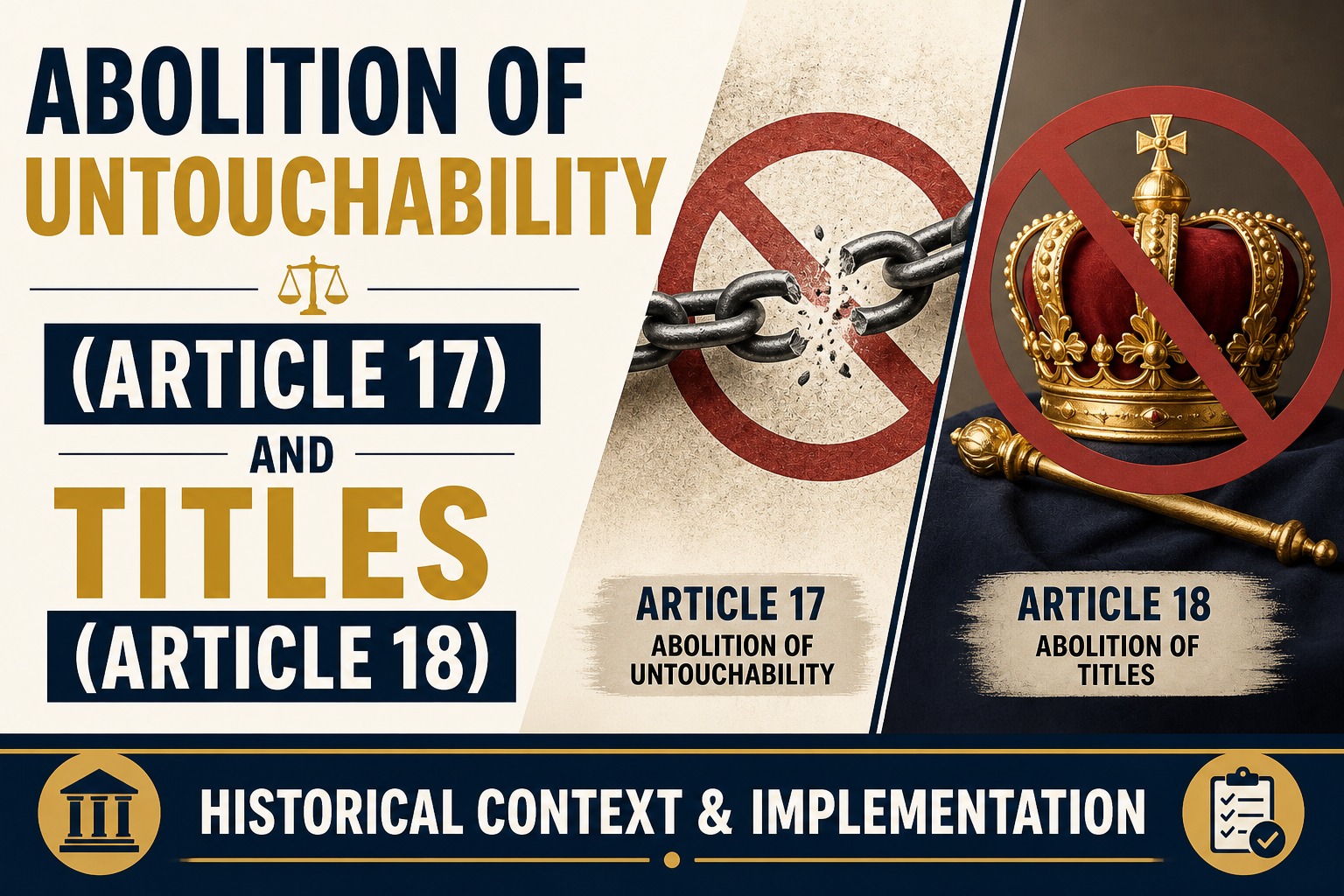
Abolition of Untouchability (Article 17) and Titles (Article 18): Historical Context & Implementation
The Constitution of India is not merely a legal document; it is a revolutionary charter aimed at transforming society. Among the most progressive provisions within the Fundamental Rights chapter are Article 17 and Article 18, which seek to dismantle centuries-old social hierarchies and promote equality, dignity, and democratic values.
Article 17 abolishes untouchability and forbids its practice in any form, while Article 18 abolishes titles and prevents the creation of artificial distinctions among citizens. Together, these articles reflect the constitutional commitment to social justice, equality, and the eradication of discriminatory practices rooted in caste and privilege.
These provisions were included to ensure that independent India would not continue the oppressive social structures inherited from the past. Article 17 attacks caste-based discrimination directly, whereas Article 18 aims to eliminate elitism and feudal recognition systems that contradict democratic ideals.
This article explores the meaning, historical background, constitutional significance, implementation, judicial interpretation, challenges, and contemporary relevance of Articles 17 and 18 in detail.
Understanding the Right to Equality in the Indian Constitution
The Right to Equality is guaranteed under Articles 14 to 18 of the Constitution. These provisions collectively ensure:
- Equality before law
- Equal protection of laws
- Prohibition of discrimination
- Equal opportunity in public employment
- Abolition of untouchability
- Abolition of titles
The framers of the Constitution understood that political independence alone would not guarantee justice unless deep-rooted social inequalities were addressed.
Dr. B. R. Ambedkar, himself a victim of caste discrimination, strongly advocated constitutional safeguards against social oppression and inequality.
Historical Background of Untouchability in India
Origin of Untouchability
Untouchability emerged as a rigid social practice associated with the caste system in ancient and medieval India. Certain communities, later classified as “untouchables,” were considered impure and socially inferior.
These communities faced severe discrimination in almost every aspect of life, including:
- Denial of temple entry
- Segregation in villages
- Restriction from public wells and roads
- Prohibition from education
- Occupational exploitation
- Social exclusion
Untouchability became one of the darkest aspects of the caste hierarchy.
Social Reform Movements Against Untouchability
Several reformers and movements challenged caste discrimination.
1. Jyotirao Phule
Jyotirao Phule advocated education and social equality for lower castes and women.
2. Mahatma Gandhi
Mahatma Gandhi called untouchables “Harijans” and launched campaigns for their upliftment.
He promoted:
- Temple entry movements
- Social integration
- Rural reforms
3. B. R. Ambedkar
B. R. Ambedkar strongly opposed caste oppression and demanded legal and political safeguards for Dalits.
He believed social equality was impossible without destroying caste discrimination.
4. Temple Entry Movements
Movements across India demanded equal religious access for lower castes.
Examples include:
- Vaikom Satyagraha
- Guruvayur Satyagraha
These movements challenged traditional caste barriers.
Article 17: Abolition of Untouchability
Text of Article 17
Article 17 states:
“Untouchability” is abolished and its practice in any form is forbidden. Enforcement of any disability arising out of untouchability shall be an offense punishable in accordance with law.
This provision is absolute in nature.
Key Features of Article 17
1. Complete Abolition
Article 17 completely abolishes untouchability in every form.
The Constitution does not merely discourage the practice—it criminalizes it.
2. Punishable Offense
Any act enforcing untouchability becomes a punishable offense under law.
This transforms social discrimination into a legal crime.
3. Protection of Human Dignity
Article 17 recognizes dignity as a constitutional value.
It ensures that no individual is treated as socially inferior because of caste.
4. Enforceable Fundamental Right
Victims of untouchability can approach courts directly for protection of their rights.
Meaning of “Untouchability” Under Article 17
The term “untouchability” is not explicitly defined in the Constitution.
However, courts have clarified that it refers to caste-based social disabilities historically imposed on certain communities.
It does not apply to:
- Personal hygiene practices
- Religious customs unrelated to caste
- Social distancing unrelated to caste discrimination
The constitutional meaning is specifically linked to caste oppression.
Laws Enacted to Implement Article 17
The State enacted several laws to give practical effect to Article 17.
1. Protection of Civil Rights Act, 1955
Protection of Civil Rights Act
Originally called the Untouchability (Offences) Act, 1955, this law criminalized practices related to untouchability.
The Act prohibits:
- Denial of access to public places
- Refusal of services
- Social discrimination
- Restriction from religious places
Punishments include imprisonment and fines.
2. Scheduled Castes and Scheduled Tribes (Prevention of Atrocities) Act, 1989
Scheduled Castes and Scheduled Tribes (Prevention of Atrocities) Act
This law strengthened protections for SC/ST communities against caste-based violence and humiliation.
The Act addresses:
- Physical violence
- Social boycott
- Forced labor
- Sexual violence
- Land grabbing
- Public humiliation
Special courts were established for speedy trials.
Importance of Article 17
1. Social Revolution
Article 17 represents a constitutional attack on caste oppression and social inequality.
2. Human Rights Protection
It protects basic human dignity and equality.
3. Democratic Inclusion
The article ensures participation of marginalized communities in public life.
4. Constitutional Morality
It promotes constitutional values over oppressive social traditions.
Landmark Judgments Related to Article 17
1. State of Karnataka v. Appa Balu Ingale (1995)
State of Karnataka v. Appa Balu Ingale
The Supreme Court condemned caste discrimination and emphasized that untouchability violates constitutional morality.
The Court stated that Article 17 must be interpreted broadly to eliminate all forms of caste-based exclusion.
2. Safai Karamchari Andolan v. Union of India (2014)
Safai Karamchari Andolan v. Union of India
The Supreme Court ordered strict implementation of laws banning manual scavenging and emphasized rehabilitation of affected workers.
The judgment linked manual scavenging directly to caste discrimination and Article 17.
Continuing Challenges Despite Article 17
Although untouchability is constitutionally abolished, caste discrimination still exists in many parts of India.
Major Challenges
1. Social Practices
- Segregated housing
- Separate burial grounds
- Temple entry restrictions
2. Violence Against Dalits
Caste-based atrocities continue despite legal protections.
3. Manual Scavenging
Despite prohibition, manual scavenging still exists in some regions.
4. Educational Discrimination
Students from marginalized communities sometimes face exclusion and prejudice.
5. Social Boycott
Certain communities continue facing informal exclusion.
These realities show that legal abolition alone cannot eliminate deeply rooted social prejudice.
Constitutional Vision Behind Article 17
The framers intended Article 17 to:
- Restore dignity
- Promote social equality
- Eliminate caste hierarchy
- Integrate marginalized communities
It is one of the strongest constitutional provisions against social discrimination anywhere in the world.
Historical Background of Titles in India
Before independence, titles were widely used during:
- Mughal rule
- British colonial rule
- Feudal kingdoms
The British government awarded titles such as:
- Rai Bahadur
- Khan Bahadur
- Sir
- Diwan Bahadur
These titles created social hierarchy and loyalty toward colonial rulers.
The framers of the Constitution believed such distinctions were incompatible with democracy and equality.
Article 18: Abolition of Titles
Text and Meaning
Article 18 abolishes titles and prohibits the State from conferring titles except military or academic distinctions.
The provision seeks to prevent artificial social divisions.
Key Features of Article 18
1. Prohibition of State Titles
The State cannot confer hereditary or honorary titles that create inequality.
Examples prohibited:
- Rai Bahadur
- Raja
- Nawab (as official State titles)
2. Academic and Military Exceptions
Academic and military distinctions are permitted.
Examples:
- Doctor
- Professor
- Param Vir Chakra
- Ashoka Chakra
These distinctions recognize achievement rather than social superiority.
3. Restriction on Foreign Titles
Indian citizens cannot accept foreign titles without government permission.
This preserves national loyalty and sovereignty.
4. Public Officials Restricted
Foreign titles cannot be accepted by government officials while holding office.
Objectives of Article 18
The article aims to:
- Promote equality
- Prevent aristocracy
- Eliminate feudal hierarchy
- Strengthen democratic culture
- Ensure equal citizenship
National Awards and Article 18
A major constitutional debate emerged regarding civilian awards such as:
- Bharat Ratna
- Padma Shri
- Padma Bhushan
- Padma Vibhushan
Critics argued these awards resembled titles.
Balaji Raghavan v. Union of India (1996)
Balaji Raghavan v. Union of India
The Supreme Court held that national awards are constitutional because:
- They do not create hereditary privilege
- They are recognitions of merit
- Awardees cannot use them as prefixes or suffixes
Thus, civilian awards do not violate Article 18.
Importance of Article 18
1. Equality Among Citizens
Article 18 reinforces the democratic principle that all citizens are equal.
2. End of Feudalism
It abolished colonial and aristocratic distinctions.
3. Promotion of Meritocracy
Recognition should be based on merit and contribution rather than inherited status.
4. Democratic Values
The article reflects republican ideals where citizens are equal participants in governance.
Relationship Between Articles 17 and 18
Both provisions promote equality but address different forms of hierarchy.
| Article | Focus |
|---|---|
| Article 17 | Social hierarchy based on caste |
| Article 18 | Artificial hierarchy based on titles |
Together, they seek to build a society free from discrimination and privilege.
Role of Judiciary in Enforcing Articles 17 and 18
The judiciary has played a significant role by:
- Expanding protections
- Condemning caste discrimination
- Upholding constitutional morality
- Clarifying legality of national awards
Courts continue interpreting equality in light of evolving social realities.
Constitutional Morality and Social Transformation
The concept of constitutional morality emphasizes:
- Respect for dignity
- Equality over tradition
- Democratic values
- Human rights
Articles 17 and 18 embody this philosophy.
They remind society that constitutional principles must prevail over oppressive customs.
Modern Relevance of Article 17
Article 17 remains highly relevant because:
- Caste discrimination persists
- Dalit rights movements continue
- Social inclusion remains incomplete
- Manual scavenging still exists
- Online caste discrimination has emerged
The fight against untouchability today extends into:
- Education
- Employment
- Social media
- Housing
- Digital spaces
Modern Relevance of Article 18
Article 18 continues to matter because:
- Democracy requires equality
- Personality cults threaten institutions
- Social elitism can weaken republican values
The provision prevents institutionalized privilege.
Government Initiatives for Social Equality
Several initiatives support constitutional goals:
- Scholarships for SC/ST students
- Reservation policies
- Awareness campaigns
- Anti-discrimination laws
- Skill development schemes
However, effective implementation remains critical.
Challenges in Implementation
1. Social Mindset
Legal reform alone cannot eliminate centuries-old prejudice.
2. Weak Enforcement
Laws are sometimes poorly implemented.
3. Fear of Reporting
Victims may hesitate to report discrimination due to social pressure.
4. Political Factors
Caste politics can complicate reform efforts.
Need for Social Awareness
True equality requires:
- Education
- Social reform
- Community participation
- Constitutional awareness
Citizens must internalize constitutional values rather than treating them as merely legal obligations.
Conclusion
Article 17 and Article 18 are among the most revolutionary provisions of the Indian Constitution. They attack two major forms of inequality that historically shaped Indian society—caste-based discrimination and feudal privilege.
Article 17 abolishes untouchability and protects the dignity of marginalized communities, while Article 18 eliminates artificial distinctions created through titles and aristocratic recognition. Together, these provisions strengthen democracy, equality, and constitutional morality.
Although India has made significant progress through legislation, judicial intervention, and social reform movements, challenges remain. Caste discrimination, social exclusion, and inequality continue to exist in various forms.
The true success of Articles 17 and 18 lies not only in legal enforcement but also in societal transformation. A democratic society can flourish only when every individual is treated with dignity, respect, and equality.
These constitutional provisions remain powerful reminders that the Indian Republic was founded not on privilege or hierarchy, but on justice, liberty, equality, and fraternity.
Disclaimer:
This article is based on publicly available information, official statements, and media reports available at the time of publication. The content is intended for informational purposes only and should not be considered financial or policy advice. Readers are encouraged to refer to official sources for the latest updates.
The content is solely for educational and informational purposes. Whether it is global news, indian news, political news or any other sort of content, we do not independently verify the content or claims.
While efforts have been made to ensure accuracy, the information presented may change as new developments emerge. Readers are advised to conduct their own research and consult financial advisors before making any investment decisions.
NoCap Times does not independently verify all claims or statements and shall not be held responsible for any inaccuracies or omissions.
Stay updated with the latest and breaking news on NoCap Times. Get the latest India News, World News, Business News, Sports News, Viral News and Research Articles for various competitive Exams & UPSC Aspirants.