

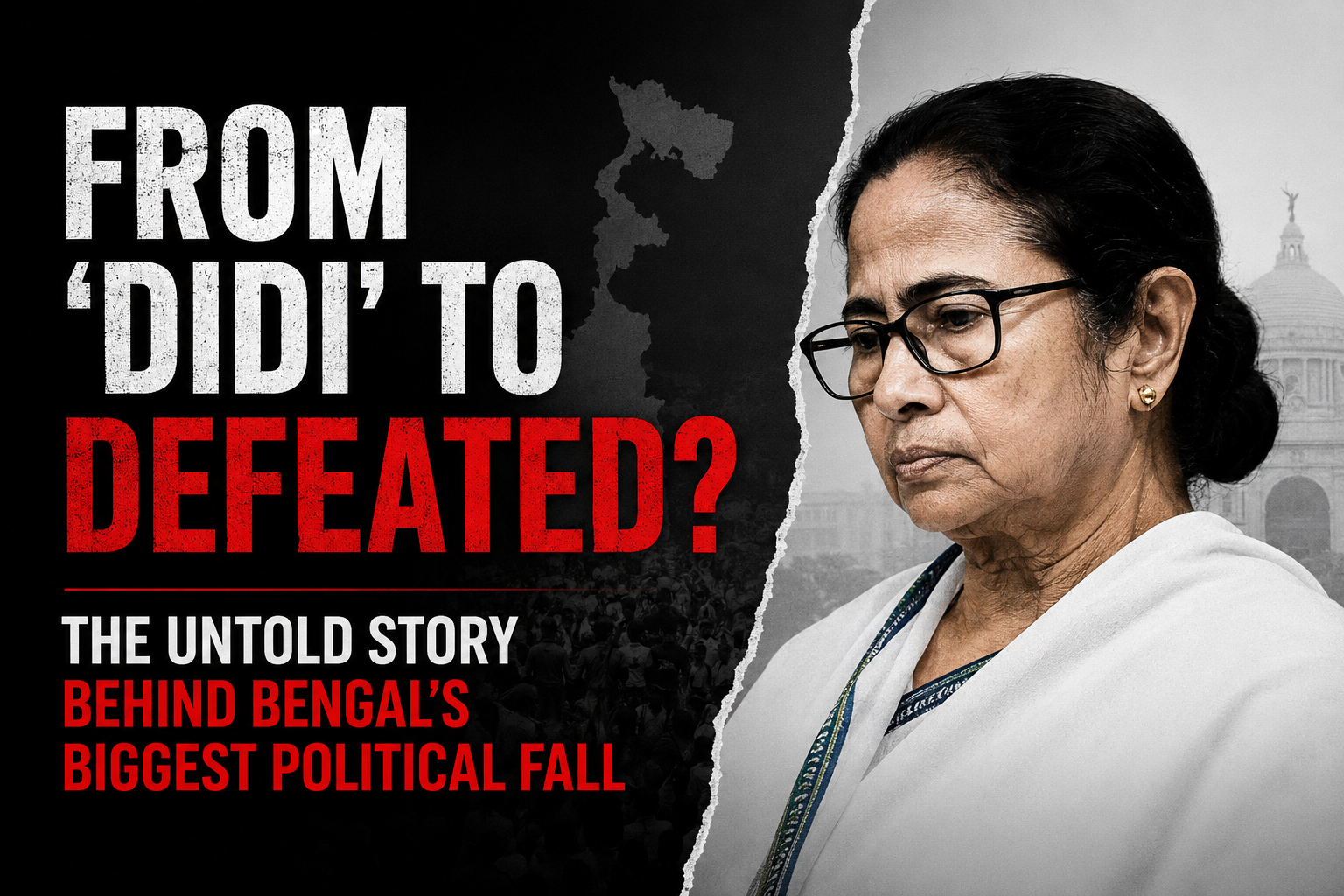
What Will Now Happen to Mamata Banerjee? The Making—and Unmaking—of ‘Didi’ in Bengal’s Long Political Memory
This is not just the story of an election defeat.
This is the story of how Mamata Banerjee rose from the streets of Bengal to become an unstoppable political force — and how years of power, political violence allegations, corruption scandals, Sandeshkhali, the RG Kar Hospital outrage, economic decline, identity politics, industry exodus, and growing public anger slowly shattered the emotional bond between “Didi” and the people.
From her legendary rise against the Left Front to the dramatic collapse of the All India Trinamool Congress in 2026, this is a deep political story of power, perception, fear, ambition, betrayal, and the brutal reality that no leader remains invincible forever.
Chapter 01: The Introduction
There are leaders who win elections.
And then there are leaders who become something far more powerful—an emotion that lives inside the people.
For West Bengal, for over a decade, that emotion had a name: Mamata Banerjee.
She was not merely a chief minister. She was a story whispered in tea stalls, shouted in rallies, and carried in the hearts of millions—a story of defiance, of a lone woman who dared to stand against entrenched power and bend history to her will. When she ended the long, unbroken reign of the Left Front in 2011, it did not feel like a routine transfer of power. It felt like a revolution—like the streets themselves had risen, spoken, and won.
The slogans were not political. They were personal.
“Didi” was not just a name. It was trust. It was belonging. It was faith.
But every story built on emotion carries within it a fragile truth—
the deeper the connection, the deeper the fracture when it breaks.
Because when power replaces empathy, when distance replaces dialogue, when the voice that once listened begins to sound distant… the fall is no longer just political.
It becomes deeply, painfully human.
And by 2026, Bengal did not merely vote for change.
It felt it.
Chapter 02: The Rise – When Defiance Became Destiny
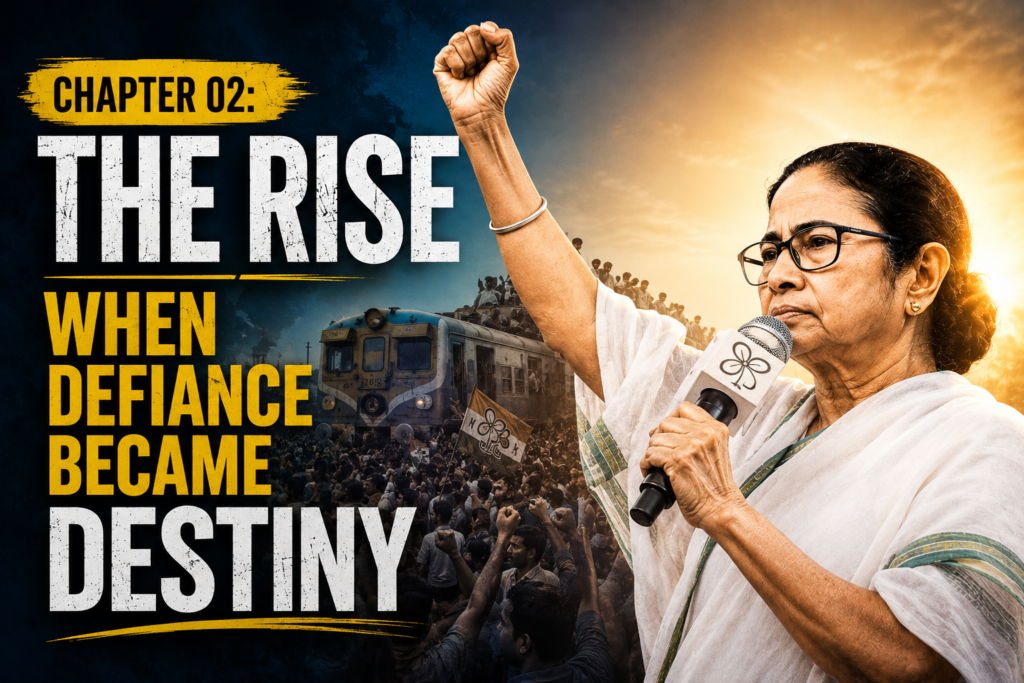
To understand how a leader falls, you must first walk through the fire that made her.
Long before she became a symbol, before the chants of “Didi” echoed through Bengal’s streets, Mamata Banerjee was just a restless force—unyielding, impatient, almost defiant by instinct. She did not inherit power. She clawed her way toward it.
In a political landscape dominated for over three decades by the seemingly unshakeable Left Front, she stood as an anomaly—loud where others were measured, emotional where others were ideological, unpredictable where others were disciplined. Many dismissed her. Some mocked her. Most underestimated her.
But Mamata Banerjee understood something that many seasoned politicians had forgotten—
power does not always live in institutions; sometimes, it lives in the wounded pride of the people.
She mastered what can only be described as the art of political storytelling.
Where others spoke of policy, she spoke of pain.
Where others cited data, she narrated injustice.
And slowly, she began to turn scattered grievances into a unified voice.
Then came Singur.
Then came Nandigram.
What might have remained localized land acquisition disputes became, under her voice, something far larger—a battle for dignity. Farmers were no longer just negotiating compensation; they were defending their identity, their soil, their right to exist without being displaced.
Mamata Banerjee did not merely support these movements—she became their face, their echo, their urgency.
She walked among the people, not above them. She fasted. She protested. She confronted power not from conference rooms, but from the streets—where dust, anger, and hope mixed into something electric.
And then she gave Bengal a slogan that was not just political—it was almost spiritual:
“Ma, Mati, Manush.”
Mother. Land. People.
Three words.
But within them, an entire revolution.
It was poetry wrapped in politics. And it worked.
Because Bengal did not just hear it.
It felt it.
By the time the 2011 elections arrived, the tide was no longer turning—it had already turned.
The mighty Left Front, once considered ideologically invincible, organizationally unmatched, and electorally unbeatable, began to crumble under the weight of something it could not fully counter:
Emotion.
When the results were declared, it wasn’t just a victory.
It was an upheaval.
A rewriting of political history.
For the first time in 34 years, Bengal had chosen someone else.
And that someone was not just a politician.
She was Didi.
The early years of her rule felt like a continuation of that movement.
Her governance carried the same rhythm as her protests—direct, visible, and deeply personal. Welfare schemes reached women, students, and the marginalized. Bicycles for girls, financial support for families, visible engagement with grassroots issues—these were not just policies; they were extensions of her political philosophy.
Even her appearance told a story—simple cotton sarees, worn slippers, no display of excess.
She looked like the people she governed.
She spoke like them.
She argued like them.
And most importantly—she felt like one of them.
The message was powerful and clear:
Power had not changed her.
For years, Bengal believed that.
Not because it was told to.
But because it wanted to.
Chapter 03: The Turning – When Power Rewrites the Script
Power does not arrive like a storm.
It settles quietly—like dust on a mirror—until one day, the reflection is no longer the same.
Governance is not a moment. It is a marathon.
And the very traits that help a leader conquer power can, over time, begin to reshape them.
For Mamata Banerjee, control had always been strength. A tightly held command. A trusted inner circle. A relentless grip over narrative. These were not flaws—they were the tools that dismantled a 34-year-old political empire.
But power has a way of turning tools into habits… and habits into blind spots.
As the years passed, something subtle began to shift.
The movement that once breathed through the streets slowly gathered walls. Decisions, once instinctive and grassroots-driven, began to feel distant, filtered through layers of authority. The party, once a living, breathing organism of protest and participation, started resembling a structure—organized, disciplined… but increasingly rigid.
To her critics, it no longer felt like a force that listened.
It felt like one that expected to be followed.
Local leadership—once the backbone of her rise—began to transform into something more complex. Power concentrated in pockets. Influence grew uneven. And with it came whispers—of excess, of control, of a system that was no longer as clean as its origin story.
But while this transformation was unfolding within, something equally powerful was rising from outside.
The Bharatiya Janata Party did not enter Bengal like a visitor.
It entered like a force determined to stay.
What had once been a marginal presence began building itself with precision—booth by booth, district by district, narrative by narrative. It did not merely oppose Mamata Banerjee; it sought to redefine Bengal’s political identity.
Religion, nationalism, cultural pride—threads that had long existed at the edges—were pulled into the center.
And soon, the battle lines were no longer just political.
They became emotional.
Civilizational.
Personal.
On one side stood Narendra Modi and Amit Shah—representing a national surge, a centralized vision, an expanding political machine.
On the other stood Mamata Banerjee—alone, defiant, rooted in Bengal’s soil, carrying the weight of regional pride on her shoulders.
It was no longer just an election.
It was a confrontation between two ideas of India.
And in 2021, she won.
Not just electorally—but symbolically.
Against immense pressure, relentless campaigning, and a narrative that seemed unstoppable, she held her ground. Bengal chose her again. The chants returned. The belief strengthened.
For many, that victory was not just a mandate.
It was proof that she was unbreakable.
But power has a quiet irony.
The louder the victory, the heavier the expectation that follows.
Because every triumph raises the stakes.
Every win narrows the margin for error.
And every moment of invincibility carries within it the seed of its own test.
What came next was not immediate collapse.
It was something far more dangerous.
A slow drift.
One that few notice while it is happening…
…but everyone recognizes once it is complete.
Chapter 04: The Incidents That Wouldn’t Fade
In any large state, crises occur. What transforms them into political turning points is how they accumulate and how they are perceived.
Sandeshkhali: When Fear Found a Language
There are moments in politics when statistics fall silent… and stories begin to speak.
Sandeshkhali was one such moment.
It did not begin with headlines.
It began in hushed voices—inside homes, along narrow village paths, in conversations that carried more fear than volume.
Residents, especially women, began to speak of a life that felt increasingly controlled—of pressure, of intimidation, of spaces that no longer felt entirely their own. There were allegations of coercion, of land being taken, of local power structures becoming too powerful to question.
For a long time, these voices did not travel far.
But when they did—when cameras arrived, when testimonies reached beyond the villages—they did not sound like political statements.
They sounded like distress.
Raw. Uneven. Human.
The narratives quickly collided.
The Bharatiya Janata Party seized upon the accounts, amplifying them across the national stage, presenting Sandeshkhali as evidence of a deeper collapse. The All India Trinamool Congress pushed back, questioning the timing, the framing, the intent—arguing that facts were being stretched for political gain.
Investigations began. Counter-claims followed. Facts, allegations, and narratives tangled into a complex web.
But outside this battle of versions, something far more delicate had already shifted.
For many watching—especially those far from the noise of political debate—the question was no longer about who was right.
It became about what was felt.
Why did it take so long for these voices to be heard?
Why did reassurance not come faster?
Why did the system, which once prided itself on being close to the people, appear distant in a moment of fear?
Because when people begin to speak out of fear, they are not asking for explanations.
They are asking for protection.
For acknowledgment.
For someone to listen—immediately, unmistakably, without hesitation.
And in Sandeshkhali, for many, that response felt delayed.
In politics, perception does not wait for verification.
Emotion does not pause for investigation.
And delay—no matter the reason—can begin to look like indifference.
Sometimes, even like denial.
Sandeshkhali was not just an incident.
It was a signal.
That somewhere, in some corners of Bengal, fear had found a language…
…and once spoken, it could no longer be unheard.
RG Kar Hospital: When Even Healing Spaces Felt Unsafe
Some incidents shake a government.
Some shake a society.
And then there are those that do something far deeper—
they shake the very idea of safety itself.
The tragedy at RG Kar Medical College and Hospital was one such moment.
A young doctor—someone who had chosen a life of healing, long hours, and quiet sacrifice—became the victim of a brutal crime within the very institution meant to protect life. The details that emerged were disturbing, deeply unsettling, and impossible to process without anguish.
This was not a crime in a dark alley.
It was not an isolated incident in an unknown corner.
It happened inside a government hospital—
a place where people come seeking care, trust, and safety.
And that is what made it unbearable.
The immediate aftermath was not silence.
It was eruption.
Doctors, usually bound by duty and discipline, stepped out of wards and into the streets. Junior doctors protested. Senior medical professionals stood beside them. Students, civil society groups, and ordinary citizens joined in.
The protests were not just about justice for one victim.
They were about a question that echoed across Bengal:
If a doctor is not safe inside a hospital… who is?
But as the outrage grew, so did scrutiny.
Questions began to surface—not just about the crime, but about the response:
- Were security measures in public institutions adequate?
- Could this have been prevented?
- Was the initial administrative response swift and sensitive enough?
- Did official statements reflect the gravity of the tragedy?
The Bharatiya Janata Party and other opposition voices accused the state government of administrative failure and insensitivity, turning the incident into a larger critique of governance and law-and-order.
The All India Trinamool Congress government, led by Mamata Banerjee, initiated investigations, promised strict action, and urged calm. Officials maintained that due process was being followed and that justice would be delivered.
Yet, in moments like these, governance is not judged only by action.
It is judged by speed, tone, and empathy.
For many citizens, the early hours of response felt uncertain.
Not necessarily absent—but not immediate enough to match the scale of grief and anger.
And that gap—between what people felt and what they heard—became the fault line.
Kolkata, a city known for its intellectual debates and cultural calm, found itself gripped by something else:
Fear.
Parents began asking questions they had never asked before.
Young professionals—especially women—felt a quiet unease.
Doctors questioned the safety of their own workplaces.
The incident had moved beyond crime.
It had become a crisis of confidence in institutions.
Because hospitals are not just buildings.
They are symbols.
Symbols of care.
Of trust.
Of protection.
And when something breaks inside a symbol…
it echoes far beyond its walls.
In the days that followed, the case continued through legal and investigative channels.
But politically, its impact had already been sealed.
It became a reference point—
in debates, in speeches, in living rooms, in silent thoughts.
Not just as an incident.
But as a moment when Bengal asked itself:
Have the systems we trusted begun to fail us?
Governments operate through procedure.
Societies respond through emotion.
And when those two move at different speeds…
trust does not collapse in one moment.
It slowly slips away.
Chapter 05: Violence, Elections, and the Burden of Perception
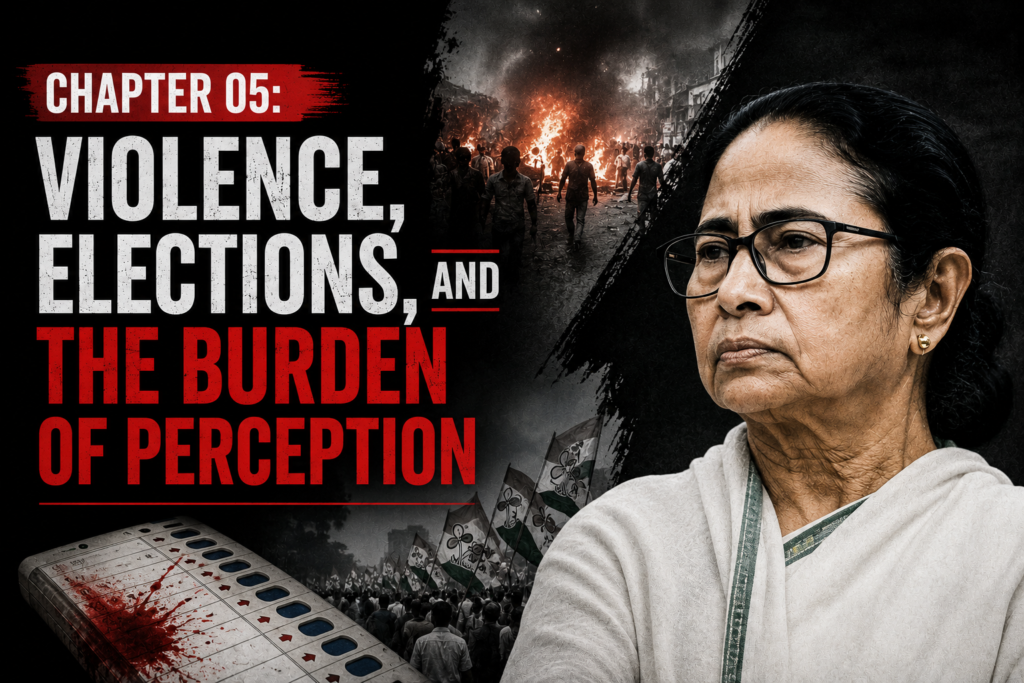
West Bengal has always known political passion.
But in the years under Mamata Banerjee and the All India Trinamool Congress, that passion—critics increasingly argued—began to take a darker, more troubling form.
What was once ideological rivalry began, in the eyes of many observers, to resemble a climate where politics and fear coexisted.
The numbers—contested, debated, but repeatedly cited—painted an uneasy picture.
In the aftermath of the 2021 Assembly elections, multiple petitions and reports placed before the Calcutta High Court referred to dozens of deaths linked to post-poll violence, with figures in public discourse often ranging between 30 and 50 fatalities, alongside hundreds of reported cases of assault, displacement, and intimidation.
The National Human Rights Commission, in its observations submitted during court proceedings, described aspects of the situation as “retributive violence” and indicative of serious law-and-order concerns—remarks that added institutional weight to what had, until then, largely been a political battle of narratives.
The judiciary did not remain distant.
The Calcutta High Court ordered CBI investigations into serious allegations, including cases of murder and sexual violence, observing that the protection of fundamental rights appeared to be under strain.
Even as the state government contested these directions legally, the broader message had already reached the public:
Questions were being asked—not just politically, but constitutionally.
The pattern did not end there.
Election after election—panchayat, municipal, bypolls—brought with it fresh allegations of clashes, intimidation, and coercion. The ruling party consistently denied any organized wrongdoing, attributing incidents to local rivalries or politically motivated exaggeration.
But the opposition, particularly the Bharatiya Janata Party, sharpened its narrative:
That Bengal’s elections were no longer just contests of popularity—
but contests of control.
By the time the 2026 elections approached, the concern had grown significant enough for the Election Commission of India to take heightened security measures, including the deployment of central forces such as the CRPF, in large numbers across sensitive constituencies.
This was not routine.
It was precaution driven by precedent and perception.
Alongside this, a series of allegations—voiced by opposition leaders, ground-level workers, and sections of civil society—began to dominate the political discourse.
Terms like “chhapa voting” (proxy or forced voting) re-entered public vocabulary. Critics alleged that in certain pockets, voters were either pressured to support the ruling party or discouraged from stepping out to vote altogether.
There were also claims—particularly from BJP leaders and supporters—that during earlier elections, including 2021, some of their voters were prevented from casting ballots, influencing outcomes in closely contested seats.
The ruling establishment rejected these accusations, maintaining that the electoral process remained fair and that such claims were politically motivated.
But in elections, what is alleged repeatedly often becomes what is believed widely.
And then there were the quieter stories.
Voices from villages, from localities, from ordinary people—
some speaking out, others choosing silence.
Critics claimed that dissent at the grassroots level often struggled to sustain itself, that those who raised their voices sometimes faced pressure, social or political, to withdraw.
These claims, too, were contested.
But they added to a growing atmosphere where perception began to outweigh verification.
Burning party offices.
Clashes outside polling booths.
Families leaving homes after results.
Political workers—across parties—injured, sometimes killed.
These were not isolated frames anymore.
They were a sequence.
For supporters of the government, this entire narrative was exaggerated—a political construction amplified for electoral gain.
For critics, it was a lived reality—a system that had grown intolerant of opposition.
For the ordinary voter, the question became deeply personal:
Is my vote truly mine?
Because democracy is not just about casting a ballot.
It is about casting it without fear.
And when doubt begins to creep into that space—
even slightly, even silently—
it changes everything.
By the time Bengal moved towards 2026, the debate was no longer about isolated incidents or competing statistics.
It had become a question of trust.
Of safety.
Of freedom.
And in a democracy, once voters begin to question whether they are truly free…
they answer that question not in debates—
but in the ballot box.
Chapter 06: Recruitment Scams – When Aspiration Collided With Distrust
Nothing tests a government more brutally than the dreams of its youth.
Not roads. Not speeches. Not even elections.
Because when a young person studies late into the night, fills out forms, pays fees, travels to exam centers, and waits—sometimes for years—they are not just chasing a job.
They are investing faith.
And in West Bengal, that faith was shaken.
The controversy began quietly—like many such stories do.
Whispers among candidates.
Delayed results.
Unanswered questions.
Then the whispers grew louder.
Allegations began surfacing around irregularities in recruitment processes, particularly those conducted by the West Bengal School Service Commission (SSC) for teaching and non-teaching staff in government-aided schools.
Candidates claimed that deserving applicants were overlooked, while others—allegedly through influence or financial transactions—secured positions.
For a while, it remained a dispute.
Then it became a scandal.
Petitions reached the Calcutta High Court.
And what followed transformed the issue from allegation to national headline.
The court, after examining materials and hearing arguments, ordered investigations into the recruitment process, raising serious concerns about transparency and fairness.
Soon after, central agencies, including the Central Bureau of Investigation and the Enforcement Directorate, stepped in.
And then came the arrests.
One of the most high-profile names was Partha Chatterjee, a senior leader of the All India Trinamool Congress and then a minister in the state government.
He was arrested in connection with the alleged scam.
The case intensified dramatically when large amounts of cash—reported to be over ₹50 crore—were recovered by the Enforcement Directorate from properties linked to his close associate.
Images of stacks of currency notes—seized, counted, displayed—spread rapidly across television screens and social media.
They did not just represent money.
They symbolized, for many, something far more painful:
The price of stolen opportunity.
As the investigation unfolded, more names surfaced.
Officials linked to the recruitment process, intermediaries, and alleged beneficiaries came under scrutiny. The scale of the issue began to expand beyond a single department, raising concerns about whether this was an isolated breakdown—or a systemic failure.
The Calcutta High Court took an unprecedented step.
It ordered the cancellation of thousands of appointments—reportedly over 25,000 teaching and non-teaching jobs—after finding that the recruitment process had been compromised.
For those who had secured jobs legitimately, it was devastating.
For those who had been waiting for years, it was infuriating.
For the system, it was a crisis.
The streets began to speak.
Protests erupted across Kolkata and other parts of Bengal.
Young men and women—many with degrees, training certificates, and years of preparation behind them—sat in demonstrations that lasted not days, but months.
Some protested under the open sky.
Some held placards with roll numbers.
Some carried admit cards like evidence of a broken promise.
They were not shouting slogans of ideology.
They were asking a simpler question:
“If merit doesn’t matter… what does?”
The political battle intensified.
The opposition, particularly the Bharatiya Janata Party, framed the scandal as proof of deep-rooted corruption within the system, directly targeting the leadership of Mamata Banerjee and her administration.
The ruling party maintained that individual wrongdoing was being investigated, that the law was taking its course, and that the government itself was cooperating with agencies.
But in public perception, distinctions between individual guilt and institutional responsibility began to blur.
And that is where the real damage occurred.
Because for the youth, this was no longer about a minister.
It was about a system they had trusted.
A system that now appeared uncertain.
Families felt it too.
Parents who had invested savings into education, coaching, and years of preparation watched their children sit at home—qualified, eligible, but jobless.
The pain was not loud.
It was quiet.
And that quiet pain often lasts the longest.
In economic terms, it affected employment cycles.
In political terms, it affected credibility.
But in human terms, it did something deeper:
It replaced hope with doubt.
The recruitment scam became more than a controversy.
It became a symbol.
Of what happens when governance fails not in policy—but in fairness.
Because governments can recover from slow growth.
They can recover from political defeat.
But when young people stop believing that effort leads to opportunity…
the cost is far greater.
And by the time Bengal approached 2026, this was no longer just a legal case.
It was a memory carried by thousands.
A memory that did not shout.
But waited.
And when it finally spoke…
it spoke through votes.
Chapter 07: The Economy beneath the Politics- When Decline Became Quietly Visible
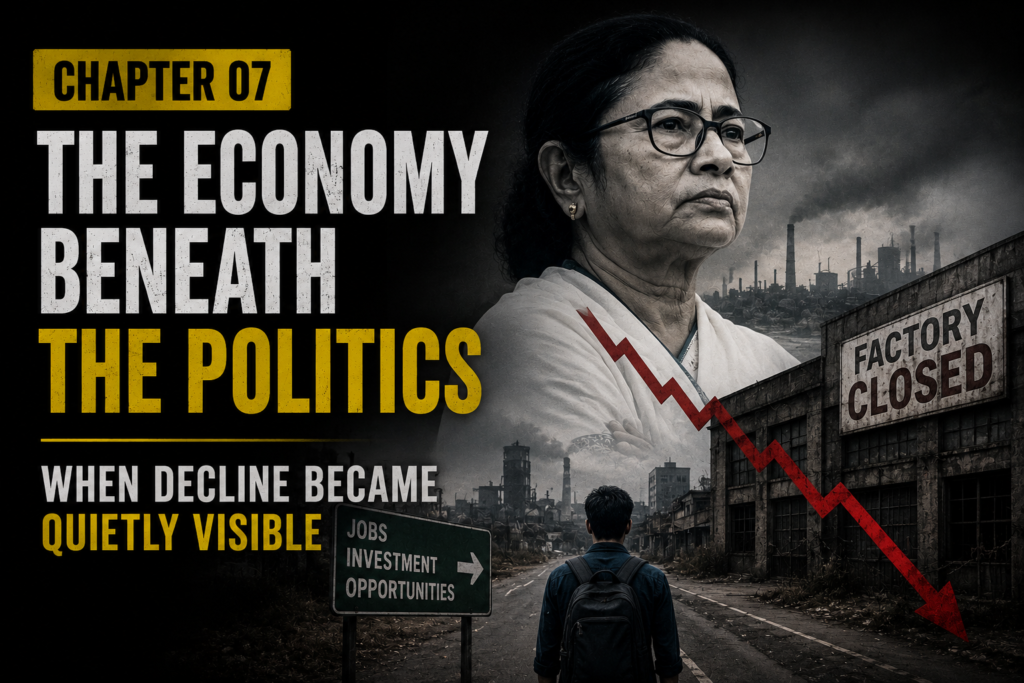
If violence shook Bengal’s conscience, the economy did something far more dangerous.
It eroded belief.
Not in a day.
Not in a headline.
But slowly—year after year—until people began to feel it in their own lives.
For decades, West Bengal carried the memory of being India’s industrial gateway.
Kolkata was once the nerve center of commerce.
Factories along the Hooghly defined its skyline.
Industry was not just economic activity—it was identity.
But under Mamata Banerjee, critics argue that instead of revival, the state witnessed a continuation—and in some areas, an acceleration—of industrial drift.
The most striking indicator came not from rhetoric, but from corporate movement.
According to data cited by central government sources and filings with the Ministry of Corporate Affairs, between April 1, 2011 and March 31, 2025, approximately 6,688 to 6,895 companies shifted their registered offices out of West Bengal or exited the state ecosystem.
This was not a marginal number.
This included over 100 listed companies—firms with scale, visibility, and employment impact.
The destinations told their own story.
Companies moved to:
- Maharashtra (over 1,300 firms)
- Delhi (nearly 1,300 firms)
- Uttar Pradesh (around 800+)
- Gujarat (a major industrial magnet)
They were not leaving India.
They were leaving Bengal.
The timeline made it even more concerning.
Between 2015 and 2018, the pace of exits accelerated significantly, with over 1,000 companies relocating in certain periods.
This was not random movement.
It was a pattern.
Each company that left carried more than paperwork.
It carried:
Jobs.
Tax revenue.
Future investment signals.
And perhaps most importantly—
confidence.
The implications rippled outward.
Fewer companies meant fewer employment opportunities.
Fewer opportunities meant rising outward migration.
And rising migration meant a silent admission:
the state was not creating enough for its own people.
The manufacturing sector told a similar story.
Despite national pushes like “Make in India,” West Bengal failed to emerge as a major destination for large-scale manufacturing investments.
While states like Gujarat, Tamil Nadu, and Karnataka built industrial corridors, attracted global giants, and expanded production ecosystems, Bengal remained largely on the sidelines of this transformation.
Factories that could have been built… were built elsewhere.
Investments that could have come… went elsewhere.
Industry voices repeatedly pointed to familiar concerns:
Land acquisition remained politically sensitive after Singur and Nandigram.
There were perceptions—rightly or wrongly—of bureaucratic delays and local-level political interference.
Policy unpredictability, even if exaggerated in parts, created hesitation among investors.
In business, hesitation is enough.
Capital does not wait.
It moves.
And it moved.
Meanwhile, the state’s economic growth, though positive, remained largely aligned with or slightly below national averages, failing to create the kind of breakout momentum needed to transform employment landscapes.
This meant that while the economy did not collapse—
it also did not inspire.
For the youth, this translated into a stark reality.
Degrees were increasing.
Jobs were not.
Large numbers of workers—both skilled and unskilled—continued migrating to other states.
From construction workers in Kerala to IT professionals in Bengaluru, from factory workers in Gujarat to service staff in Delhi—
Bengal’s workforce was building other states.
And back home, families watched.
Parents who had hoped their children would find opportunities within the state saw them leave instead.
Not by choice.
But by necessity.
The government continued to emphasize welfare schemes, social development, and rural support—and those efforts were real and impactful.
But welfare can ease hardship.
It cannot replace economic expansion.
Because ultimately, a state is not judged by how well it distributes resources.
It is judged by how effectively it creates them.
By the time Bengal approached 2026, the economic story had become impossible to ignore.
Not because of a single failure.
But because of a consistent pattern:
- Companies leaving
- Investments bypassing
- Youth migrating
- Opportunities shrinking
West Bengal was not collapsing.
But it was being outpaced.
And in a rapidly growing country, being outpaced is not a neutral position.
It is decline—just slow enough to go unnoticed…
until it becomes undeniable.
By then, the damage is no longer statistical.
It is emotional.
Because people stop asking, “What is happening?”
And start asking,
“Why is nothing happening here?”
And when that question spreads across a generation…
it does not remain economic.
It becomes political.
Migration: The Quiet Measure of Opportunity
Perhaps the most telling indicator was not a number in a report but a trend in people’s lives.
Young Bengalis continued to move—to Bengaluru, Pune, Hyderabad, Delhi, Mumbai—seeking opportunities in technology, services, construction, and beyond. Migration is not inherently negative; it can signal ambition. But when it becomes a steady outflow tied to limited local options, it becomes a question:
Why must aspiration travel so far from home?
That question lingered in households—and, eventually, in voting booths.
Leadership, Messaging, and the Cost of Tone
Crises do not just test governments.
They test the instincts of leadership—what to say, when to say it, and how it will be heard beyond the words themselves.
For years, the greatest political strength of Mamata Banerjee was her ability to speak directly to people.
She did not sound rehearsed.
She did not sound distant.
She sounded like someone who felt what the people felt.
That emotional immediacy built her connection with Bengal.
But over time, that same style began to face a new challenge:
interpretation.
Because in a deeply diverse and politically charged society, what a leader says is only half the story.
How it is perceived becomes the other half.
In the later years of her tenure, especially amid rising political polarization, several statements by Mamata Banerjee and leaders of the All India Trinamool Congress began to be interpreted—particularly by critics and opposition groups—as appeasement-driven or selectively sensitive to certain communities.
These perceptions were amplified in the context of:
- Religious identity politics gaining momentum nationally
- The growing presence of the Bharatiya Janata Party in Bengal
- A sharper narrative battle around “cultural identity” and “civilizational politics”
The opposition framed a powerful storyline:
That the ruling leadership was tilting towards minority appeasement, while ignoring concerns of the Hindu majority.
This narrative was repeated consistently—through rallies, media, and grassroots campaigns.
The ruling party, on the other hand, maintained that its approach was inclusive and secular, focused on protecting all communities and maintaining social harmony.
But on the ground, the perception battle was moving in a very different direction.
There were repeated allegations from opposition parties, sections of the media, and local residents that certain leaders and workers of the All India Trinamool Congress were either directly involved in or complicit in incidents of intimidation and oppression, particularly against political opponents and, in some cases, members of specific communities.
These allegations were strongly denied by the party, but they did not disappear.
They circulated.
They accumulated.
They hardened into belief for many.
At the same time, statements by Mamata Banerjee on issues related to minorities, migration, and border dynamics were increasingly picked apart in the political arena.
Her critics accused her of being overly accommodating towards sections of minority communities, and in particular pointed to remarks that were interpreted—rightly or wrongly—as soft on the issue of illegal immigration from Bangladesh.
The leadership consistently rejected these accusations, framing them as politically motivated distortions.
But by then, the narrative had already taken a life of its own.
Because in politics, repetition creates reality.
And the opposition—especially the Bharatiya Janata Party—leaned heavily into this line of attack:
That the government was engaging in appeasement of one section, while failing to address the fears and grievances of another.
What made the situation more complex was the government’s attempt to balance both sides through public messaging.
Statements meant to reassure minorities…
Statements meant to counter polarization…
Statements meant to defend administrative actions…
Instead of stabilizing the narrative, they often appeared—at least to critics—as reactive, inconsistent, or politically calculated.
And that is where tone became costly.
Because for a section of voters, this was no longer about policy.
It became about trust.
They began to feel that their concerns were either:
Not being acknowledged…
Not being addressed…
Or being countered with political defensiveness rather than clarity.
Whether every allegation was true, exaggerated, or politically constructed became secondary.
What mattered was this:
A significant number of people began to believe it.
And in democracy, belief—once formed—does not require proof every day.
It only needs reinforcement.
By the time the state moved toward 2026, this perception—that the leadership’s tone, priorities, and responses were no longer evenly aligned—had quietly embedded itself into the political consciousness.
And once a leader is seen as partial instead of protective…
the emotional contract with the people begins to break.
Chapter 08: Abhishek Banerjee – The Prince Inside the Fortress
Every long political reign eventually confronts the same question:
What happens after the leader?
For Mamata Banerjee, that question slowly began taking the shape of one man:
Abhishek Banerjee.
Young, articulate, aggressive in debate, and visibly more modern in political style than many traditional regional leaders, Abhishek emerged as the unmistakable second center of gravity within the All India Trinamool Congress.
At first, his rise appeared strategic.
Perhaps even necessary.
Because Mamata Banerjee’s politics had always revolved around extraordinary personal energy. She was everywhere—campaigning, protesting, responding, confronting.
But time changes every political movement.
And as age, health pressures, and administrative fatigue inevitably entered public discussion, the party needed a future face.
Abhishek became that face.
He represented a different generation.
Sharper in media appearances.
More polished in organizational language.
More digitally aware.
He spoke the language of political management as much as emotional mobilization.
For supporters, he symbolized continuity.
For critics, he symbolized consolidation.
And that distinction would become crucial.
Because in Indian politics, the moment a relative rises inside a party structure, the debate changes immediately.
It is no longer just about leadership.
It becomes about inheritance.
Opposition parties—especially the Bharatiya Janata Party—began attacking the Trinamool Congress not merely as a ruling party, but as a political structure increasingly centered around one family.
The irony was politically powerful.
Mamata Banerjee had once risen by portraying herself as the anti-establishment outsider fighting entrenched systems of power.
Now her opponents accused her of building one herself.
The attacks intensified as Abhishek’s authority within the party visibly expanded.
Candidate selections.
Organizational reshuffles.
Campaign strategy.
His influence appeared everywhere.
And within the party, whispers began growing louder.
Not always publicly.
But privately.
Some senior leaders reportedly felt sidelined.
Others feared that the party’s traditional structure—once built around street-level loyalty to Mamata—was transforming into a far more centralized command system.
The rise of Abhishek created both ambition and anxiety.
Because political succession is rarely smooth in regional parties built around charismatic personalities.
The question quietly haunting the Trinamool ecosystem became:
Was the party preparing for transition…
or tightening into a smaller circle of control?
Then came the scrutiny.
And the scrutiny was relentless.
Over the years, Abhishek Banerjee faced repeated allegations and investigations linked to various financial and political controversies raised by opposition parties and central agencies.
Among the most politically explosive was the alleged coal smuggling case, where agencies like the Enforcement Directorate and the Central Bureau of Investigation conducted investigations involving individuals reportedly linked to the broader network under scrutiny.
The Psychology of Power: When Control Feels Like Distance
Power often simplifies decision-making at the top and complicates perception at the bottom.
To supporters, centralized control can look like efficiency.
To skeptics, it can look like arrogance.
Over time, a narrative took shape among critics: that the leadership had grown less receptive to dissent, more insulated from ground realities, and slower to admit error.
Whether fully fair or not, such narratives matter because they shape the lens through which every new incident is viewed.
Chapter 09: The Issue of Illegal Immigrants from Bangladesh
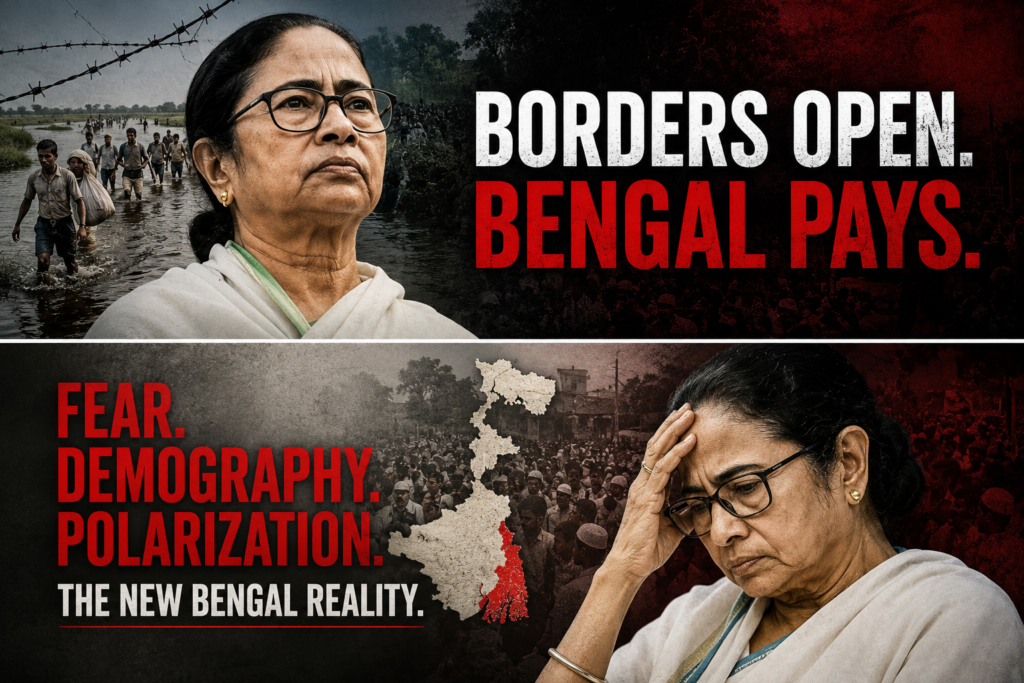
One of the most politically devastating transformations in Mamata Banerjee’s public image was not about corruption, elections, or even violence.
It was about identity.
Because there was a time when Mamata Banerjee herself spoke the language of border anxiety.
Long before becoming the undisputed ruler of Bengal, she had raised concerns in Parliament over illegal infiltration from Bangladesh. In the 1990s and early 2000s, she, like many leaders across party lines, publicly acknowledged demographic pressures and illegal cross-border migration as serious issues affecting border states and posing risks to national stability.
Old speeches and parliamentary references would later return to haunt her.
Because decades later, her political opponents would ask a brutal question:
What changed?
As Bengal’s politics became increasingly polarized, the TMC itself was often alleged to be openly playing the politics of appeasement. Citizens of West Bengal were becoming increasingly vocal about crimes allegedly committed by a particular community. Threats to the sisters, mothers, and wives of common people had started becoming visible across media and social media platforms. Yet, the state government was accused of failing to take strict action against these criminals because they allegedly belonged to a particular community — as reported by locals, sections of the local media, and various scholars.
Now, immigration stopped being merely an administrative issue.
It became emotional.
Civilizational.
Electoral.
And increasingly, a matter of national security.
The Opposition strategically and aggressively built a narrative that West Bengal’s porous borders were no longer simply a governance concern, but a direct internal security challenge for India.
The accusation was explosive:
That sections of illegal immigrants from Bangladesh were being treated as a vote bank by the ruling ecosystem, even as unchecked infiltration allegedly altered demographics in sensitive border regions and increased long-term security concerns.
The All India Trinamool Congress repeatedly denied these allegations.
But politically, the damage did not depend entirely on proof.
It depended on perception.
And perception was shifting rapidly.
Several statements by Mamata Banerjee during debates around the NRC (National Register of Citizens) and CAA (Citizenship Amendment Act) intensified this perception battle.
Her open challenge to the central government that she would not allow even a single illegal immigrant to be sent back to Bangladesh infused anger among a section of Bengalis.
Her government’s decisions regarding restrictions on Maa Durga processions during festivals of a particular community, along with controversies surrounding people allegedly being stopped or questioned for chanting “Jai Shri Ram,” further intensified political tensions.
These and several other such incidents fueled anger among a section of Bengali Hindus and accelerated political polarization across the state. Critics argued that, intentionally or unintentionally, Mamata Banerjee herself became one of the catalysts behind this growing polarization.
To many of her opponents, these actions and statements sounded like resistance against identifying illegal infiltrators and an attempt to balance politics through appeasement rather than equal enforcement.
Then came the rhetoric surrounding Bengali identity.
Mamata Banerjee repeatedly argued that Bengali-speaking citizens were being unfairly targeted and harassed under the larger political narrative around infiltration.
Again, her supporters saw this as a defence of Bengal’s pluralism and federal dignity.
But the opposition weaponized these statements masterfully.
They merged “Bengali identity” with “illegal migration” in political messaging and repeatedly claimed that the government was deliberately blurring the distinction between citizens and infiltrators for electoral gain.
The border districts became central to this narrative war.
Reports of cattle smuggling, fake identity networks, cross-border syndicates, and illegal settlement patterns were amplified continuously in political discourse and media debates.
Investigative agencies conducted operations in several cases involving alleged smuggling and border-linked rackets.
Opposition leaders claimed these networks survived because of political protection at local levels.
The ruling party denied institutional involvement and accused central agencies of politically targeting Bengal.
But once again, the optics became dangerous.
For many ordinary voters—especially in rural Bengal and Hindu-majority belts—the issue was no longer discussed in technical legal language.
It became psychological.
A fear of cultural displacement.
A fear of political appeasement.
A fear that demographic realities were visibly changing, while their concerns were dismissed as communal or politically motivated.
And above all, a fear that the state government was undermining the larger agenda of national security in pursuit of vote-bank politics.
This fear grew stronger as reports repeatedly highlighted changing demographics in several districts bordering Bangladesh. Critics argued that the issue was no longer merely humanitarian, but strategic.
Illegal migration, they claimed, could impact:
- Internal security
- Border stability
- Identity documentation systems
- Electoral integrity
- Resource distribution
- Social cohesion
Whether every claim was accurate, exaggerated, or politically amplified became secondary.
What mattered was that a large section of the population had started believing that Bengal’s borders were no longer fully under control.
And that belief carried enormous political consequences.
The Opposition understood this fear with extraordinary precision.
Under Narendra Modi and Amit Shah, the party transformed border politics into a larger emotional campaign about nationalism, citizenship, civilizational identity, and security.
The irony was politically tragic.
The same Mamata Banerjee who once built her image as a fierce Bengali protector against external domination was now being accused by critics of failing to protect Bengal’s borders, identity, and internal security interests.
And the more aggressively she denied these allegations, the more aggressively the opposition repeated them.
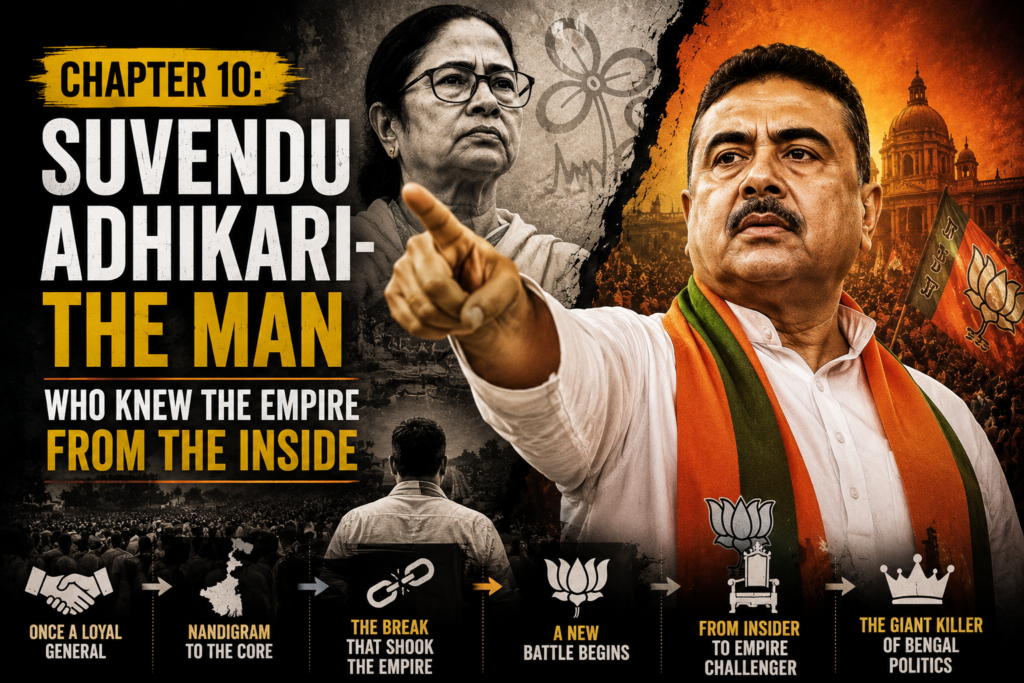
Chapter 10: Suvendu Adhikari- The Man Who Knew the Empire from the Inside
Every great political downfall carries within it the story of a former loyalist.
Someone who once helped build the throne…
understood its strengths…
witnessed its weaknesses…
and eventually walked away from it.
For Mamata Banerjee, that man was Suvendu Adhikari.
And perhaps no character in Bengal’s modern political drama symbolizes betrayal, revenge, strategy, and poetic irony more than him.
Before he became the face of the BJP’s Bengal uprising, Suvendu Adhikari was one of the most powerful architects of Mamata Banerjee’s rise.
Not a television politician.
Not merely a speechmaker.
He was an organizer.
A ground commander.
A political field marshal who understood Bengal booth by booth, district by district, village by village.
If Mamata Banerjee became the emotional face of the anti-Left revolution…
leaders like Suvendu Adhikari became its operational machinery.
His role during the Nandigram movement was historic.
At a time when Bengal was boiling over land acquisition protests, Suvendu emerged as one of the fiercest local faces resisting the Left Front government.
The movement transformed him into a mass leader almost overnight.
For villagers in East Midnapore, he was not simply a politician.
He was the son of the soil who stood against state power.
And together, Mamata and Suvendu built one of the most powerful political movements Bengal had witnessed in decades.
That partnership changed the history of West Bengal.
The seemingly invincible 34-year-old Left empire collapsed in 2011.
And for years afterward, Suvendu Adhikari remained one of the most influential pillars of the Trinamool Congress.
He held organizational influence across large parts of Bengal, especially in the politically critical districts of East Midnapore.
His political network was formidable.
Many within TMC quietly acknowledged that Suvendu was among the few leaders capable of mobilizing both cadre strength and emotional loyalty simultaneously.
But power changes political equations.
And slowly, the distance between Mamata Banerjee’s inner circle and Suvendu Adhikari began widening.
At the heart of this growing tension was a question that destroys many regional parties:
Succession.
As Abhishek Banerjee rose rapidly inside the party structure, many senior leaders allegedly began feeling sidelined.
Critics within the party whispered that the Trinamool Congress was increasingly becoming centralized around a smaller family-centric power structure.
Suvendu Adhikari reportedly became one of the biggest faces of this internal discomfort.
The tension was not merely personal.
It was political.
Because Suvendu represented an older TMC culture built on district-level mass leadership, while the newer ecosystem increasingly revolved around centralized command and strategic loyalists.
Over time, reports of friction intensified.
Meetings became colder.
Signals became sharper.
Public appearances became politically awkward.
And Bengal’s political corridors began sensing what was coming.
Then came the rupture.
In 2020, Suvendu Adhikari formally left the Trinamool Congress and joined the Bharatiya Janata Party.
The moment was seismic.
Because this was not just another defection.
This was a senior insider walking out with deep knowledge of TMC’s organizational machinery, electoral strategy, district structures, and political vulnerabilities.
For Mamata Banerjee, the change was deeply personal.
For the BJP, it was a masterstroke.
And Suvendu did not arrive quietly.
He arrived with fury.
Once a loyal defender of “Didi,” he transformed into one of her fiercest political attackers.
His speeches became aggressive, emotional, and relentless.
He directly challenged the very leadership he once helped strengthen.
He accused the TMC leadership of corruption, appeasement politics, authoritarianism, and betrayal of Bengal’s original aspirations.
And because he had once belonged to the system, his attacks carried a dangerous credibility among many voters.
Then came the moment that turned him into a political symbol.
Nandigram.
The land that had once launched Mamata Banerjee’s rise…
became the battlefield where Suvendu Adhikari challenged her directly in 2021.
It was more than an election contest.
It was mythology colliding with revenge.
The symbolism was extraordinary.
The disciple versus the leader.
The insider versus the empire.
The man who helped build the revolution now attempting to destroy its creator.
And when Suvendu defeated Mamata Banerjee in Nandigram, the political shockwaves traveled across India.
Even though Mamata later returned as Chief Minister through Bhabanipur, something fundamental had changed psychologically.
For the first time in years, Bengal saw visible proof that Mamata Banerjee could be defeated.
The aura of invincibility cracked.
And Suvendu Adhikari became the face of that crack.
But his role grew even larger after 2021.
Because while many BJP leaders came and went in Bengal…
Suvendu stayed rooted.
Aggressive.
Persistent.
Always on the offensive.
He understood Bengal’s emotional language better than most BJP leaders imported from Delhi.
He knew where resentment was growing.
Where TMC cadres were vulnerable.
Where Hindu polarization was intensifying.
Where anti-incumbency was silently accumulating.
And perhaps most importantly—
He understood the emotional weaknesses of the Mamata system because he had once been part of it.
As controversies like Sandeshkhali, recruitment scams, political violence allegations, and the RG Kar Hospital outrage shook Bengal, Suvendu positioned himself as the loudest opposition voice on the streets.
He relentlessly attacked the government over:
- Alleged minority appeasement
- Political violence
- Corruption allegations
- Hindu identity politics
- Administrative collapse
- Law-and-order failures
To supporters, he became the man fighting an entrenched regime.
To critics, he became an aggressive polarizing force exploiting public anger.
But politically, he was becoming impossible to ignore.
By the time the 2026 elections approached, Suvendu Adhikari was no longer merely a BJP leader.
He had become the principal battlefield commander against Mamata Banerjee.
And this time, the BJP machinery was far more prepared.
The opposition narrative was sharper.
The booth structure was stronger.
Central forces deployment was tighter.
The Election Commission scrutiny was heavier.
The allegations of “chhappa voting” and voter intimidation were under national focus.
The BJP understood one crucial thing:
If Mamata Banerjee’s greatest strength had once been emotional connection with Bengal…
then her greatest vulnerability now was public exhaustion.
And Suvendu Adhikari knew exactly how to weaponize that exhaustion politically.
In many ways, his journey mirrors Bengal’s political transformation itself.
He began as a soldier of Mamata’s revolution.
Then became the rebel against her empire.
And finally emerged as one of the central figures responsible for breaking the psychological dominance of the woman once considered politically untouchable.
That is why Suvendu Adhikari’s story is not merely a subplot in Mamata Banerjee’s downfall.
It is one of its defining chapters.
Because history is often rewritten not by strangers…
but by those who once stood closest to the throne.
Chapter 11: The Election as a Reckoning
By 2026, the election was not about a single issue. It was a convergence:
- Incidents that stirred fear and anger
- Youth disillusionment over jobs and fairness
- Economic comparisons with faster-growing states
- A powerful opposition narrative that stitched these threads together
When the results arrived, they did not feel like a routine alternation. They felt like release—a decision shaped by accumulated memory.
After the Verdict: The Silence That Speaks
There are moments after defeat when leaders rely on loyalists to fill the air.
This time, Bengal felt quieter.
The chants were fewer. The defenses were less emotional.
Silence, in politics, is not emptiness. It is often judgment waiting to settle.
What Remains of ‘Didi’
It would be easy—but inaccurate—to reduce Mamata Banerjee to the sum of recent controversies.
She remains:
- The leader who broke a decades-long political order
- A formidable campaigner who challenged national heavyweights
- The architect of welfare programs that touched millions
But she is also, now, a leader confronting:
- Questions about governance and responsiveness
- The consequences of a system that grew too centralized
- A public that has learned to separate memory from present experience
This is what makes her story not just political, but tragic in the classical sense: a figure shaped by strengths that, over time, contributed to her vulnerabilities.
What Happens Now
For Mamata Banerjee, the road ahead is not closed—but it is narrow.
A return would require:
- Rebuilding credibility through visible, sustained reform
- Opening the system to scrutiny and dissent
- Relearning the language of empathy that once defined her politics
For Abhishek Banerjee:
- Converting inheritance into independent legitimacy
- Expanding trust beyond the party’s core
- Navigating scrutiny without deepening polarization
For Bengal:
- Ensuring that the new political order delivers on jobs, safety, and dignity
- Avoiding the cycle where one dominance simply replaces another
The Ending That Isn’t an End
Political stories rarely conclude. They transform.
Mamata Banerjee’s journey now stands at a crossroads between reinvention and retreat.
The woman who once turned pain into power must now confront a different challenge: turning criticism into correction.
Because in the end, Bengal did not forget her.
It simply decided that remembering her was no longer enough.
Disclaimer:
This article is a long-form political analysis and narrative commentary based on publicly available reports, court observations, media coverage, election narratives, statistical data, political statements, and allegations made by various parties and public figures over the years. Certain incidents, accusations, and claims mentioned in this story remain politically contested and may not have reached final judicial conclusions. References to violence, corruption, appeasement, infiltration, or misconduct reflect allegations, perceptions, public discourse, and reported narratives surrounding the political environment in West Bengal during the tenure of Mamata Banerjee and the All India Trinamool Congress government.
The purpose of this article is not to defame, target, or malign any individual, community, religion, or political party, but to present a broad political and socio-economic narrative examining the rise, dominance, controversies, challenges, and public perception surrounding one of India’s most significant regional political eras. Readers are encouraged to interpret the analysis critically and consider multiple perspectives before forming conclusions.
NoCap Times does not independently verify all claims or statements and shall not be held responsible for any inaccuracies or omissions.
Stay updated with the latest and breaking news on NoCap Times. Get the latest India News, World News, Business News, Sports News, Viral News and Research Articles for various competitive Exams & UPSC Aspirants.