

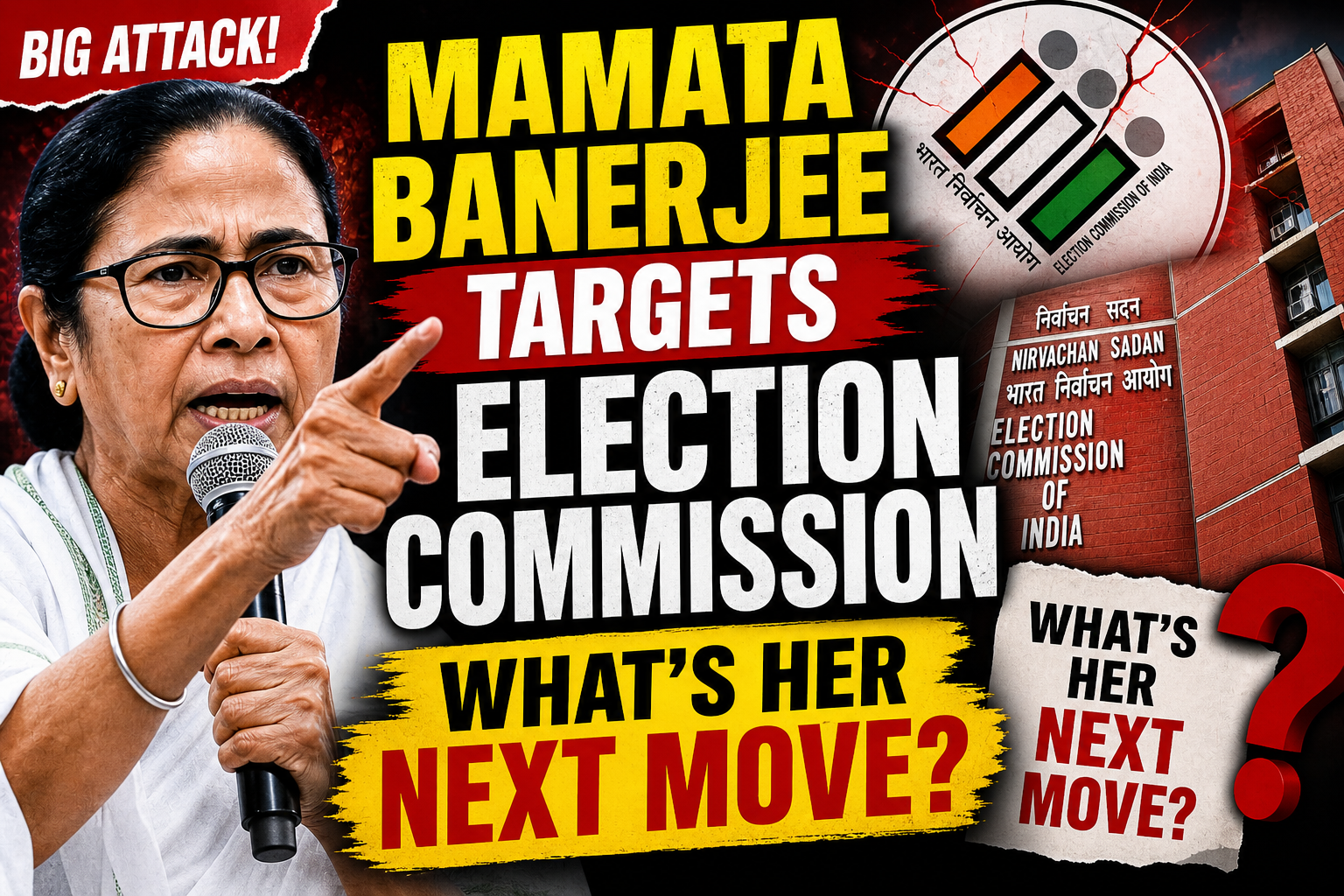
Mamata Banerjee Targets Election Commission—What’s Her Next Move?
Mamata Banerjee targets the Election Commission after a shocking defeat in the West Bengal elections 2026. The 2026 West Bengal Assembly elections concluded with a decisive victory for the Bharatiya Janata Party (BJP), which won 206 seats in the 294-member assembly, crossing the majority mark comfortably. The All India Trinamool Congress (TMC), led by Mamata Banerjee, secured 80 seats with one more lead reported in initial counts. This result ended TMC’s 15-year rule in the state and marked a historic breakthrough for BJP in eastern India.
A day after the results, TMC chief Mamata Banerjee addressed the media in Kolkata, expressing strong disappointment and raising concerns about the electoral process. While acknowledging the setback, she maintained a defiant stance and outlined her plans to strengthen the opposition at the national level.
Mamata Banerjee’s Press Conference: Key Statements
Mamata Banerjee described the defeat as resulting from what she termed “dirty and nasty games” by the Election Commission of India (ECI). She claimed the real contest was not against the BJP but against the poll body itself, alleging direct interference and that elections were influenced in multiple states, including Maharashtra, Haryana, Bihar, and now West Bengal. She did not provide specific evidence during the address but promised to pursue the matter further through appropriate channels.
Banerjee also made personal allegations, stating she was assaulted at a polling station. She claimed she was “kicked in her belly and back,” that CCTV cameras were switched off, and that she was pushed out of the counting centre and misbehaved with. As a senior woman leader, these claims drew significant attention, and she indicated she would take them up formally.
Despite the loss, Banerjee highlighted solidarity from INDI bloc partners. She named Sonia Gandhi, Rahul Gandhi, Arvind Kejriwal, Uddhav Thackeray, Akhilesh Yadav, Tejashwi Yadav, and Hemant Soren as leaders who reached out to express support. She emphasized that the alliance’s unity would grow stronger and that opposition leaders would visit her in the coming days.
Striking a resilient note, Banerjee described herself as a “free bird” and a “commoner” without any official position. She pointed out that she had not drawn any salary or pension during her 15 years in office and reaffirmed her commitment to public service. Her focus, she said, would now shift toward consolidating the national opposition.
Official Election Results and Vote Share Analysis
According to the Election Commission of India, the BJP secured approximately 45.84% of the popular vote, while the TMC received 40.80%. The CPI(M) got 4.45%, Congress 2.97%, and others around 4.28%. This close vote share indicates a competitive contest at the grassroots level, even as the seat tally showed a clear majority for the BJP (206 seats) compared to TMC’s 80. Smaller parties like AJUP won two seats, and CPI(M) was reduced to one.
This represented a sharp reversal from the 2021 elections, where TMC had won 213 seats with nearly 48% vote share, and BJP had emerged as the main opposition with 77 seats. The 2026 polls saw record voter turnout of over 92%, reflecting high public engagement.
Balanced Analysis: Factors Behind TMC’s Defeat and BJP’s Victory
The 2026 verdict can be analyzed through several non-controversial lenses rooted in governance, voter sentiment, and political strategy:
Anti-Incumbency After 15 Years: Long tenures often lead to voter fatigue. Issues such as unemployment, industrial revival, infrastructure gaps, and demands for better governance contributed to a desire for change among large sections of the electorate. Many voters who had benefited from TMC’s welfare schemes still sought renewed momentum on economic opportunities and development.
BJP’s Organizational and Campaign Efforts: The BJP demonstrated strong grassroots mobilization, effective booth management, and consistent outreach across regions. National leaders actively campaigned on themes of development, good governance, cultural pride, and integration with national progress. This resonated with diverse communities and helped consolidate support, particularly in North Bengal and parts of South Bengal.
Shift in Voter Aspirations: While TMC’s schemes had built a loyal base, especially among women and marginalized groups, a significant portion of voters—youth, migrants, and aspiring middle classes—responded to promises of job creation, industrial investment, and long-term economic growth. The narrowing of vote share gap from 2021 shows evolving priorities.
Regional and Demographic Dynamics: BJP made deep inroads into areas previously considered TMC strongholds. Community preferences, local issues, and effective alliance-building played roles, as reflected in statements by winning candidates like Suvendu Adhikari in Bhabanipur.
The Election Commission conducted the polls in phases with high security and oversight. Pre-poll exercises like the Special Intensive Revision (SIR) of electoral rolls aimed at cleaning voter lists, which the Commission described as a standard integrity measure. Official results were declared after thorough counting processes.
Mamata Banerjee’s allegations are part of the political discourse common in competitive elections. India’s democratic framework provides mechanisms—courts, formal complaints to ECI, and public scrutiny—for addressing such concerns. The high turnout and peaceful conduct in most areas were widely noted as positive aspects of the exercise.
Seat-wise and Regional Breakdown
BJP’s victory was broad-based:
- Strong performance in North Bengal, building on earlier gains.
- Significant inroads in urban and semi-urban constituencies.
- Retention and expansion in key rural pockets.
TMC held influence in specific minority-concentrated and traditional core areas but lost ground even there. The polarization between the two major parties further marginalized the Left and Congress.
Notable outcomes included Suvendu Adhikari’s victory over Mamata Banerjee in Bhabanipur by around 15,000 votes, symbolizing the momentum shift.
Implications for West Bengal and National Politics
For the incoming BJP government, the mandate brings both opportunity and responsibility. Priorities likely include accelerating industrial growth, improving law and order perception, generating employment, and ensuring inclusive development that respects Bengal’s cultural identity. Enhanced cooperation with the Centre on infrastructure and investment projects is expected.
For TMC, the defeat offers a chance for introspection and reorganization. Mamata Banerjee’s continued leadership and her emphasis on strengthening national opposition alliances signal an active role in future contests. Her “free bird” approach may allow greater focus on street-level mobilization and alliance-building.
Nationally, the result reinforces BJP’s expanding footprint in eastern and diverse states. It also highlights the resilience of multi-party democracy, where power alternates through ballots.
Future Outlook: Challenges and Opportunities
West Bengal faces key challenges: unemployment, education quality, healthcare access, agricultural modernization, and climate resilience. The new government will be judged on its ability to deliver tangible results while maintaining social harmony in the state’s pluralistic society.
Mamata Banerjee’s vow to strengthen opposition unity could influence national politics ahead of future elections. Her personal allegations and criticism of the poll process will likely be debated in political and legal forums.
The 2026 elections, despite the heated post-poll narrative, ultimately reflect the will of the people as per official tallies. High participation underscores citizens’ faith in democracy. Both the ruling party and opposition have important roles: one in governance and delivery, the other in constructive accountability.
As Bengal enters a new political chapter, the focus for all stakeholders should remain on the state’s progress, prosperity, and preservation of its rich heritage. The coming months will reveal how the mandate translates into action for the benefit of all sections of society.
This historic shift, achieved through a massive electoral exercise, reaffirms the dynamic nature of Indian democracy.
Disclaimer:
This article is based on publicly available information, official statements, and media reports available at the time of publication. The content is intended for informational purposes only and should not be considered financial or policy advice. Readers are encouraged to refer to official sources for the latest updates.
The content is solely for educational and informational purposes. Whether it is global news, indian news, political news or any other sort of content, we do not independently verify the content or claims.
While efforts have been made to ensure accuracy, the information presented may change as new developments emerge. Readers are advised to conduct their own research and consult financial advisors before making any investment decisions.
NoCap Times does not independently verify all claims or statements and shall not be held responsible for any inaccuracies or omissions.
Stay updated with the latest and breaking news on NoCap Times. Get the latest India News, World News, Business News, Sports News, Viral News and Research Articles for various competitive Exams & UPSC Aspirants.