

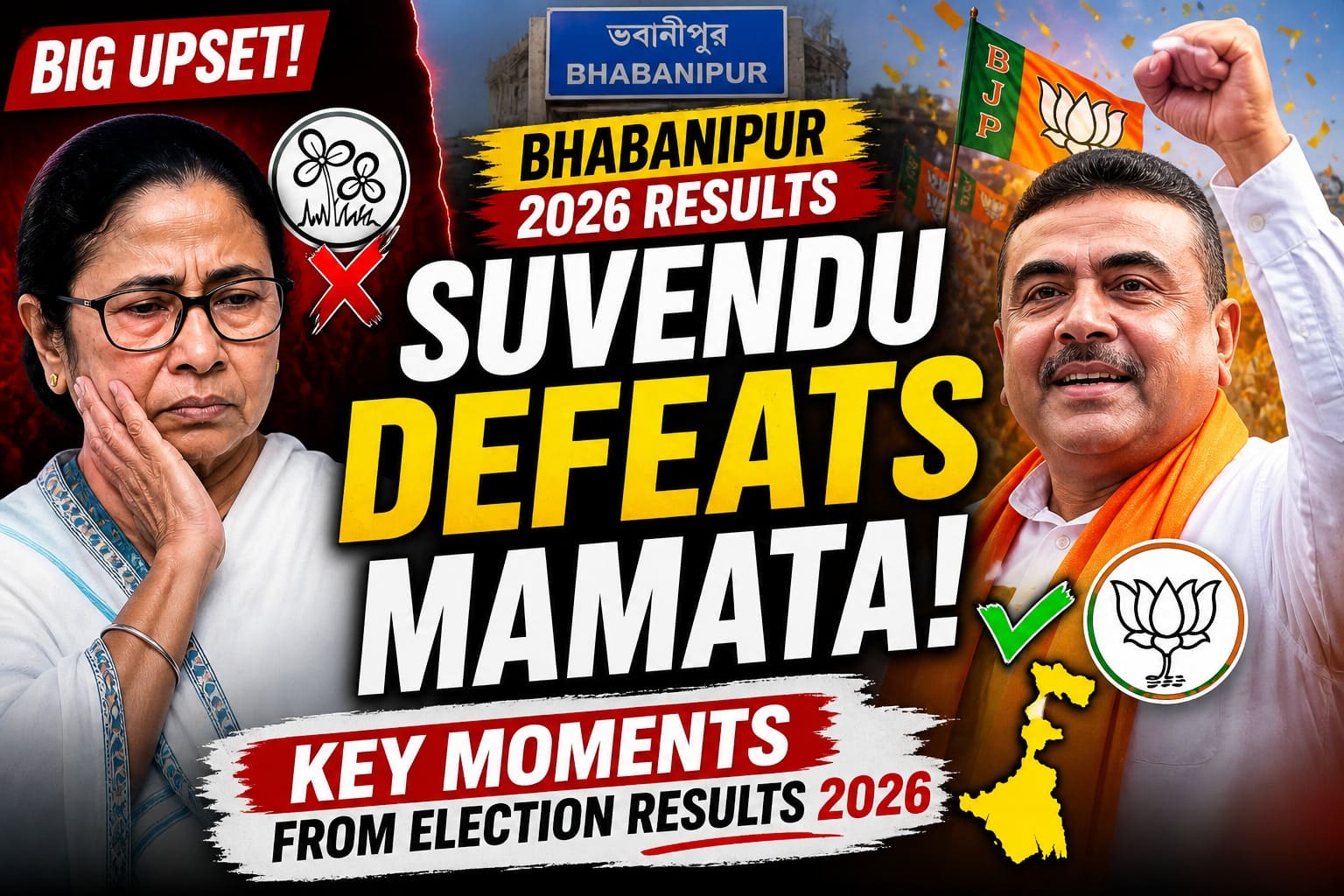
Suvendu Adhikari Defeats Mamata Banerjee in Bhabanipur: Key Moments from West Bengal Election Results 2026
The major headline of most of the newspapers today is – Suvendu Adhikari Defeats Mamata Banerjee in Bhabanipur. The 2026 West Bengal Assembly elections delivered one of the most dramatic upsets in Indian politics as BJP leader Suvendu Adhikari defeated Chief Minister Mamata Banerjee in her traditional stronghold of Bhabanipur by a margin of approximately 15,105 votes. Adhikari secured 73,917 votes against Banerjee’s 58,812. This high-profile victory symbolized the broader shift that saw the Bharatiya Janata Party (BJP) end the Trinamool Congress (TMC)’s 15-year rule, winning around 206 seats in the 294-member assembly. (Source: Results.eci)
This contest captured national attention as a direct battle between two influential leaders. The result underscored significant voter preferences for change amid evolving political dynamics in the state.
Detailed Account of the Bhabanipur Contest
Bhabanipur, long considered a safe seat for Mamata Banerjee, witnessed intense competition. Early trends showed Banerjee taking a substantial lead. By the end of the 7th round, she led by over 17,000 votes (32,822 to Adhikari’s 15,451). However, the gap narrowed progressively: it reduced to about 15,494 after the 8th round and further to 12,131 by the 10th round. By the 12th round, the lead had shrunk to 7,184 votes, indicating a clear shift in momentum toward Adhikari. (Source: Hindustan Times)
As counting progressed, both leaders were present at the Sakhawat Memorial Government Girls’ High School counting centre, heightening the atmosphere. TMC raised concerns about one of its counting agents, but the process continued under Election Commission oversight. Adhikari ultimately emerged victorious, also retaining his Nandigram seat with a comfortable margin.
This outcome was part of BJP’s statewide success, where the party crossed the majority mark decisively. TMC was left with around 81 seats, reflecting widespread anti-incumbency after a long tenure in power.
Suvendu Adhikari’s Post-Victory Statements
Following his win, Suvendu Adhikari shared his perspective on the voting patterns in Bhabanipur. He noted that Muslim voters in areas like Ward No. 77 largely supported Mamata Banerjee. In contrast, he received strong backing from Bengali Hindus, as well as from communities such as Gujaratis, Jains, Marwaris, Purvanchalis, Sikhs, and others. Adhikari described the result as a “victory for Hindutva,” highlighting ideological and community-based consolidation.
He also pointed to the transfer of a significant portion of CPI(M) votes—estimating that out of their previous 13,000 votes in the constituency, around 10,000 shifted in his favor. These observations reflected his analysis of the diverse demographic support that contributed to the outcome.
Adhikari mentioned receiving multiple calls from Union Home Minister Amit Shah during the process and expressed his commitment to serving the people. He also referred to obtaining a certificate related to Nandigram, underscoring his connection to that area. Due to restrictions on phone use during counting, he had limited communication earlier.
Such statements by winning candidates often provide insights into perceived voter behavior, though official Election Commission data focuses primarily on aggregate results rather than community-wise breakdowns.
Broader Context of BJP’s Victory and TMC’s Performance
The Bhabanipur result mirrored larger trends across West Bengal. BJP demonstrated strength in both rural and urban areas, making notable inroads into regions previously dominated by TMC. Factors contributing to the overall mandate included:
- Anti-Incumbency: After 15 years, voters expressed a desire for fresh governance approaches, particularly on issues like employment, industrial growth, and infrastructure.
- Organizational Efforts: BJP’s sustained grassroots work, booth-level management, and high-profile campaigns emphasizing development and good governance resonated with many sections.
- Voter Aspirations: A record turnout highlighted public engagement. Many voters balanced past welfare measures with expectations for long-term economic opportunities and stability.
- Strategic Leadership: Figures like Suvendu Adhikari, with his experience and local connect, played a pivotal role in consolidating support.
TMC’s performance, while reduced, showed resilience in specific pockets, particularly where its welfare initiatives retained loyalty. The party is expected to analyze these results for future strategies under Mamata Banerjee’s continued leadership.
Analysis of Voting Trends and Regional Dynamics
The narrowing of leads in Bhabanipur illustrated how late-counted rounds can shift outcomes, often due to varying booth patterns. Statewide, BJP benefited from broader appeal across communities and regions, including North Bengal and parts of South Bengal. The marginalization of smaller parties like Left and Congress further polarized the contest between the two main players.
Discussions on community voting patterns, as mentioned by Adhikari, are common in post-poll analyses in India’s diverse democracy. They highlight the complex interplay of social identities, local issues, and national narratives. Political observers note that effective outreach across groups remains key to electoral success in a state as culturally rich as West Bengal.
Implications for West Bengal Politics
Suvendu Adhikari’s victory in Bhabanipur not only weakened TMC symbolically but also positioned him as a prominent leader in the incoming BJP government. As the party prepares to assume power, focus is expected on governance priorities such as job creation, law and order, infrastructure development, and inclusive growth that respects Bengal’s unique identity.
For TMC, the defeat prompts reflection on addressing voter concerns while strengthening its organizational base. The transition of power, following a peaceful electoral process, reflects the strength of India’s democratic institutions.
This result strengthens BJP’s presence in eastern India and opens possibilities for enhanced central-state cooperation on developmental projects. Challenges ahead include meeting high public expectations, managing social harmony, and delivering tangible progress for all sections of society.
Looking Ahead: A New Chapter for the State
The 2026 elections mark a historic turning point. West Bengal, known for its intellectual heritage, cultural vibrancy, and resilience, now embarks on a new political phase. The mandate emphasizes development, accountability, and responsive governance.
Stakeholders across parties will play important roles— the government in implementing its agenda and the opposition in constructive critique. Sustained focus on education, healthcare, agriculture, and industry can help realize the state’s full potential.
As celebrations and reviews continue, the emphasis remains on unity and progress. The high participation of voters underscores their faith in the democratic process to shape a better future.
In summary, Suvendu Adhikari’s defeat of Mamata Banerjee in Bhabanipur encapsulated the winds of change sweeping West Bengal in 2026. Through strategic campaigning, organizational depth, and alignment with voter aspirations, BJP achieved a landmark victory. The coming years will test the new government’s ability to translate this mandate into meaningful outcomes for the people of Bengal.
Disclaimer:
This article is based on publicly available information, official statements, and media reports available at the time of publication. The content is intended for informational purposes only and should not be considered financial or policy advice. Readers are encouraged to refer to official sources for the latest updates.
The content is solely for educational and informational purposes. Whether it is global news, indian news, political news or any other sort of content, we do not independently verify the content or claims.
While efforts have been made to ensure accuracy, the information presented may change as new developments emerge. Readers are advised to conduct their own research and consult financial advisors before making any investment decisions.
NoCap Times does not independently verify all claims or statements and shall not be held responsible for any inaccuracies or omissions.
Stay updated with the latest and breaking news on NoCap Times. Get the latest India News, World News, Business News, Sports News, Viral News and Research Articles for various competitive Exams & UPSC Aspirants.