

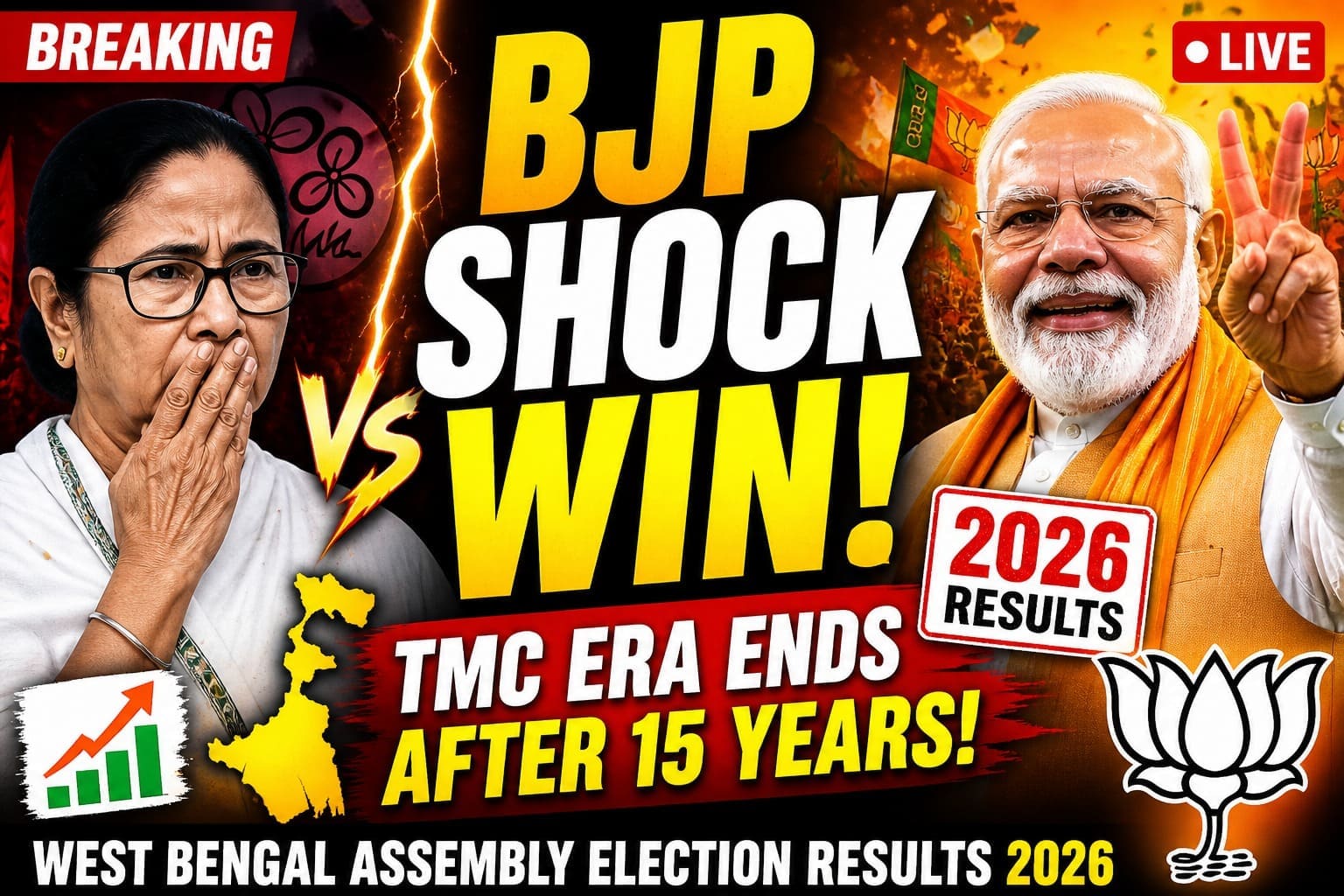
West Bengal Election Results 2026: Historic BJP Victory Ends TMC’s 15-Year Rule
The West Bengal election results 2026 have marked a watershed moment in the state’s political history. The Bharatiya Janata Party (BJP) secured a resounding victory, winning 206 seats in the 294-member assembly, comfortably surpassing the majority mark of 148 in the West Bengal election results 2026. The All India Trinamool Congress (AITC or TMC), led by Chief Minister Mamata Banerjee, was reduced to 81 seats, a significant decline from its 215 seats in 2021. Other parties, including the Indian National Congress (INC) with 2 seats, saw minimal success.
This outcome represents the first time the BJP has formed a government in West Bengal, a state long considered a stronghold of regional forces. With a record voter turnout of approximately 92.93%, the results reflect strong public participation and a clear mandate for change.
West Bengal election results 2026: Detailed Election Results and Seat Distribution
According to the Election Commission of India (ECI), the BJP not only crossed the majority threshold but also established dominance across various regions. The party made substantial gains in both rural and urban constituencies, consolidating support in North Bengal, parts of South Bengal, and traditionally challenging areas. TMC retained pockets of influence, particularly in certain minority-concentrated districts, but lost ground even in its core bastions.
Key highlights include:
- BJP’s Tally: 206 seats with a vote share of around 45.85%, up significantly from previous performances.
- TMC’s Performance: 81 seats with approximately 40.8% vote share.
- Other Parties: INC (2), AJUP (2), CPI(M) (1), and AISF (1). One seat (Falta) awaits repolling.
Notable individual results added to the drama. Mamata Banerjee lost her Bhabanipur seat to BJP leader Suvendu Adhikari, a prominent figure who had previously been with TMC. This defeat symbolized the broader shift. Several TMC cabinet ministers and sitting MLAs also faced defeat, underscoring widespread anti-incumbency.
The high turnout indicated voters’ eagerness to participate in shaping the state’s future, with polling conducted in two main phases on April 23 and 29, 2026.
Historical Context: From Left Front Dominance to TMC Era and Beyond
West Bengal’s politics have seen dramatic shifts. The Left Front ruled for over three decades until 2011, when Mamata Banerjee’s TMC, riding on anti-incumbency and movements like Singur and Nandigram, swept to power. TMC governed for 15 years, focusing on welfare schemes, women’s empowerment, and Bengali identity.
In 2021, TMC secured a strong mandate despite BJP’s improved showing (77 seats). However, by 2026, multiple factors converged to challenge TMC’s hold. The BJP’s consistent organizational efforts, starting from its expansion post-2014, laid the groundwork for this breakthrough.
Reasons for TMC’s Loss and BJP’s Victory in West Bengal Election Results 2026: A Balanced Analysis
The BJP’s victory can be attributed to a combination of strategic planning, effective campaigning, and voter sentiment. TMC’s defeat stemmed primarily from anti-incumbency after a long tenure, alongside governance challenges.
- Anti-Incumbency Wave: After 15 years in power, voter fatigue set in. Issues such as governance, employment opportunities, and perceptions of institutional credibility played a role. Many voters sought alternatives for development and change, leading to a shift even in TMC strongholds. High turnout reflected this desire for renewal.
- Organizational Strength and Campaign Strategy: The BJP invested heavily in grassroots mobilization. Leaders like Prime Minister Narendra Modi and Union Home Minister Amit Shah actively campaigned, emphasizing development, good governance, and national integration. The party’s focus on booth-level management, cadre building, and addressing local issues proved effective. Reports highlight strategic roles played by central leaders in coordinating the effort.
- Electoral Roll Revision (SIR): The Special Intensive Revision of electoral rolls was a major pre-poll exercise. It aimed at removing duplicate, deceased, or migrated entries, which the BJP supported as enhancing electoral integrity. This process, while controversial, appears to have influenced dynamics in key areas, contributing to a cleaner voter list and altered outcomes in some constituencies.
- Focus on Development and Aspirations: BJP’s narrative centered on job creation, industrial revival, infrastructure, and economic growth. Voters, especially youth and those affected by migration for work, responded to promises of better opportunities and reduced dependence on welfare alone. TMC’s extensive welfare schemes, while impactful, showed signs of diminishing returns amid demands for sustainable development.
- Identity, Security, and Regional Issues: Themes of Bengali pride, border security, and cultural preservation resonated differently across groups. BJP successfully consolidated support among various communities while addressing concerns over migration and security in border regions. TMC positioned itself as the defender of state autonomy and inclusive politics, but this did not fully counter the call for change.
- Leadership and Key Personalities: Suvendu Adhikari’s role as a prominent opposition voice strengthened BJP’s appeal. The party’s ability to project a united front and viable governance alternative contrasted with TMC’s internal dynamics in some perceptions.
These factors interacted to produce a decisive verdict. The results do not indicate a complete rejection of TMC’s past contributions, particularly in social welfare, but rather a preference for new leadership to tackle ongoing challenges like unemployment, education, and infrastructure.
Regional Variations and Key Takeaways
- North Bengal: Strong BJP performance, building on previous gains.
- South and Central Bengal: Mixed results, with BJP making deep inroads into TMC territories.
- Urban vs Rural: Urban areas showed interest in development agendas, while rural voters balanced welfare with aspirations for growth.
The vote share swing (BJP up ~8%, TMC down ~7%) highlights a clear polarization toward two major players, marginalizing smaller parties like Left and Congress further.
Implications for West Bengal and National Politics After West Bengal Election Results 2026
BJP’s win is expected to open avenues for greater central-state collaboration on projects, potentially boosting investment in industry, infrastructure, and employment generation. The new government will likely prioritize governance reforms, law and order, and economic revival while addressing the state’s diverse needs.
For TMC, this serves as a period of introspection and reorganization. Mamata Banerjee’s leadership remains influential, and the party may focus on strengthening its base for future contests.
Nationally, the result strengthens the BJP’s footprint in eastern India, demonstrating the party’s adaptability and appeal across diverse cultural landscapes. It underscores the dynamic nature of Indian federalism, where states continue to evolve politically.
Future Outlook After West Bengal Election Results 2026
As the BJP prepares to assume office, expectations are high for inclusive development respecting West Bengal’s unique ethos. Challenges include managing a diverse population, ensuring social harmony, and delivering on promises. The opposition TMC will play a crucial role in holding the government accountable.
The 2026 elections reaffirm democracy’s vibrancy in India. West Bengal, with its rich history and cultural depth, stands at the cusp of a new era. The mandate calls for focused governance aimed at prosperity, stability, and progress for all sections of society.
This historic shift, achieved through peaceful electoral processes, highlights the maturity of India’s democratic framework. Stakeholders across the spectrum will watch closely as the new administration charts the state’s course.
Disclaimer:
This article is based on publicly available information, official statements, and media reports available at the time of publication. The content is intended for informational purposes only and should not be considered financial or policy advice. Readers are encouraged to refer to official sources for the latest updates.
The content is solely for educational and informational purposes. Whether it is global news, indian news, political news or any other sort of content, we do not independently verify the content or claims.
While efforts have been made to ensure accuracy, the information presented may change as new developments emerge. Readers are advised to conduct their own research and consult financial advisors before making any investment decisions.
NoCap Times does not independently verify all claims or statements and shall not be held responsible for any inaccuracies or omissions.
Stay updated with the latest and breaking news on NoCap Times. Get the latest India News, World News, Business News, Sports News, Viral News and Research Articles for various competitive Exams & UPSC Aspirants.