

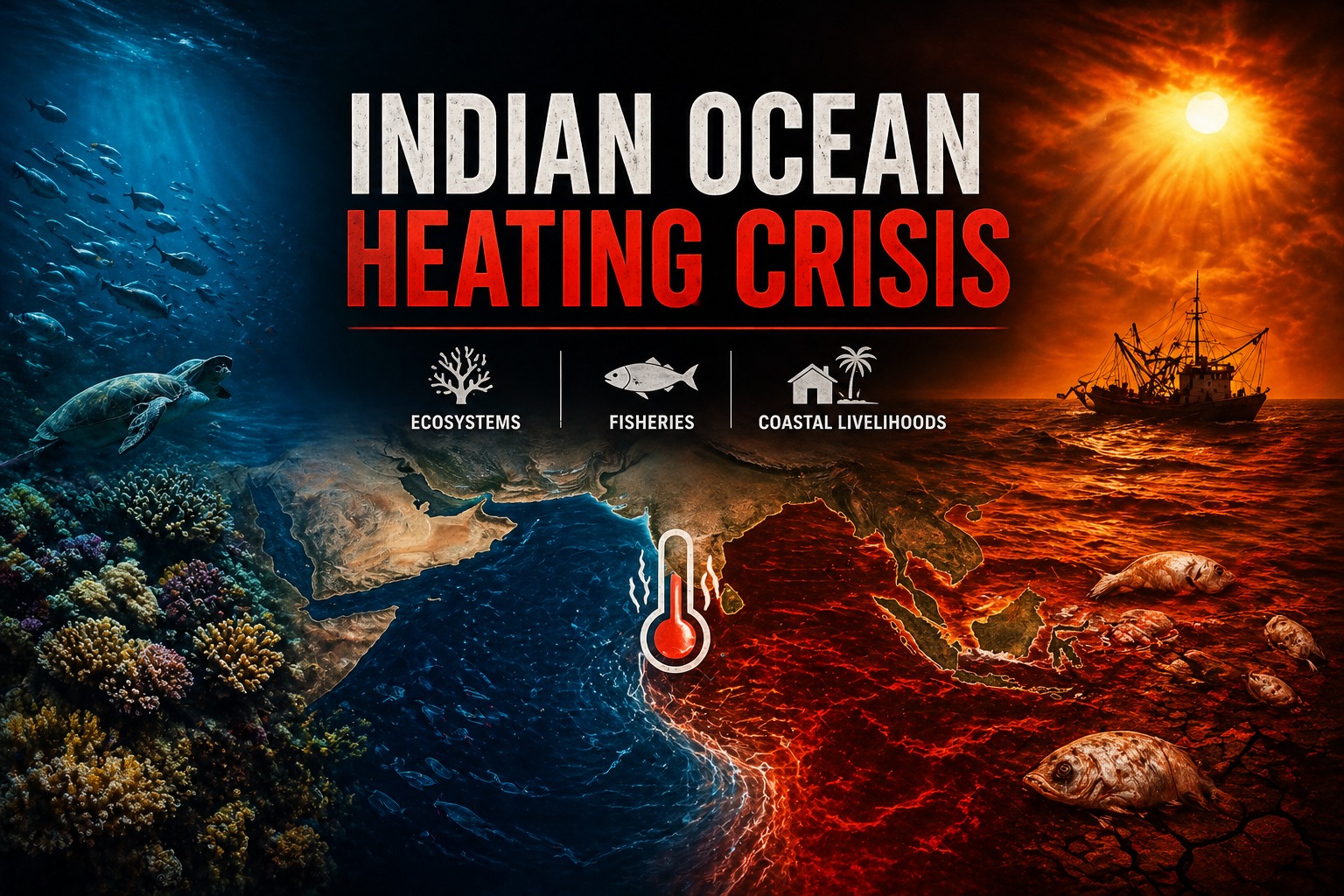
Indian Ocean Heating Crisis: Marine Heatwaves Threaten Ecosystems, Fisheries, and Coastal Livelihoods
The Indian Ocean is witnessing an alarming rise in temperatures, pushing its delicate marine ecosystems toward a dangerous tipping point. Scientists and climate monitoring agencies have raised serious concerns over intensifying marine heatwaves and persistently high sea surface temperatures across critical regions such as the Arabian Sea and the Bay of Bengal. These changes are not short-term anomalies but part of a broader, long-term climate trend driven by global warming.
As ocean temperatures climb beyond ecologically safe limits, the consequences are cascading across marine biodiversity, fisheries, coral reef systems, and millions of people whose livelihoods depend on coastal ecosystems. The Indian Ocean, often considered a vital climate regulator, is now becoming a hotspot of environmental stress.
Rising Marine Heatwaves Signal a Dangerous Trend
Marine heatwaves—periods of unusually high ocean temperatures lasting days to months—are becoming more frequent, intense, and widespread in the Indian Ocean. Scientific observations indicate that large sections of the ocean are experiencing prolonged thermal stress, disrupting natural oceanic processes.
One of the key drivers behind this phenomenon is the increasing concentration of greenhouse gases, which trap heat in the Earth’s atmosphere. Oceans absorb over 90% of this excess heat, making them highly vulnerable to temperature fluctuations. As a result, the upper layers of the Indian Ocean are warming rapidly, creating an imbalance that threatens marine life.
These heatwaves are particularly harmful to microscopic marine organisms like phytoplankton and microalgae, which form the foundation of the oceanic food chain. When these organisms are affected, the entire marine ecosystem—from small fish to large predators—faces disruption.
Coral Reefs Under Severe Stress and Bleaching Events
Among the most visible and devastating impacts of ocean warming is the widespread bleaching of coral reefs. Coral ecosystems, often referred to as the “rainforests of the sea,” are extremely sensitive to temperature changes. Even a slight increase in water temperature can trigger coral bleaching, a process in which corals expel the symbiotic algae that provide them with food and vibrant color.
Regions across the Indo-Pacific, including areas within the Indian Ocean, have already experienced repeated bleaching events. Continuous exposure to elevated temperatures reduces the ability of corals to recover, leading to large-scale coral mortality.
The degradation of coral reefs has far-reaching consequences. Not only do these ecosystems support immense marine biodiversity, but they also act as natural barriers that protect coastlines from storm surges, erosion, and extreme weather events. Their decline increases the vulnerability of coastal communities to climate-related disasters.
Declining Fish Stocks and Shifting Marine Life Patterns
The warming waters of the Indian Ocean are also altering the behavior, distribution, and survival of fish populations. Fish species are highly sensitive to temperature changes and often migrate toward cooler or deeper waters to maintain optimal living conditions.
This shift in fish distribution is creating significant challenges for fishing communities, particularly in countries like India, Sri Lanka, Bangladesh, and Indonesia. Traditional fishing zones are becoming less productive, forcing fishermen to travel farther into deeper and more dangerous waters.
Longer fishing trips not only increase operational costs—such as fuel and labor—but also expose fishermen to greater physical risks. Many small-scale fishermen lack the resources to adapt to these changes, resulting in declining incomes and increased economic hardship.
Additionally, the reduction in fish stocks disrupts food security, especially in coastal regions where seafood is a primary source of protein. The ripple effects extend beyond fishermen to entire supply chains, including local markets and export industries.
Deoxygenation and Disrupted Marine Food Chains
Another critical consequence of rising ocean temperatures is deoxygenation—the reduction of oxygen levels in seawater. Warmer water holds less dissolved oxygen, creating stressful conditions for marine organisms that rely on oxygen to survive.
This phenomenon leads to the formation of “dead zones,” where oxygen levels are too low to support most marine life. Fish and other species either migrate away or perish, further reducing biodiversity.
At the same time, warming disrupts the natural mixing of ocean layers, limiting the upward flow of nutrients from deeper waters. This reduces the growth of phytoplankton, which are essential for maintaining the marine food web. A decline in these primary producers can destabilize the entire ecosystem, affecting species at every level.
Broader Ecological Imbalance in the Indian Ocean
The Indian Ocean is undergoing structural changes that extend beyond individual species or ecosystems. Scientists have observed a steady increase in the frequency and duration of marine heatwaves globally, with the Indian Ocean emerging as one of the most affected regions.
These changes are altering ocean circulation patterns, nutrient distribution, and biological productivity. The long-term implications include reduced marine biodiversity, altered migration patterns, and increased vulnerability to invasive species.
Furthermore, the warming of ocean waters contributes to rising sea levels through thermal expansion. This adds another layer of risk for low-lying coastal areas, increasing the likelihood of flooding and habitat loss.
Impact on Coastal Communities and Livelihoods
Millions of people living along the Indian Ocean coastline depend directly on marine resources for their livelihoods. From fishing and aquaculture to tourism and coastal trade, these communities are highly vulnerable to changes in ocean conditions.
The decline in fish stocks, degradation of coral reefs, and increased frequency of extreme weather events are already affecting incomes and living standards. In many regions, fishermen are forced to work longer hours under more hazardous conditions, often with diminishing returns.
Tourism industries, particularly those centered around coral reefs and marine biodiversity, are also at risk. Coral bleaching and ecosystem degradation reduce the attractiveness of these destinations, leading to economic losses.
In addition, coastal populations face heightened risks from storms, cyclones, and coastal erosion, as natural protective barriers like coral reefs weaken. This creates a pressing need for climate adaptation strategies and sustainable resource management.
Monitoring Systems and Early Warning Mechanisms
Recognizing the severity of the situation, organizations like the Indian National Centre for Ocean Information Services, under the Ministry of Environment, Forest and Climate Change, are actively monitoring ocean conditions.
These agencies use advanced satellite data and oceanographic models to track sea surface temperatures, detect marine heatwaves, and issue early warnings for coral bleaching and marine stress events. Such systems play a crucial role in helping governments, researchers, and communities prepare for potential impacts.
However, experts emphasize that monitoring alone is not sufficient. Without meaningful action to reduce greenhouse gas emissions and protect marine ecosystems, the situation is likely to worsen.
The Indian Ocean as a Climate Indicator
The current state of the Indian Ocean serves as a powerful indicator of global climate change. Oceans act as heat sinks, absorbing excess energy from the atmosphere. When ocean temperatures rise significantly, it signals a broader imbalance in the Earth’s climate system.
The rapid warming of the Indian Ocean highlights the urgency of addressing climate change at both global and regional levels. It underscores the need for coordinated efforts to reduce carbon emissions, promote sustainable fishing practices, and conserve marine habitats.
The Way Forward: Urgent Need for Climate Action
Addressing the Indian Ocean heating crisis requires a multi-pronged approach. Governments, international organizations, and local communities must work together to implement effective solutions.
Key measures include:
- Reducing greenhouse gas emissions through cleaner energy sources
- Strengthening marine conservation efforts and protecting coral reefs
- Promoting sustainable fishing practices to prevent overexploitation
- Investing in climate-resilient infrastructure for coastal areas
- Enhancing research and data collection to better understand ocean dynamics
Public awareness and community participation are equally important. Empowering local populations with knowledge and resources can help build resilience and support long-term sustainability.
Conclusion: A Critical Turning Point
The Indian Ocean is at a critical juncture. Rising temperatures, marine heatwaves, and ecological disruptions are pushing the region toward an uncertain future. The impacts are not limited to marine life—they extend to millions of people who depend on the ocean for survival.
If current trends continue unchecked, the consequences could be irreversible. However, with timely intervention, scientific innovation, and global cooperation, it is still possible to mitigate the damage and restore balance.
The message from scientists is clear: the time to act is now. The fate of the Indian Ocean—and the communities it supports—depends on the choices made today.
Disclaimer:
This article is based on publicly available information, official statements, and media reports available at the time of publication. The content is intended for informational purposes only and should not be considered financial or policy advice. Readers are encouraged to refer to official sources for the latest updates.
The content is solely for educational and informational purposes. Whether it is global news, indian news, political news or any other sort of content, we do not independently verify the content or claims.
While efforts have been made to ensure accuracy, the information presented may change as new developments emerge. Readers are advised to conduct their own research and consult financial advisors before making any investment decisions.
NoCap Times does not independently verify all claims or statements and shall not be held responsible for any inaccuracies or omissions.
Stay updated with the latest and breaking news on NoCap Times. Get the latest India News, World News, Business News, Sports News, Viral News and Research Articles for various competitive Exams & UPSC Aspirants.