

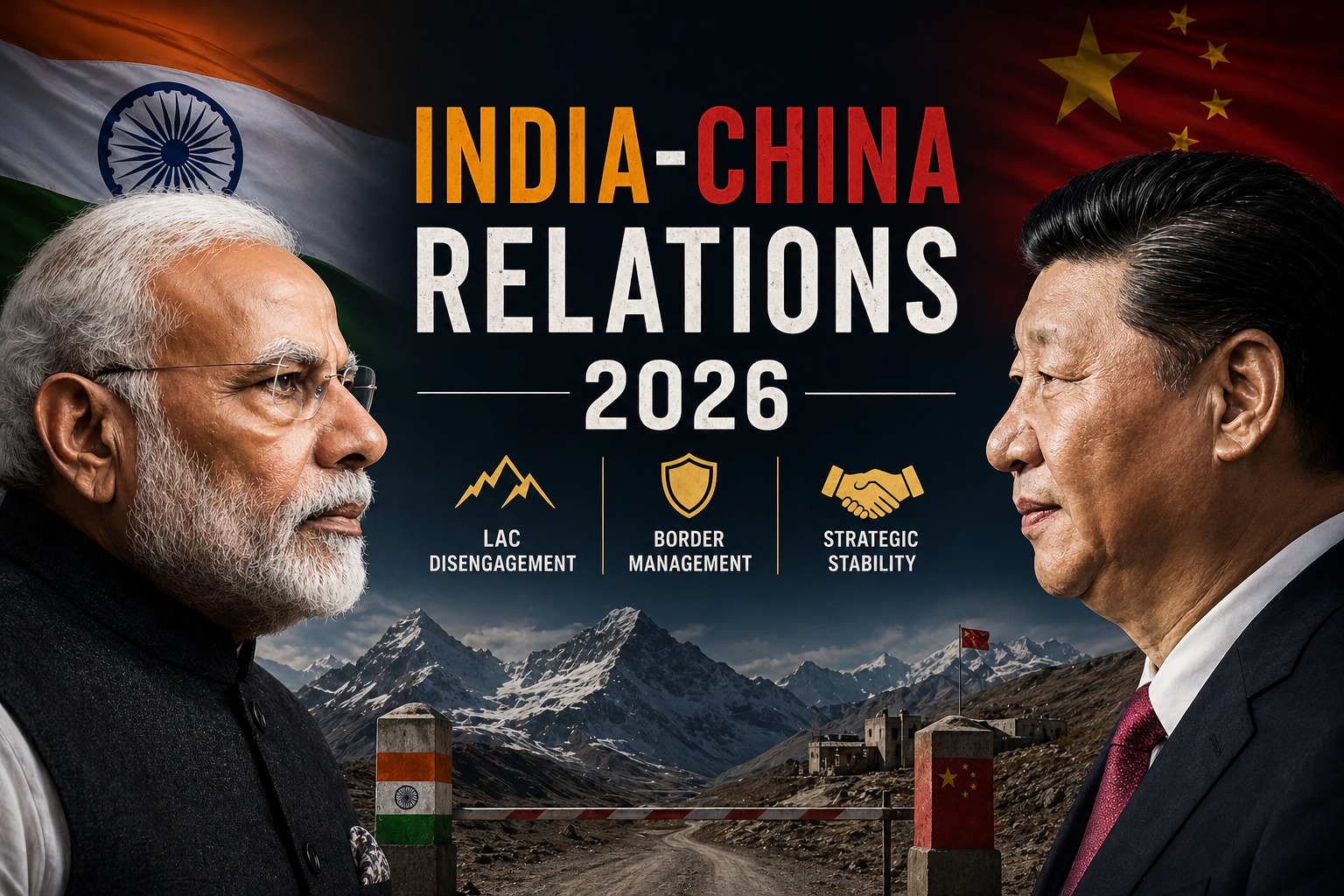
India-China Relations 2026: LAC Disengagement, Border Management, and the Road to Strategic Stability – A Comprehensive Analysis
Introduction: India-China Relations From Galwan to Fragile Normalisation
In the complex tapestry of 21st-century geopolitics, India-China relations in 2026 stand as a critical case study of rivalry tempered by pragmatism. The relationship between Asia’s two largest nations remains defined by deep structural contradictions: territorial disputes along the Line of Actual Control (LAC), competing visions for the Indo-Pacific, economic interdependence, and differing approaches to global governance. Yet, since the breakthrough patrolling agreement of October 2024 and the subsequent disengagement at Depsang and Demchok friction points, both sides have cautiously moved towards a phase of tactical stabilisation and diplomatic re-engagement.
As of April 29, 2026, Defence Minister Rajnath Singh’s meeting with his Chinese counterpart Admiral Dong Jun on the sidelines of the SCO Defence Ministers’ meeting in Bishkek highlighted the continued emphasis on maintaining peace and tranquillity along the LAC. This interaction underscores New Delhi’s consistent position: sustained border stability remains the essential precondition for broader normalisation of bilateral ties.
India-China relations 2026 exemplifies concepts such as multi-alignment versus strategic autonomy, the interplay between territorial disputes and economic engagement, the limits of confidence-building measures (CBMs), power asymmetry in bilateral relations, and the challenges of managing a “rival-partner” dynamic in a multipolar world. This comprehensive analysis adopts a diplomatic lens to examine historical context, the 2020 Galwan-triggered crisis and its resolution process, current border management mechanisms, economic and strategic dimensions, persistent challenges, and the long and uncertain road toward strategic stability.
Historical Evolution: India-China Relations From Hindi-Chini Bhai-Bhai to Strategic Rivalry
India-China Relations till 1962: India-China relations have oscillated between hope and hostility since the establishment of diplomatic ties in 1950. The early years were marked by ideological solidarity and the famous slogan “Hindi-Chini Bhai-Bhai.” The 1954 Agreement on Trade and Intercourse with Tibet laid the foundation for the Panchsheel (Five Principles of Peaceful Coexistence). However, differing interpretations of the Himalayan boundary, the 1959 Tibetan uprising, and the forward policy adopted by both sides culminated in the 1962 border war—a traumatic event that continues to shape Indian strategic thinking.
India-China Relations Post 1962: The post-1962 period saw decades of frozen relations until the 1988 visit of Prime Minister Rajiv Gandhi to China, which resumed high-level dialogue and established the Joint Working Group on the boundary question. The 1993 Agreement on Maintenance of Peace and Tranquillity along the LAC, followed by the 1996 Confidence Building Measures Agreement, introduced important military CBMs, including restrictions on troop deployments and notification of military exercises near the border.
India-China Relations in the Early 2000s: The early 2000s witnessed economic engagement accelerating alongside political dialogue. Bilateral trade grew exponentially from less than $3 billion in 2000 to over $130 billion by 2024 (with a massive deficit in India’s favour for China). The Special Representatives mechanism, established in 2003, was tasked with exploring a framework for boundary settlement. Yet, underlying tensions persisted due to China’s growing assertiveness, infrastructure build-up in Tibet and Xinjiang, and the strategic encirclement concerns manifested through the China-Pakistan Economic Corridor (CPEC) passing through Gilgit-Baltistan.
The watershed moment arrived in April-May 2020 when Chinese troops intruded into multiple friction points in eastern Ladakh, leading to the deadly Galwan Valley clash on June 15, 2020—the first fatal border incident in 45 years. This event fundamentally altered the trajectory of bilateral relations, prompting India to impose economic countermeasures, strengthen Quad engagement, and accelerate infrastructure development along the LAC.
India-China Relations: The 2020–2024 Standoff and the Path to Disengagement
The 2020 crisis saw both armies mobilise nearly 50,000–60,000 troops each in forward deployments across eastern Ladakh. Multiple friction points emerged: Galwan, Pangong Tso (Finger area), Hot Springs, Gogra, Demchok, and Depsang Plains. India responded with a firm “mirror deployment” strategy, rapid infrastructure push under the Border Roads Organisation, and diplomatic insistence that peace and tranquillity on the border were prerequisites for normal bilateral relations.
Between 2020 and 2024, 21 rounds of Corps Commander-level talks were held, resulting in partial disengagements at several points by 2022. However, Depsang and Demchok remained major sticking points, where Chinese forces had blocked Indian patrolling to traditional areas.
The breakthrough came in October 2024 with an agreement on patrolling arrangements along the LAC in eastern Ladakh. This pact enabled resumption of patrolling as per pre-2020 patterns in Depsang (PP10 to PP13) and Demchok areas. Disengagement of troops and equipment from these last remaining friction points was completed in subsequent weeks, paving the way for the Modi-Xi meeting on the sidelines of the BRICS Summit in Kazan. This development marked the completion of the disengagement process that had begun after Galwan.
In 2025, further diplomatic momentum was visible through the resumption of Special Representatives talks, restoration of direct flights, and limited easing of people-to-people contacts. By early 2026, both sides continued to emphasise the need for sustained peace along the border during high-level interactions, including the February 2026 Strategic Dialogue between Foreign Secretary Vikram Misri and his Chinese counterpart.
As of April 2026, while disengagement at friction points has been achieved, full de-escalation and reduction of forward troop deployments to pre-2020 levels have not occurred. Both armies maintain significant presence in depth areas, reflecting a new normal of heightened vigilance.
Border Management Mechanisms: Progress and Limitations
India and China have developed a layered architecture for border management:
- Corps Commander-level talks: The primary military channel for resolving ground-level issues (23+ rounds held till late 2025).
- Special Representatives Dialogue: Led by NSA Ajit Doval and the Chinese counterpart for exploring overall boundary settlement.
- Working Mechanism for Consultation and Coordination (WMCC): Diplomatic channel for day-to-day management.
- Border Defence Cooperation Agreement (2013): Provides guidelines for handling face-offs.
The October 2024 patrolling agreement introduced practical arrangements such as coordinated patrolling, limits on personnel strength during patrols, and regular commander-level meetings to prevent misunderstandings. These measures represent tactical stabilisation but fall short of a comprehensive border settlement or mutual demarcation of the LAC.
India continues to stress that restoration of normalcy requires verifiable de-escalation, removal of temporary structures, and return to the pre-April 2020 status quo. China, on the other hand, appears inclined towards managing the dispute rather than resolving it, while pushing for broader economic and diplomatic normalisation.
Economic Dimension: Interdependence Amid Strategic Caution
Bilateral trade remains substantial despite the 2020 downturn, though India maintains a large deficit. Key Indian exports include iron ore, pharmaceuticals, and agricultural products, while imports are dominated by electronics, machinery, chemicals, and consumer goods. Post-2020, India tightened scrutiny on Chinese FDI through Press Note 3 and promoted production-linked incentive (PLI) schemes to reduce import dependence in critical sectors.
In March 2026, India made calibrated adjustments to FDI norms for land-border countries, allowing automatic route in select cases with low ownership thresholds. This reflects pragmatic economic recalibration without compromising security concerns. Meanwhile, both nations explore cooperation in areas like renewable energy and global supply chains, even as India diversifies away from excessive reliance on Chinese manufacturing.
Strategic and Multilateral Context
India-China relations in 2026 cannot be viewed in isolation. The relationship is shaped by broader geopolitical currents:
- India’s deepening engagement with the Quad, US, Japan, Australia, and Europe as part of its Indo-Pacific strategy.
- China’s expanding influence through Belt and Road Initiative (BRI), though India remains firmly opposed to CPEC.
- Divergent positions on global issues such as UNSC reforms, climate change responsibilities, and WTO rules.
- Regional dynamics in South Asia, where China’s growing footprint in India’s neighbourhood raises concerns.
India has consistently pursued multi-alignment—engaging China where possible while strengthening partnerships that enhance its strategic space. The cautious re-engagement since late 2024 demonstrates strategic maturity: avoiding escalation while refusing to compromise core interests.
Challenges on the Road to Strategic Stability
Several formidable challenges persist in 2026:
- Trust Deficit: The Galwan incident and subsequent standoff have deeply eroded mutual confidence. India views Chinese actions as part of a broader pattern of salami-slicing and grey-zone tactics.
- Asymmetric Power Dynamics: China’s economic and military superiority creates structural imbalance, making equitable negotiations difficult.
- Differing Perceptions of the LAC: Both sides have varying interpretations of the alignment, complicating any final settlement.
- Infrastructure Race: Continued build-up of roads, bridges, villages, and dual-use facilities on both sides sustains tension.
- Third-Party Factors: Pakistan, the US-China rivalry, and developments in the Indian Ocean Region influence bilateral equations.
- Domestic Politics: Nationalist sentiments in both countries limit flexibility for compromise.
Analysts describe the current phase as “tactical de-escalation” rather than genuine strategic reconciliation. While disengagement has reduced the immediate risk of accidental clashes, the absence of full de-escalation and a binding boundary agreement means the potential for flare-ups remains.
The Long Road to Strategic Stability: Realistic Expectations
Achieving strategic stability in India-China relations requires a multi-decade effort. Short-term priorities include:
- Strict adherence to patrolling agreements and existing CBMs.
- Gradual de-escalation of forward deployments.
- Resumption of regular high-level political dialogue.
- Expansion of cooperation in non-contentious areas such as climate change, global health, and multilateral trade reform.
Long-term stability would necessitate a political understanding on the boundary, possibly based on mutual and equal security, as envisaged in earlier agreements. However, given the strategic competition and China’s reluctance to accept a settlement that freezes the status quo in a manner favourable to India, a comprehensive resolution appears distant.
India’s approach in 2026 continues to rest on three pillars: deterrence through military modernisation and infrastructure development, diplomacy to manage differences, and diversification of economic and strategic partnerships. This calibrated strategy aims to safeguard sovereignty while preventing the border issue from derailing India’s broader developmental goals.
UPSC Relevance and Analytical Takeaways
For Civil Services aspirants, this relationship offers multiple high-yield insights:
- Realism vs Idealism in foreign policy: Shift from Panchsheel optimism to pragmatic power management.
- Border Management: Evolution and effectiveness of CBMs in disputed frontiers.
- Economic Security: Balancing trade with strategic concerns (Atmanirbhar Bharat, supply chain resilience).
- Multi-alignment: How India navigates relations with both China and the US-led groupings.
- Grey-zone Warfare: Understanding non-kinetic tools of coercion.
- PYQ Linkages: Questions on India’s neighbourhood policy, Indo-Pacific strategy, and challenges to strategic autonomy frequently feature elements of the India-China dynamic.
Aspirants should focus on comparing India’s approach with other major powers’ handling of China, evaluating the costs and benefits of disengagement agreements, and analysing the implications for regional stability.
Conclusion: Cautious Engagement in an Era of Strategic Competition
India-China relations in 2026 reflect a delicate balance between necessary engagement and enduring strategic suspicion. The completion of disengagement at Depsang and Demchok, renewed diplomatic channels, and emphasis on LAC peace represent important tactical gains. However, the road to genuine strategic stability remains long, arduous, and contingent on verifiable behavioural change, mutual respect for core interests, and sustained peace along the border.
As both nations pursue their respective visions of national rejuvenation—Viksit Bharat for India and the “Chinese Dream” for China—the management of their complex relationship will significantly influence the future Asian security architecture. For India, the guiding principle remains clear: peace on the border is non-negotiable, and any normalisation must be based on equality, mutual sensitivity, and respect for sovereignty.
In the words of seasoned diplomacy, managing rivalry with a neighbour of China’s stature demands strategic patience, military preparedness, and diplomatic dexterity. As of April 2026, India appears committed to this nuanced path—engaging where possible, deterring where necessary, and always safeguarding its long-term national interests.
Disclaimer:
This article is based on publicly available information, official statements, and media reports available at the time of publication. The content is intended for informational purposes only and should not be considered financial or policy advice. Readers are encouraged to refer to official sources for the latest updates.
The content is solely for educational and informational purposes. Whether it is global news, indian news, political news or any other sort of content, we do not independently verify the content or claims.
While efforts have been made to ensure accuracy, the information presented may change as new developments emerge. Readers are advised to conduct their own research and consult financial advisors before making any investment decisions.
NoCap Times does not independently verify all claims or statements and shall not be held responsible for any inaccuracies or omissions.
Stay updated with the latest and breaking news on NoCap Times. Get the latest India News, World News, Business News, Sports News, Viral News and Research Articles for various competitive Exams & UPSC Aspirants.