
India-US Relations in 2026: Strategic Partnership, Technology Cooperation, and Challenges of Strategic Autonomy – A Comprehensive Analysis
Introduction: India-US Relations- A Partnership Defined by Convergence and Contradictions
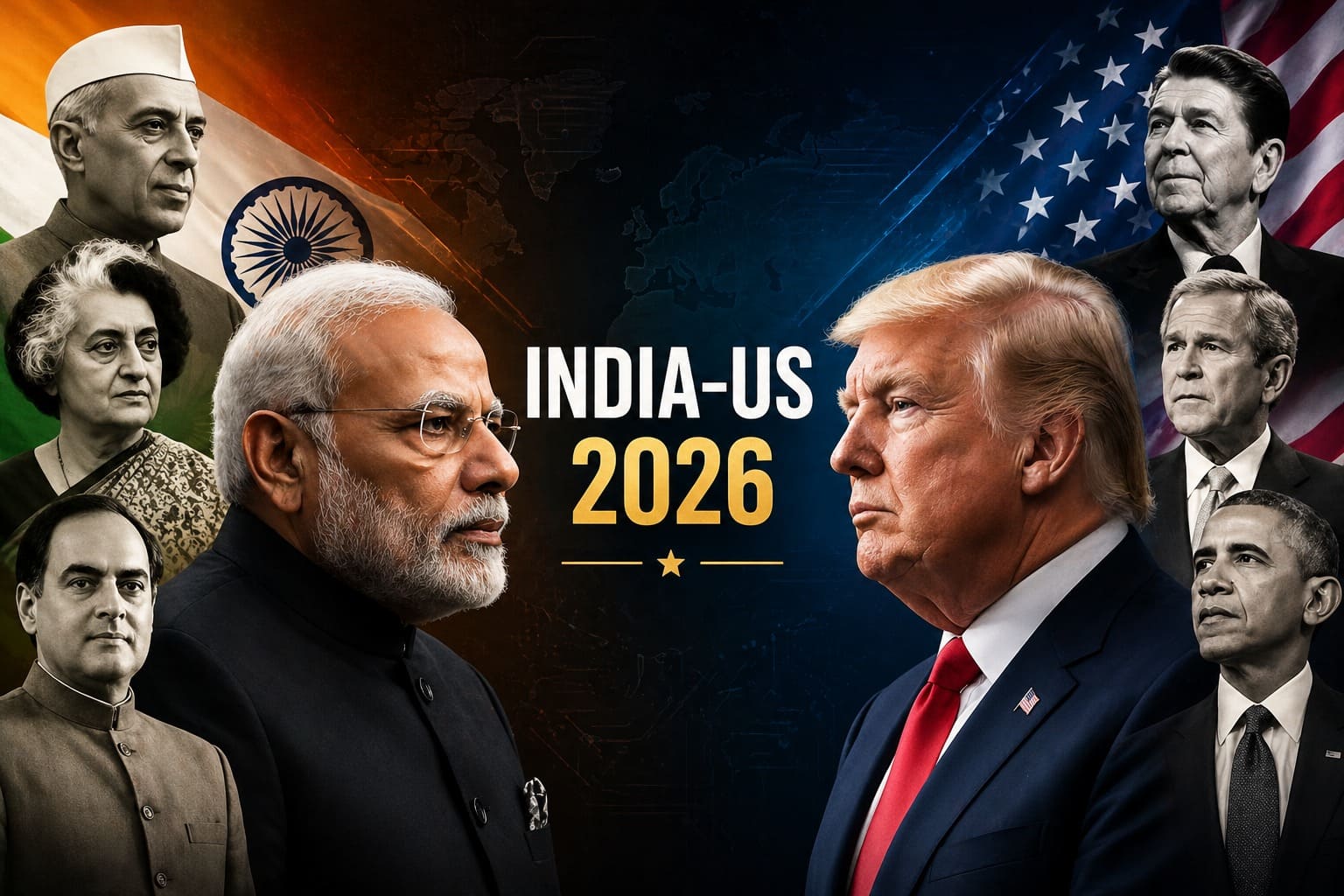
In the evolving landscape of global geopolitics, India-US relations in 2026 represent one of the most consequential bilateral relationships of the 21st century. Characterised by deepening strategic convergence in defence, critical and emerging technologies, and Indo-Pacific security, the partnership simultaneously grapples with persistent tensions over trade imbalances, energy choices, and India’s cherished principle of strategic autonomy.
As of April 2026, the partnership has witnessed a pragmatic reset through an interim trade agreement in February 2026, continued momentum in the TRUST initiative (the evolved form of iCET), and a new 10-year Framework for the U.S.-India Major Defense Partnership. Yet, underlying frictions—ranging from tariffs linked to Russian oil imports to differing visions on global governance—underscore the transactional nature of ties under the second Trump administration.
This article provides a diplomat’s perspective: tracing historical evolution, dissecting key pillars (defence, technology, trade, and multilateral cooperation), examining recent 2025–2026 developments, analysing challenges to India’s strategic autonomy, and outlining future trajectories with clear takeaways for civil services preparation.
Historical Evolution: From Estrangement to Comprehensive Global Strategic Partnership
India-US relations have traversed a complex trajectory marked by ideological divergences during the Cold War, nuclear sanctions post-1998, and gradual convergence since the early 2000s.
The early decades were defined by mistrust. India’s non-aligned policy, close ties with the Soviet Union, and the 1971 Indo-Soviet Treaty contrasted sharply with US support for Pakistan. The 1998 Pokhran nuclear tests triggered comprehensive sanctions under the Glenn Amendment, further straining ties.
A turning point arrived with the Next Steps in Strategic Partnership (NSSP) in 2004 and the landmark Civil Nuclear Agreement of 2008, which ended India’s nuclear isolation and signalled US recognition of India as a responsible nuclear power. Subsequent milestones included the signing of foundational defence agreements: LEMOA (2016) for logistics exchange, COMCASA (2018) for communications compatibility, and BECA (2020) for geospatial intelligence sharing. These pacts transformed India into a Major Defence Partner of the United States.
The elevation to a Comprehensive Global Strategic Partnership under successive administrations reflected shared concerns over China’s assertiveness in the Indo-Pacific. The revival of the Quadrilateral Security Dialogue (Quad) in 2017, alongside initiatives like the Indo-Pacific Oceans Initiative and Supply Chain Resilience, institutionalised this convergence. By 2026, bilateral trade exceeds $240 billion, with ambitions to reach $500 billion, while defence cooperation has moved from buyer-seller dynamics to co-development and co-production.
For UPSC, this evolution illustrates key concepts: shift from idealism to pragmatism in Indian foreign policy, the role of economic liberalisation (1991) and nuclear diplomacy in reshaping great-power equations, and the centrality of the China factor in contemporary alignments.
Defence and Security Cooperation: From Interoperability to Industrial Partnership
Defence remains the strongest pillar of India-US relations in 2026. The Framework for the U.S.-India Major Defence Partnership (signed in late 2025 for the period up to 2035) provides a unified vision for the next decade, focusing on interoperability across land, sea, air, space, and cyber domains, joint exercises, intelligence sharing, and defence industrial cooperation.
Key elements include:
- Expansion of joint military exercises: Yudh Abhyas (Army), Malabar (Navy), Cope India (Air Force), and tri-service Tiger Triumph.
- Major platforms in the Indian inventory: C-17 Globemaster, P-8I Poseidon, AH-64E Apache, CH-47 Chinook, MQ-9B drones, and M777 howitzers.
- Progress on co-production: Discussions on Javelin anti-tank missiles, Stryker vehicles, and potential GE-HAL F414 jet engine manufacturing in India.
- Institutional mechanisms: The India-US Defense Acceleration Ecosystem (INDUS-X) and Defense Technology and Trade Initiative (DTTI) facilitate private sector collaboration and technology transfer.
In early 2026, high-level visits—including US Secretary of the Army Dan Driscoll and INDOPACOM Commander Admiral John Paparo—underscored operational coordination, particularly in the Indian Ocean Region. India’s participation as an Associate Partner in the Combined Maritime Force (CMF) further aligns maritime security efforts.
This cooperation enhances India’s defence modernisation under Atmanirbhar Bharat while allowing the US to diversify supply chains away from China. However, delays in deals like additional P-8I aircraft and ITAR relaxations highlight bureaucratic and regulatory hurdles.
Technology Cooperation: The TRUST Initiative and Critical Emerging Technologies
Technology has emerged as the most dynamic frontier in India-US relations 2026. The Initiative on Critical and Emerging Technology (iCET, 2023) evolved into the TRUST (Transforming the Relationship Utilizing Strategic Technology) framework during PM Modi’s February 2025 visit to Washington. TRUST encompasses AI, semiconductors, quantum computing, biotechnology, energy, and space, with strong emphasis on defence applications and trusted supply chains.
Notable advancements include:
- Semiconductor ecosystem: Micron’s assembly and test facility in Gujarat and broader India Semiconductor Mission collaborations.
- AI infrastructure roadmap and joint efforts under the Pax Silica declaration for secure AI supply chains.
- Quantum and biotech partnerships aimed at resilient pharmaceutical supply chains.
- Joint Technical Group (JTG) meetings hosted by DRDO in February 2026 focusing on defence science and innovation.
These initiatives align with India’s goals of technological self-reliance and the US strategy of “friendshoring” critical technologies. The COMPACT (Catalyzing Opportunities for Military Partnership, Accelerated Commerce & Technology) initiative, launched alongside the defence framework, seeks results-driven outcomes in these domains.
For aspirants, this dimension highlights techno-nationalism, the weaponisation of technology in great-power competition, and India’s positioning as a bridge between Global South developmental needs and advanced Western innovation ecosystems.
Trade and Economic Ties: The 2026 Interim Agreement and Lingering Frictions
Economic relations have seen both breakthroughs and turbulence. Bilateral trade crossed $240 billion, with the US as India’s largest trading partner. In February 2026, the two sides announced an interim trade agreement that reduced US tariffs on Indian goods from 50% (imposed earlier over Russian oil imports) to 18%, while India committed to purchasing approximately $500 billion worth of US goods and services over five years, with focus on energy, agriculture, semiconductors, and critical minerals. The deal also involved India agreeing to wind down Russian oil purchases as part of energy diversification.
This pragmatic reset resolved immediate tariff tensions and opened pathways for a fuller Bilateral Trade Agreement (BTA). Ongoing talks in April 2026, including Foreign Secretary Vikram Misri’s Washington visit, emphasised market access, non-tariff barriers, and supply chain resilience.
Challenges persist: US demands for greater access to Indian dairy, pulses, and digital markets clash with India’s protective stance on sensitive sectors. Intellectual property concerns, data localisation norms, and H-1B visa issues add layers of complexity. The interim deal reflects the transactional style of the current US administration, where trade concessions are explicitly linked to geopolitical behaviour (e.g., energy sourcing).
Multilateral Cooperation and the Indo-Pacific: The Quad and Beyond
The Quad remains a key platform, though leader-level summits have faced delays, with India (as rotating chair) yet to host one in 2025–2026 amid differing priorities. Functional cooperation continues in vaccines, infrastructure, maritime domain awareness, and critical technologies. India balances Quad engagement with its broader multi-alignment strategy, including active participation in BRICS, SCO, and G20.
Other formats like I2U2 (India-Israel-UAE-US) and the India-Middle East-Europe Economic Corridor (IMEC) demonstrate India’s bridging role. Convergence on a free, open, and inclusive Indo-Pacific persists, but differing threat perceptions and US transactionalism test cohesion.
Challenges of Strategic Autonomy: Hedging in a Transactional Era
India’s strategic autonomy—the ability to pursue independent foreign policy without formal alliances—faces its most significant test in 2026. Key pressure points include:
- Energy Security vs Sanctions: US pressure to curtail Russian oil imports (a lifeline for affordable energy) led to tariff hikes and subsequent negotiations. India has diversified sourcing but resists abrupt shifts that compromise economic stability.
- CAATSA and Secondary Sanctions: Potential application against defence or energy deals with Russia or Iran.
- Transactional Diplomacy: Linkage of trade relief to geopolitical concessions raises questions about the reliability of the partnership.
- Divergences on Global Issues: Differing approaches to climate finance, WTO reforms, and multilateralism (US scepticism of certain institutions vs India’s push for Global South representation).
Despite these, New Delhi has demonstrated hedging: maintaining dialogue with Russia and China while deepening Western ties. The February 2026 trade reset and continued high-level engagements (including US Ambassador Sergio Gor’s outreach) suggest pragmatic management rather than rupture. Analysts note that India continues strategic hedging as a cornerstone, avoiding over-dependence on any single power.
This balancing act exemplifies “multi-alignment” — a concept frequently tested in UPSC — where India engages multiple poles without exclusive commitments.
Key Takeaways
India-US relations in 2026 offer multiple insights:
- Continuity and Change: Personal chemistry (Modi-Trump) coexists with institutional depth (foundational agreements, 50+ dialogue mechanisms).
- Economics of Strategy: Trade and technology as instruments of geopolitical influence.
- Strategic Autonomy in Practice: How India navigates great-power competition without formal alliances.
- Indo-Pacific as Theatre: Role of minilaterals like Quad in shaping regional order.
- PYQ Linkages: Questions on bilateral relations, emerging technologies, defence indigenisation, and challenges to non-alignment/multi-alignment.
Comparative analysis with other partnerships (India-Russia, India-China, India-France) reveals India’s calibrated approach.
The Road Ahead: Towards a Mature, Resilient Partnership
As of late April 2026, India-US relations stand at a crossroads of opportunity and caution. The interim trade deal, TRUST framework, and defence partnership framework provide a solid foundation for deeper industrial and technological integration. Realisation of the $500 billion trade ambition, successful co-production projects, and sustained Quad functionality could elevate ties to a new level.
Challenges related to strategic autonomy will persist, requiring deft diplomacy that safeguards core interests while capitalising on complementarities. For India, the goal remains a partnership of equals that accelerates its rise as a leading power without compromising policy independence.
In an era defined by geopolitical flux, supply chain vulnerabilities, and technological disruption, a stable, high-trust India-US relationship serves mutual interests and contributes to global stability. Sustained high-level engagement, private sector involvement, and focus on deliverables over declarations will determine whether this partnership realises its full potential.
Conclusion
India-US relations in 2026 embody the complexities of contemporary international relations: convergence on strategic threats, collaboration in frontier technologies, pragmatic economic resets, and inevitable frictions born of differing worldviews. For UPSC aspirants, mastering this relationship demands understanding not just facts but underlying drivers—power transitions, economic interdependence, normative divergences, and the perennial quest for strategic space.
As India pursues Viksit Bharat and the US navigates its domestic and global priorities, the partnership’s resilience will hinge on mutual respect for each other’s core concerns. A mature relationship that accommodates India’s strategic autonomy while advancing shared goals in the Indo-Pacific and beyond offers the most promising path forward.
Disclaimer:
This article is based on publicly available information, official statements, and media reports available at the time of publication. The content is intended for informational purposes only and should not be considered financial or policy advice. Readers are encouraged to refer to official sources for the latest updates.
The content is solely for educational and informational purposes. Whether it is global news, indian news, political news or any other sort of content, we do not independently verify the content or claims.
While efforts have been made to ensure accuracy, the information presented may change as new developments emerge. Readers are advised to conduct their own research and consult financial advisors before making any investment decisions.
NoCap Times does not independently verify all claims or statements and shall not be held responsible for any inaccuracies or omissions.
Stay updated with the latest and breaking news on NoCap Times. Get the latest India News, World News, Business News, Sports News, Viral News and Research Articles for various competitive Exams & UPSC Aspirants.