

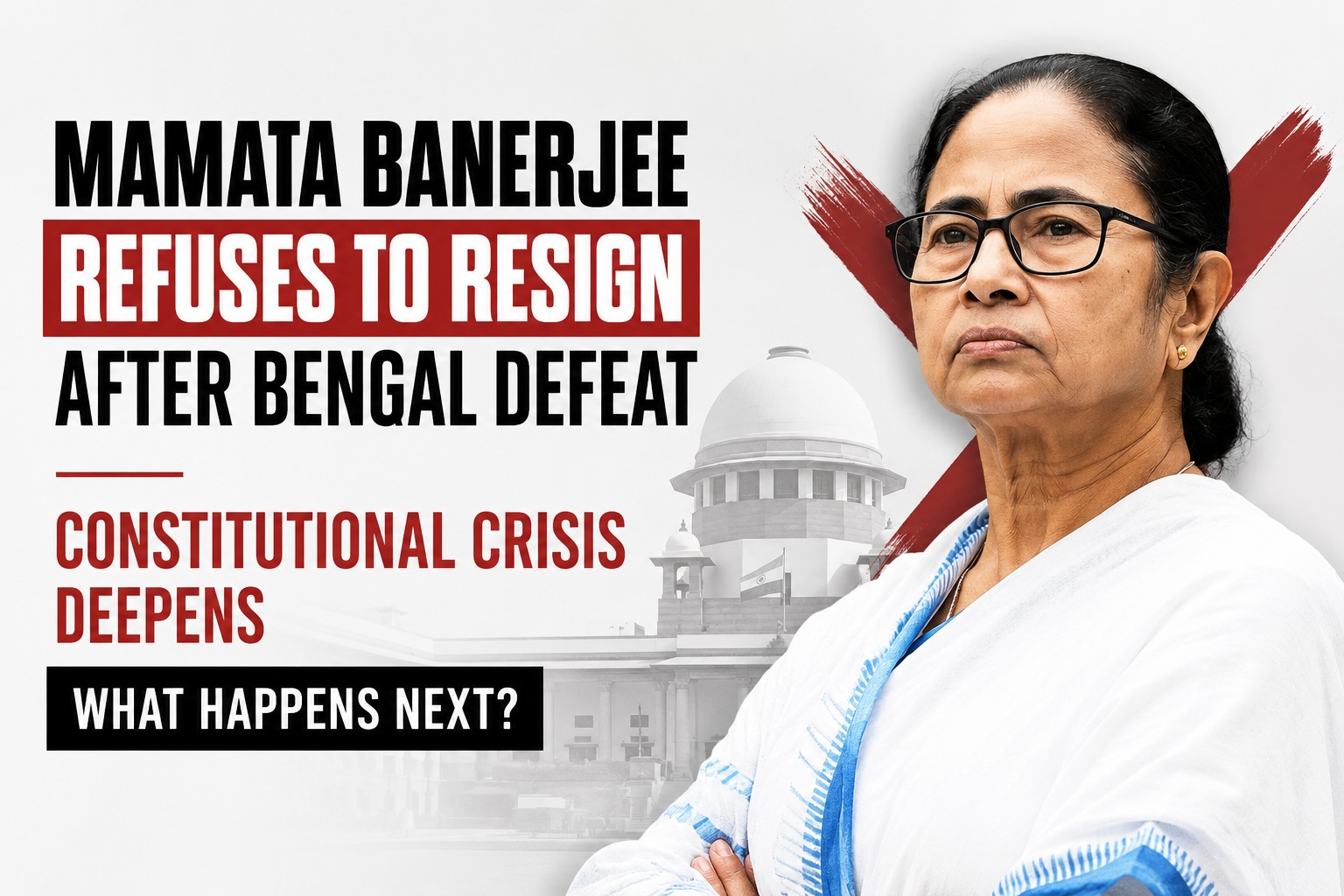
Mamata Banerjee Refuses to Resign After Bengal Defeat: Constitutional Crisis Deepens, What Happens Next?
Mamata Banerjee Refuses to Resign- What Happens Next?: West Bengal’s political landscape has entered uncharted territory after Chief Minister Mamata Banerjee refused to step down despite her party’s defeat in the 2026 Assembly elections. The dramatic standoff between the ruling Trinamool Congress (TMC) and the victorious Bharatiya Janata Party (BJP) has triggered what experts are calling a rare constitutional crisis—one that could escalate to the Governor’s office and potentially the Supreme Court. (Source: NDTV 24×7)
With the BJP securing a commanding majority in the 294-member Assembly, the refusal to resign has raised serious questions about constitutional conventions, gubernatorial powers, and the future of democratic transitions in India.
A Political Shockwave in Bengal After Mamata Banerjee Refuses to Resign
The 2026 West Bengal Assembly election results delivered a decisive verdict. The Bharatiya Janata Party emerged victorious with 207 seats—well above the majority mark—while Banerjee’s All India Trinamool Congress was reduced to just 80 seats.
Despite the clear outcome, Banerjee has refused to concede defeat. Addressing supporters, she asserted:
“I have not lost… I will not go to Raj Bhavan. I will not resign.”
Her stance has stunned political observers and sparked a fierce debate over constitutional norms versus political defiance.
Allegations of Electoral Irregularities: Why Mamata Banerjee Refuses to Resign
Banerjee has justified her refusal by alleging large-scale irregularities in the electoral process. She claimed that the BJP’s victory was the result of an “illegal campaign” allegedly facilitated by the Election Commission of India.
According to her, results in nearly 100 constituencies were “manipulated” through questionable voter roll revisions and other practices. She has also pointed to similar outcomes in recent elections in states like Maharashtra, Haryana, and Bihar, suggesting a broader pattern.
“This is not how democracy works,” she said, accusing institutions of bias and warning of a “dangerous message” being sent globally.
These allegations, if pursued legally, could further complicate the political situation and prolong uncertainty in the state.
Constitutional Position: Is Resignation Mandatory?
As Mamata Banerjee refuses to resign, one of the central questions in this crisis is whether a Chief Minister is legally required to resign after losing an election.
Interestingly, the Constitution of India does not explicitly mandate resignation in such cases. Instead, it operates on established constitutional conventions rather than written rules.
The core principle is simple: a Chief Minister must enjoy the confidence of the legislative assembly. Once election results indicate otherwise, it is expected—though not legally enforced—that the incumbent steps down to allow a smooth transfer of power.
Banerjee’s refusal challenges this long-standing convention, potentially setting a precedent for future political disputes.
Role of the Governor: The Next Key Player
The spotlight now shifts to RN Ravi, who holds crucial constitutional authority in this situation.
Under Article 164(1), the Chief Minister holds office “during the pleasure of the Governor.” This gives the Governor the power to:
- Ask the Chief Minister to prove majority on the floor of the Assembly
- Dismiss the government if it fails to demonstrate support
- Invite the leader of the majority party to form a new government
In this case, the most likely immediate step is a floor test, where Banerjee will be required to prove that she still commands majority support.
Given the election results, this appears highly unlikely.
The Floor Test Scenario
A floor test is considered the most democratic and transparent way to resolve such disputes. It involves a vote in the legislative assembly to determine whether the government still enjoys majority support.
If Banerjee fails to secure the required numbers:
- The Governor can dismiss her government
- The BJP leader will be invited to form the government
- A new Chief Minister will be sworn in
However, if the situation escalates or legal challenges are filed, the matter could reach the judiciary.
Could President’s Rule Be Imposed?
If the political deadlock continues, the Governor has another option—recommending President’s Rule under Article 356.
This would mean:
- Suspension of the state assembly
- Direct governance by the central government
However, this is considered an extreme step and is typically used only when no party is able to form a stable government.
Given the BJP’s clear majority, President’s Rule is unlikely unless the situation spirals into a prolonged constitutional impasse.
Possibility of Supreme Court Intervention
With allegations of electoral malpractice and a refusal to follow convention, the crisis may eventually reach the Supreme Court of India.
The court could be asked to:
- Order a floor test
- Examine the validity of election results
- Interpret constitutional provisions
The judiciary has historically played a key role in resolving such disputes, often prioritizing constitutional morality over political considerations.
No Precedent in Indian Politics
Legal experts point out that India has rarely witnessed a situation where a Chief Minister refuses to resign after a clear electoral defeat.
While there have been instances of disputed mandates and delayed transitions, outright refusal to step down despite losing majority support is virtually unprecedented.
This makes the current situation particularly significant, as it could redefine how constitutional conventions are interpreted in the future.
Political Implications for Bengal As Mamata Banerjee Refuses to Resign
Beyond the legal complexities, the crisis has major political implications:
1. Governance Paralysis
Administrative decisions may be delayed as uncertainty persists.
2. Investor Confidence
Political instability could impact economic activity and investment in the state.
3. Public Sentiment
The situation may polarize voters further, deepening political divisions.
BJP’s Position and Strategy
The BJP, armed with a strong mandate, is expected to challenge Banerjee’s claims and push for immediate transfer of power.
Party leaders are likely to:
- Demand a floor test
- Approach the Governor
- Seek judicial intervention if required
Their argument is straightforward: the electoral verdict must be respected.
TMC’s Counter Narrative: Why Mamata Banerjee Refuses to Resign?
On the other hand, the TMC is framing the issue as a fight to protect democracy.
By alleging institutional bias, Banerjee is attempting to mobilize public opinion and position herself as a defender of democratic values.
This narrative could play a significant role if the battle shifts from the Assembly to the courts or the streets.
Broader Impact on Indian Democracy As Mamata Banerjee Refuses to Resign
The unfolding crisis raises important questions about the balance between written law and constitutional conventions.
If conventions are ignored:
- Will future leaders follow suit?
- Will legal provisions need to be amended?
- How will institutions respond to such challenges?
These questions go beyond West Bengal and touch the very foundation of India’s democratic system.
What Happens Next As Mamata Banerjee Refuses to Resign?
The coming days are likely to be decisive as Mamata Banerjee refuses to resign. The sequence of events could unfold as follows:
- Governor calls for a floor test
- Banerjee fails to prove majority
- The government is dismissed
- BJP forms the new government
Alternatively, legal battles could delay this process, leading to prolonged uncertainty.
Conclusion
Mamata Banerjee’s refusal to resign has plunged West Bengal into a rare constitutional crisis, testing the limits of India’s democratic framework.
While the Constitution provides mechanisms to resolve such situations, the absence of explicit rules regarding resignation has created a grey area—one that may now require judicial clarity.
As the situation evolves, all eyes will be on the Governor, the courts, and the political leadership to ensure that democratic principles are upheld.
At its core, this is not just a political battle—it is a test of constitutional morality, institutional strength, and the resilience of Indian democracy.
Disclaimer:
This article is based on publicly available information, official statements, and media reports available at the time of publication. The content is intended for informational purposes only and should not be considered financial or policy advice. Readers are encouraged to refer to official sources for the latest updates.
The content is solely for educational and informational purposes. Whether it is global news, indian news, political news or any other sort of content, we do not independently verify the content or claims.
While efforts have been made to ensure accuracy, the information presented may change as new developments emerge. Readers are advised to conduct their own research and consult financial advisors before making any investment decisions.
NoCap Times does not independently verify all claims or statements and shall not be held responsible for any inaccuracies or omissions.
Stay updated with the latest and breaking news on NoCap Times. Get the latest India News, World News, Business News, Sports News, Viral News and Research Articles for various competitive Exams & UPSC Aspirants.