

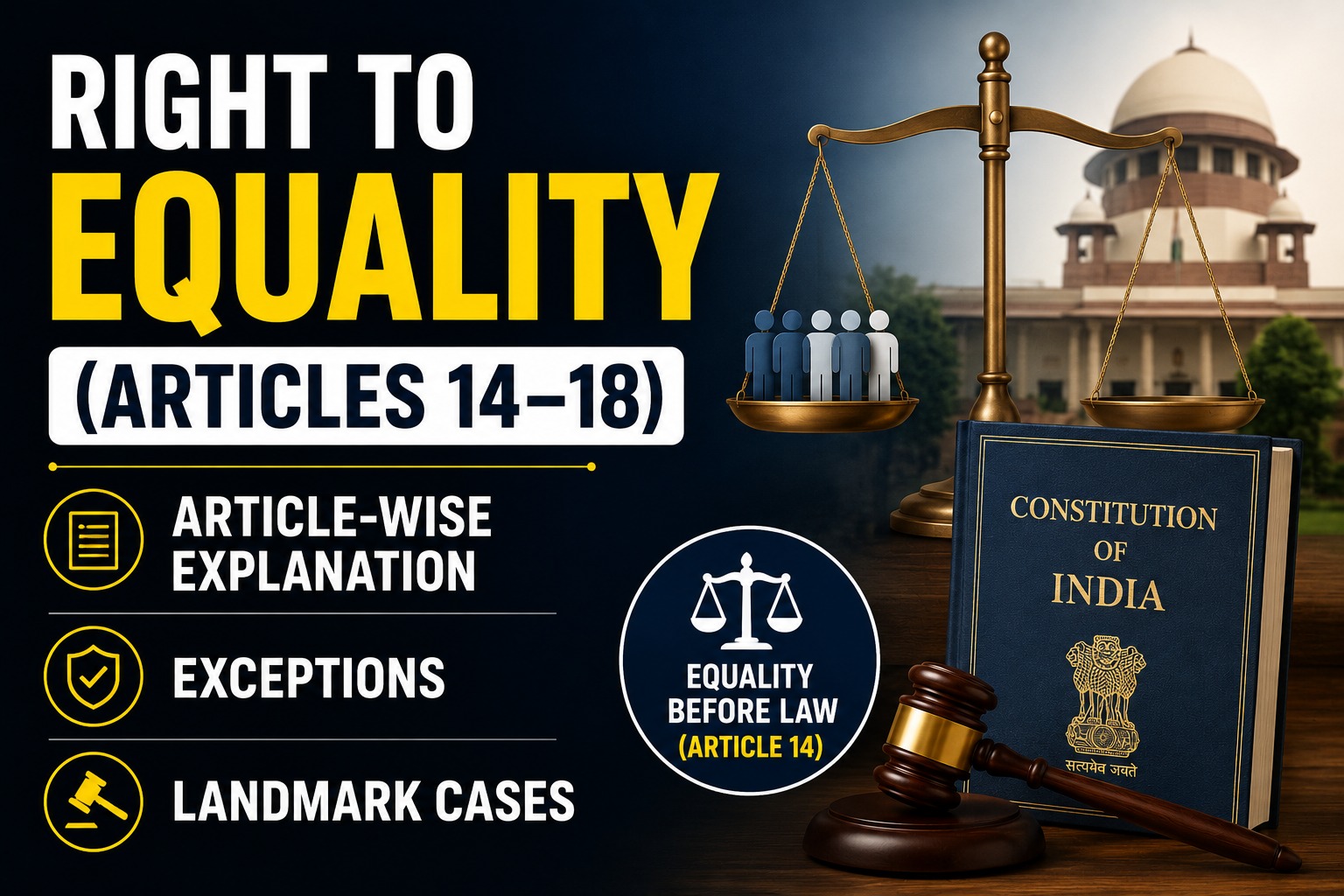
Right to Equality (Articles 14–18): Article-wise Explanation, Exceptions & Landmark Cases
Introduction: Right to Equality (Articles 14–18)
The Right to Equality under Articles 14 to 18 of the Indian Constitution forms the bedrock of India’s democratic and secular framework. It ensures that every person is treated equally before the law and prohibits arbitrary discrimination by the state. Enshrined in Part III (Fundamental Rights), these provisions reflect the ideals of justice, liberty, and equality that guided the freedom struggle.
Article 14 is the foundation, while Articles 15–18 provide specific manifestations and prohibitions. The Right to Equality is available to all persons (citizens and non-citizens) under Article 14, but certain protections (like Articles 15, 16) are citizen-specific. These rights are justiciable and have been expansively interpreted by the Supreme Court through judicial activism.
(Source: mcrhrdi.gov.in)
This comprehensive article covers article-wise explanations, exceptions, reasonable classification doctrine, landmark Supreme Court judgments, constitutional amendments, interlinkages with other Fundamental Rights and DPSPs, contemporary challenges, and UPSC relevance. It serves as complete notes for UPSC Prelims, Mains GS2, and Essay preparation.
Article 14: Equality Before Law and Equal Protection of Laws
Text: “The State shall not deny to any person equality before the law or the equal protection of the laws within the territory of India.”
Two Concepts
- Equality Before Law (British Concept): No person is above the law. It implies absence of special privileges and subjection of all to ordinary law.
- Equal Protection of Laws (American Concept): Equals should be treated equally, and unequals unequally. This allows reasonable classification.
Reasonable Classification Doctrine
The Supreme Court has laid down a two-fold test for valid classification:
- Intelligible Differentia: There must be a clear distinction between those grouped together and others left out.
- Rational Nexus: The differentia must have a rational relation to the object sought to be achieved by the classification.
Exceptions to Article 14:
- Classification based on reasonable grounds (e.g., reservations, progressive taxation).
- Foreigners in certain matters (e.g., deportation).
- Special provisions under other constitutional articles (e.g., Article 371 for North-Eastern states).
Landmark Cases on Article 14:
- State of West Bengal v. Anwar Ali Sarkar (1952): Struck down the West Bengal Special Courts Act as it allowed arbitrary classification without guidelines.
- E.P. Royappa v. State of Tamil Nadu (1974): Introduced the doctrine that “arbitrariness is the antithesis of equality.” Equality under Article 14 is a dynamic concept.
- Maneka Gandhi v. Union of India (1978): Expanded Article 14 by linking it with Articles 19 and 21 (Golden Triangle). Procedure must be fair, just, and reasonable.
- R.K. Garg v. Union of India (1981): Upheld special laws for economic offences.
- Indra Sawhney v. Union of India (1992): Cemented the 50% reservation limit (with exceptions) and creamy layer principle.
Recent Application: The Court has used Article 14 to strike down arbitrary government policies, electoral bonds (partly), and certain COVID-19 restrictions.
Article 15: Prohibition of Discrimination on Grounds of Religion, Race, Caste, Sex or Place of Birth
Text: The State shall not discriminate against any citizen on grounds only of religion, race, caste, sex, or place of birth.
Key Clauses
- 15(1): General prohibition on discrimination.
- 15(2): Access to public places (shops, hotels, wells, roads, etc.).
- 15(3): Special provisions for women and children (e.g., maternity benefits, reservations in panchayats).
- 15(4): Special provisions for socially and educationally backward classes, SCs, and STs (added by 1st Amendment).
- 15(5): Reservations in private unaided educational institutions (added by 93rd Amendment, except minority institutions).
- 15(6): Special provisions for Economically Weaker Sections (EWS) – 10% reservation (103rd Amendment, 2019).
Exceptions:
- Special provisions for backward classes are permitted.
- Minority educational institutions (Article 30) are protected.
Landmark Cases:
- M.R. Balaji v. State of Mysore (1963): Capped backward class reservations at 50%.
- Indra Sawhney v. Union of India (1992) (Mandal Case): Upheld OBC reservations with creamy layer exclusion. No reservation in promotions.
- Ashoka Kumar Thakur v. Union of India (2008): Upheld 27% OBC reservation in central institutions.
- Jarnail Singh v. Lachhmi Narain Gupta (2018): Modified earlier rulings — no need to collect quantifiable data for SC/ST promotion reservations.
- Neil Aurelio Nunes v. Union of India (2022): Upheld OBC reservation in All India Quota medical seats.
Article 16: Equality of Opportunity in Matters of Public Employment
Text: There shall be equality of opportunity for all citizens in matters relating to employment or appointment to any office under the State.
Important Clauses
- 16(2): No discrimination on grounds of religion, race, caste, sex, descent, place of birth, or residence.
- 16(3): Parliament can prescribe residence requirements for certain jobs.
- 16(4): Reservation for backward classes not adequately represented.
- 16(4A): Reservation in promotions for SC/ST (added by 77th Amendment).
- 16(4B): Carry-forward of unfilled vacancies (81st Amendment).
- 16(6): 10% EWS reservation in public employment (103rd Amendment).
Exceptions:
- Religious institutions can prefer persons of that religion.
- Reservations for backward classes if they are inadequately represented.
- Efficiency of administration must be maintained (Article 335).
Key Cases:
- Indra Sawhney (1992): Reservations in promotions not allowed initially (later amended).
- M. Nagaraj v. Union of India (2006): Upheld reservations in promotions but required quantifiable data, backwardness, and efficiency.
- Jarnail Singh (2018): Relaxed Nagaraj requirements for SC/ST promotions.
- Mukesh Kumar v. State of Uttarakhand (2020): No fundamental right to reservation; it is enabling power.
Article 17: Abolition of Untouchability
Text: “Untouchability” is abolished and its practice in any form is forbidden. The enforcement of any disability arising out of “Untouchability” shall be an offence punishable in accordance with law.
- Enacted through the Protection of Civil Rights Act, 1955 (formerly Untouchability Offences Act).
- Courts have interpreted it broadly to include social boycott and discrimination against Dalits.
Landmark Interpretations:
- People’s Union for Democratic Rights v. Union of India (1982): Linked Article 17 with forced labour.
- Recent cases involve manual scavenging and temple entry rights.
Exceptions: None — absolute prohibition.
Article 18: Abolition of Titles
Text:
- No title, not being a military or academic distinction, shall be conferred by the State.
- No citizen shall accept titles from any foreign State.
Key Points:
- Prohibits titles like “Rai Bahadur”, “Padma Shri” is an award, not a title (per Supreme Court).
- Citizens cannot accept foreign titles without President’s consent.
Landmark Case:
- Balaji Raghavan v. Union of India (1996): National awards (Bharat Ratna, Padma awards) do not violate Article 18 as they are not “titles”.
Comparative Analysis: Articles 14–18
| Article | Scope | Applies To | Key Exceptions/Features | Major Cases |
|---|---|---|---|---|
| 14 | General Equality | All persons | Reasonable classification | Royappa, Maneka Gandhi |
| 15 | Discrimination | Citizens | Special provisions for women, backward classes | Indra Sawhney, EWS cases |
| 16 | Public Employment | Citizens | Reservations, efficiency | Nagaraj, Jarnail Singh |
| 17 | Untouchability | All | Absolute | PUCL cases |
| 18 | Titles | Citizens/State | Military/academic distinctions | Balaji Raghavan |
Evolution and Constitutional Amendments
- 1st Amendment (1951): Added clause 15(4) to enable reservations after court challenges to zamindari abolition and reservations.
- 77th Amendment (1995): Added 16(4A) for SC/ST promotions.
- 81st, 82nd, 85th Amendments: Carry-forward rules and consequential seniority.
- 93rd Amendment (2005): Enabled 15(5) for private institutions.
- 103rd Amendment (2019): Added EWS reservations under 15(6) and 16(6) — upheld in Janhit Abhiyan v. Union of India (2022) with 3:2 majority.
Basic Structure Linkage: Right to Equality is part of the Basic Structure (Kesavananda Bharati, 1973; Minerva Mills, 1980).
Interlinkages with Other Provisions
- Golden Triangle: Articles 14 + 19 + 21 (Maneka Gandhi).
- Directive Principles: Courts read Articles 14/21 with DPSPs (e.g., equal pay under Article 39).
- Article 21: Substantive equality through dignity and non-arbitrariness.
- Article 32/226: Enforcement mechanism.
Contemporary Challenges and Issues
- Reservation vs Merit Debate: Balancing affirmative action with efficiency.
- Creaky Layer Exclusion: Implementation gaps in OBC/EWS.
- Marital Rape, Gender Equality: Article 14 challenges to personal laws.
- Digital Divide and Algorithmic Bias: New frontiers of equality.
- Horizontal Reservations: For women, persons with disabilities, transgenders.
- Farmers, Migrants, and Informal Sector: Equal protection during crises.
UPSC Relevance
Prelims: Direct questions on articles, clauses, amendments, and key cases. Mains GS2: Analytical questions like “Right to Equality has evolved from formal to substantive equality. Discuss.” or “Critically examine the impact of EWS reservation on the basic structure doctrine.” Essay: Topics on social justice, equality vs equity, constitutional morality. Interview: Views on reservation policy, gender justice, and uniform civil code.
Conclusion
The Right to Equality under Articles 14–18 has transformed from a formal guarantee of non-discrimination to a powerful tool for substantive equality and social justice. Through judicial innovation and timely amendments, it continues to address historical injustices while adapting to modern challenges like economic inequality and digital rights. However, its success ultimately depends on effective implementation, political will, and societal acceptance. For a truly egalitarian India, the spirit of these articles must guide governance, judiciary, and civil society alike.
This evolving jurisprudence reinforces Dr. Ambedkar’s vision of annihilating caste and ensuring dignity for every citizen.