

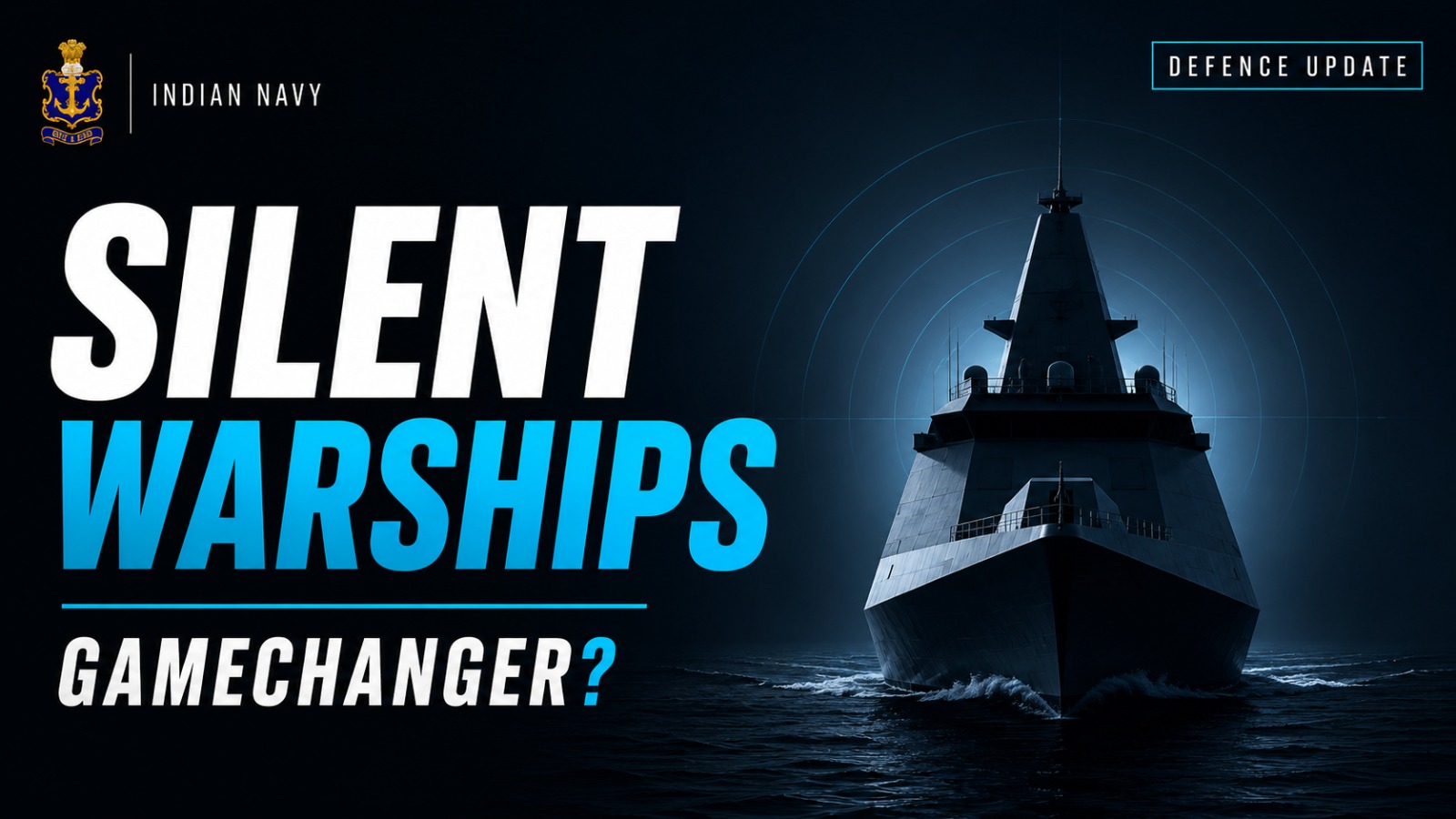
India Deploys ‘Silent’ Stealth Warships: Why the Navy’s Latest Additions Are a Strategic Gamechanger
As geopolitical tensions intensify across the Indo-Pacific, India is quietly—but decisively—reshaping its maritime strength. With China expanding its naval footprint and Pakistan enhancing its sea-based capabilities, the Indian Navy is accelerating a powerful transformation. At the center of this shift is the induction of advanced stealth warships—often referred to as “silent hunters of the sea.”
The recent delivery of INS Mahendragiri marks a significant milestone in this journey. Coming close on the heels of INS Dunagiri and the commissioning of INS Taragiri, these warships signal India’s growing dominance in both surface and underwater warfare capabilities.
But what makes these vessels such a gamechanger? And why are they being called “silent warships”? Let’s break it down.
A New Era of Indian Naval Power
India’s latest warship inductions are not isolated developments—they are part of a broader strategic vision aimed at strengthening maritime security and asserting dominance in the Indian Ocean Region.
These ships belong to the ambitious Project 17A, also known as the Nilgiri-class program. This initiative focuses on building next-generation stealth guided-missile frigates that significantly improve upon the earlier Shivalik-class warships.
While the Shivalik-class marked India’s entry into stealth naval design, Project 17A takes it several steps further—with enhanced stealth, advanced weaponry, superior automation, and increased survivability.
INS Mahendragiri: A Symbol of Indigenous Strength
Delivered on April 30 at Mazagon Dock Shipbuilders Limited in Mumbai, INS Mahendragiri is the sixth vessel in the Nilgiri-class series and represents the cutting edge of Indian naval engineering.
What makes this warship particularly noteworthy is its high level of indigenous content—approximately 75%. Designed by the Indian Navy’s Warship Design Bureau, it reflects India’s growing self-reliance in defence manufacturing.
This is not just about building ships—it’s about building capability.
The project has also had a significant economic impact, involving over 200 MSMEs and generating thousands of jobs, reinforcing the government’s push for “Aatmanirbhar Bharat” in defence.
INS Dunagiri: Legacy Meets Next-Gen Power
Before Mahendragiri, the Navy inducted INS Dunagiri, built at Garden Reach Shipbuilders and Engineers in Kolkata.
Interestingly, this new vessel carries forward the legacy of an earlier warship of the same name, which served the Indian Navy for over three decades. But beyond the name, everything else is vastly upgraded.
The modern INS Dunagiri is equipped with a formidable weapons and sensor suite, including:
- BrahMos missiles for high-speed precision strikes
- Advanced MF-STAR radar for multi-target tracking
- MRSAM (Barak-8) air defence system
- Torpedoes and rockets for anti-submarine warfare
- Multi-layered close-in defence systems
Additionally, it can operate helicopters like HAL Dhruv or Sea King, significantly extending its operational reach.
INS Taragiri and Nuclear Deterrence Boost
Adding further strength to the fleet, INS Taragiri was commissioned shortly after Dunagiri’s induction. On the same day, India also marked a major milestone with the commissioning of INS Aridhaman, the country’s third nuclear-powered ballistic missile submarine.
This dual development highlights India’s parallel focus on both surface dominance and underwater nuclear deterrence—creating a balanced and formidable maritime force.
What Makes These Warships ‘Silent’?
The term “silent warships” is not just a dramatic label—it reflects a set of advanced stealth technologies that make these vessels extremely difficult to detect.
1. Low Radar Visibility
These ships are designed with a reduced radar cross-section (RCS), meaning enemy radar systems struggle to identify them. This is achieved using special materials, angular structures, and radar-absorbing coatings.
2. Infrared Signature Reduction
Advanced exhaust systems cool down heat emissions, making the ship harder to detect via infrared sensors.
3. Acoustic Stealth
Specially designed propellers minimize cavitation—the formation of bubbles that create noise underwater. This makes the ship harder to detect by enemy sonar.
4. Clean Deck Design
Weapons and equipment are integrated into the ship’s structure, reducing visible clutter and enhancing stealth.
Together, these features allow the warships to operate undetected, giving India a crucial tactical advantage in modern naval warfare.
Advanced Technology: Power Meets Precision
Beyond stealth, these warships are packed with cutting-edge technology.
CODOG Propulsion System
The Combined Diesel or Gas (CODOG) system allows ships to switch between fuel-efficient diesel engines for long patrols and powerful gas turbines for high-speed operations.
Integrated Platform Management System (IPMS)
This advanced automation system centralizes control of machinery and onboard systems, reducing crew workload and improving operational efficiency.
Multi-Mission Capability
These ships are designed for:
- Anti-surface warfare (enemy ships)
- Anti-air defence (aircraft and missiles)
- Anti-submarine operations
This versatility makes them highly valuable assets in both peace and conflict scenarios.
Blue-Water Capability: Expanding India’s Reach
One of the most significant advantages of these warships is their ability to support “blue-water operations.”
In simple terms, this means the Indian Navy can operate far beyond its coastal waters—across deep oceans—for extended periods.
This capability is critical for:
- Protecting sea trade routes
- Responding to global crises
- Projecting power in strategic regions
With these new additions, India is strengthening its presence in key areas like the Indian Ocean, where global trade and energy flows are heavily concentrated.
Strategic Context: China and Pakistan Factor
India’s naval expansion cannot be viewed in isolation. China’s growing presence in the Indian Ocean—through ports, bases, and patrol vessels—has raised strategic concerns.
Similarly, Pakistan’s naval modernization efforts add another layer of complexity.
In this context, India’s investment in stealth warships and nuclear submarines is a clear signal: it is preparing for a more contested maritime environment.
Self-Reliance in Defence: A Long-Term Vision
One of the most important aspects of Project 17A is its emphasis on indigenous development.
India is steadily reducing its dependence on foreign defence imports by building advanced platforms domestically. The growing number of locally built warships—now exceeding 100—demonstrates this shift.
This not only strengthens national security but also boosts the domestic economy and technological ecosystem.
Why This Is a Gamechanger
The induction of INS Mahendragiri, Dunagiri, and Taragiri is more than just fleet expansion—it represents a strategic transformation.
Key Reasons:
- Enhanced Stealth: Ability to operate undetected
- Superior Firepower: Advanced missile and defence systems
- Multi-Role Flexibility: One platform, multiple missions
- Global Reach: Blue-water operational capability
- Indigenous Strength: Reduced reliance on imports
Together, these factors give India a significant edge in maritime warfare.
The Road Ahead
As India continues to strengthen its naval capabilities, these warships will play a crucial role in shaping the country’s maritime strategy for decades.
Whether operating independently or as part of larger task forces, they will be at the forefront of securing India’s interests in an increasingly complex global environment.
The message is clear: India is not just defending its waters—it is preparing to dominate them.
Conclusion
The deployment of stealth warships like INS Mahendragiri marks a defining moment for the Indian Navy. Combining advanced technology, indigenous innovation, and strategic foresight, these “silent sentinels” are set to redefine maritime warfare in the region.
In a world where control of the seas often determines global influence, India’s latest naval additions are not just upgrades—they are a game-changing leap toward becoming a dominant maritime power.
Disclaimer:
This article is based on publicly available information, official statements, and media reports available at the time of publication. The content is intended for informational purposes only and should not be considered financial or policy advice. Readers are encouraged to refer to official sources for the latest updates.
The content is solely for educational and informational purposes. Whether it is global news, indian news, political news or any other sort of content, we do not independently verify the content or claims.
While efforts have been made to ensure accuracy, the information presented may change as new developments emerge. Readers are advised to conduct their own research and consult financial advisors before making any investment decisions.
NoCap Times does not independently verify all claims or statements and shall not be held responsible for any inaccuracies or omissions.
Stay updated with the latest and breaking news on NoCap Times. Get the latest India News, World News, Business News, Sports News, Viral News and Research Articles for various competitive Exams & UPSC Aspirants.