

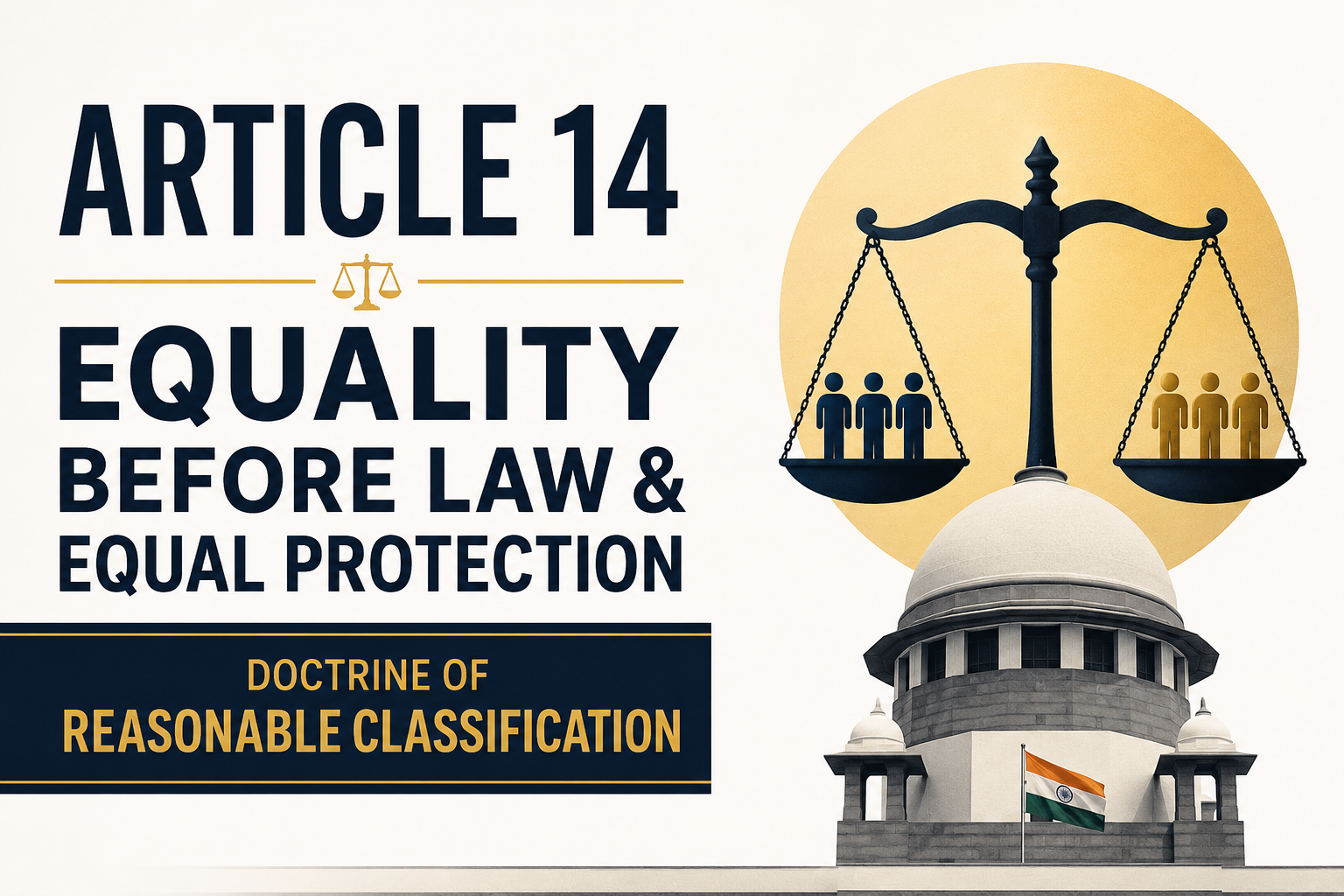
Article 14: Equality Before Law & Equal Protection – Doctrine of Reasonable Classification
Introduction
Article 14 of the Indian Constitution stands as the cornerstone of the Right to Equality, embodying the foundational principles of justice, fairness, and non-discrimination that underpin India’s democratic ethos. It declares:
“The State shall not deny to any person equality before the law or the equal protection of the laws within the territory of India.”
This seemingly simple provision has evolved into one of the most dynamic and powerful tools in the hands of the Supreme Court to strike down arbitrary state actions, whether legislative or executive. Article 14 is not merely a negative injunction against discrimination; it has transformed into a positive obligation on the state to ensure substantive equality, fairness, and non-arbitrariness in all its dealings.
For UPSC aspirants, Article 14 is indispensable for Polity (GS2), as it frequently appears in Prelims (direct factual questions), Mains (analytical questions on evolution, judicial activism, and contemporary application), and even Essays on topics like social justice, constitutional morality, or balancing liberty with equality.
This article offers an in-depth exploration of the textual meaning, historical origins, twin doctrines (Equality Before Law and Equal Protection), the Doctrine of Reasonable Classification, the shift to the Doctrine of Arbitrariness, landmark judgments, exceptions, interlinkages, recent developments, and its enduring relevance in modern India.
Textual Analysis and Scope of Article 14
Article 14 uses two distinct expressions:
- Equality Before the Law — A negative concept borrowed from British jurisprudence (Rule of Law by A.V. Dicey). It means no person is above the law; every individual, irrespective of rank or position, is subject to the ordinary law of the land. It emphasizes the absence of special privileges.
- Equal Protection of the Laws — A positive concept derived from the 14th Amendment of the US Constitution. It requires that persons in similar situations be treated similarly and allows the state to treat unequals differently through reasonable classification.
Key Features:
- Applies to all persons — citizens, foreigners, legal persons (companies), and even the state in certain contexts.
- Available against State action (as defined under Article 12).
- Not absolute — permits reasonable classification.
- Forms part of the Basic Structure of the Constitution (Kesavananda Bharati, 1973).
Doctrine of Reasonable Classification
The Supreme Court has consistently held that Article 14 forbids class legislation (arbitrary discrimination) but does not forbid reasonable classification. Classification is essential for practical governance because laws cannot be universal in application.
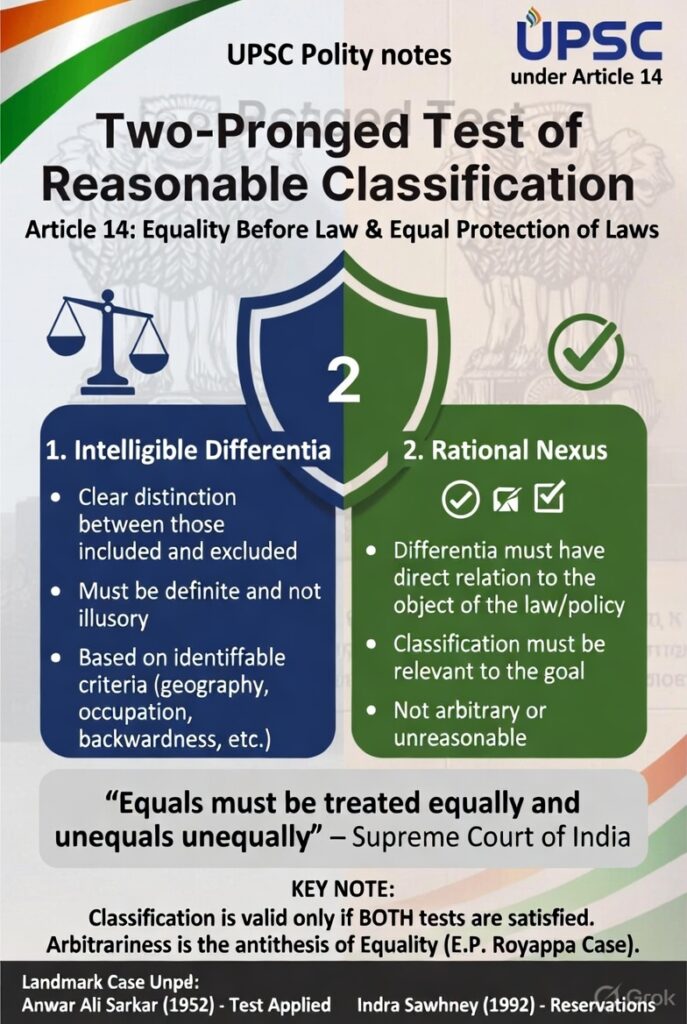
The Classic Test (Two-Pronged Test)
The doctrine was authoritatively laid down in State of West Bengal v. Anwar Ali Sarkar (1952) and refined in subsequent cases:
- Intelligible Differentia: There must be a clear, definite, and discernible distinction between persons or objects grouped together and those left out. The distinction must be based on some identifiable criterion, not vague or illusory.
- Rational Nexus: The differentia must have a rational relation to the object sought to be achieved by the law or policy. The classification must be relevant to the legislative goal.
Additional Principles:
- Classification can be based on geography, occupation, income, education, backwardness, etc.
- The burden of proof lies on the petitioner to show violation; there is a presumption of constitutionality.
- The test applies to both legislative and executive actions.
- Over time, the Court added that the classification must not be arbitrary or manifestly unreasonable.
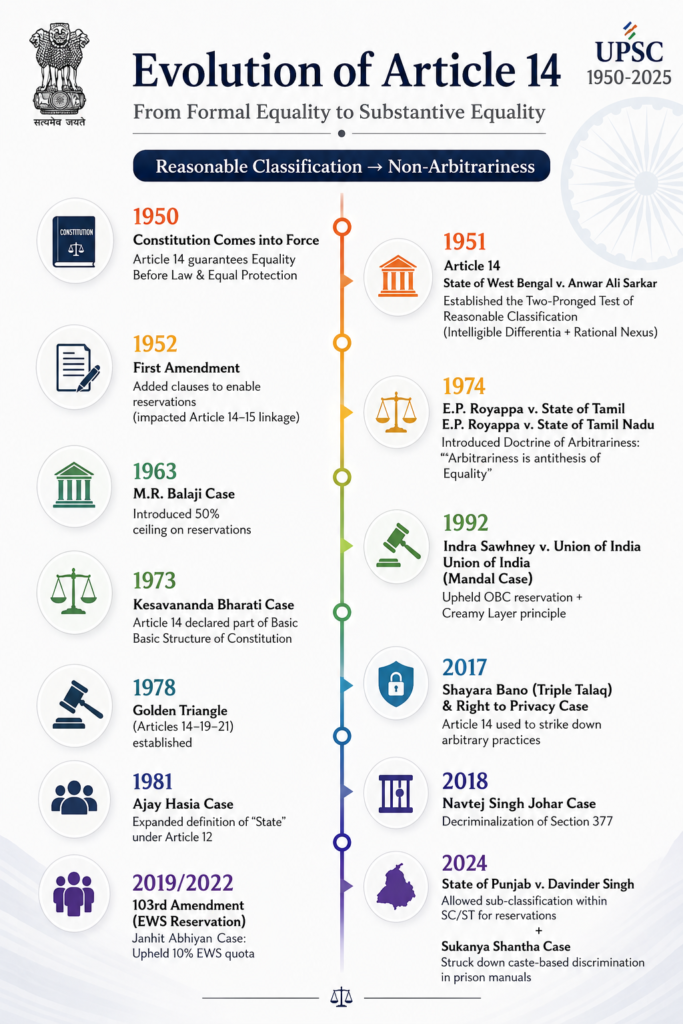
Leading Case on Classification Test: State of West Bengal v. Anwar Ali Sarkar (1952) The West Bengal Special Courts Ordinance allowed the government to refer cases to special courts with arbitrary procedure. The Supreme Court struck it down as violative of Article 14 because it enabled unchecked executive discretion without any guidelines, failing both prongs of the test.
Other Important Cases on Classification:
- Chiranjit Lal Chowdhury v. Union of India (1950): Upheld single-company legislation (Sholapur Spinning Mills) as reasonable classification for public interest.
- M.P. Jain v. State of Bihar and others refined the test further.
Evolution: From Reasonable Classification to Non-Arbitrariness
The traditional classification test proved somewhat rigid. A major shift occurred in the 1970s, expanding Article 14 significantly.
E.P. Royappa v. State of Tamil Nadu (1974) Justice P.N. Bhagwati famously observed: “Equality is a dynamic concept… Equality and arbitrariness are sworn enemies… Article 14 strikes at arbitrariness in State action.”
This introduced the Doctrine of Arbitrariness as an independent ground to challenge state action. Arbitrariness became antithetical to equality.
Maneka Gandhi v. Union of India (1978) This landmark judgment interlinked Articles 14, 19, and 21 (the Golden Triangle). The Court held that any procedure must be fair, just, and reasonable — not merely following the letter of the law. Passport impoundment without hearing was struck down as arbitrary. This case marked the transition from formal equality to substantive equality.
Further Reinforcement:
- R.D. Shetty v. International Airport Authority (1979): Expanded the concept of “State” and reiterated non-arbitrariness in contractual matters.
- Ajay Hasia v. Khalid Mujib (1981): Laid down tests to determine if a body is an “instrumentality of the State.”
Major Landmark Judgments on Article 14
Here is a curated selection of the most important cases:
- Indra Sawhney v. Union of India (1992) (Mandal Commission Case): Upheld 27% OBC reservation but introduced creamy layer exclusion. Laid down multiple guidelines on reservations under Article 16, read with Article 14.
- M. Nagaraj v. Union of India (2006): Upheld reservations in promotions for SC/ST but required quantifiable data on backwardness, inadequacy of representation, and administrative efficiency.
- Janhit Abhiyan v. Union of India (2022): Upheld 10% EWS reservation (103rd Amendment) by 3:2 majority, expanding the scope of economic criteria under equality jurisprudence.
- State of Punjab v. Davinder Singh (2024): 7-judge bench permitted sub-classification within SC/ST categories for reservations, overruling earlier precedents and advancing substantive equality.
- Sukanya Shantha v. Union of India (2024): Struck down caste-based discrimination in prison manuals as violative of Article 14 and substantive equality.
- Shayara Bano v. Union of India (2017): Triple Talaq declared arbitrary and violative of Article 14.
- Navtej Singh Johar v. Union of India (2018): Decriminalized homosexuality, emphasizing dignity and equality.
- D.S. Nakara v. Union of India (1983): Pension cut-off date held arbitrary.
These cases demonstrate how Article 14 has moved from formal to transformative equality.
Exceptions and Limitations to Article 14
While Article 14 is broad, it permits:
- Reasonable classification (as discussed).
- Special provisions under other Articles (e.g., Article 15(3) for women, Article 371 for special states).
- Presidential orders under Article 359 during Emergency (with exceptions for Articles 20 & 21 post-44th Amendment).
- Laws protecting certain dignitaries (e.g., limited immunity under Articles 105, 194).
- Foreigners: Certain rights (e.g., political rights) can be restricted.
Interlinkages with Other Constitutional Provisions
- With DPSPs (Part IV): Courts harmoniously construe Article 14 with Directive Principles (e.g., equal pay under Article 39).
- With Article 21: Substantive due process — fairness, non-arbitrariness, and dignity.
- With Article 19: Reasonable restrictions must satisfy Article 14 tests.
- With Article 32: Right to constitutional remedies for enforcement.
- Basic Structure: Equality is an essential feature (Kesavananda Bharati, Minerva Mills).
Contemporary Challenges and Recent Applications
Modern challenges include:
- Algorithmic bias and AI-driven governance.
- Data privacy and surveillance.
- Economic inequality and gig economy workers.
- Gender and marital issues (e.g., marital rape petitions).
- Reservation sub-classification and creamy layer debates.
- COVID-19 related policies and vaccine mandates.
Recent trends show the Court increasingly applying manifest arbitrariness as a ground, even for legislative actions, marking a more activist stance.
Conclusion
Article 14 has journeyed from a simple guarantee of formal equality to a profound instrument of substantive, transformative, and inclusive justice. The Doctrine of Reasonable Classification provides the foundational test, while the Doctrine of Arbitrariness and non-discrimination principles have given it dynamic reach. Through landmark judgments like Anwar Ali Sarkar, E.P. Royappa, Maneka Gandhi, and recent rulings on sub-classification and prison reforms, the Supreme Court has ensured that equality remains a living constitutional value.
In an increasingly diverse and unequal society, Article 14 continues to serve as a bulwark against majoritarian arbitrariness and a beacon for social justice. Its proper understanding and application remain central to realizing the Preamble’s promise of Equality of status and opportunity.
As Dr. B.R. Ambedkar envisioned, true equality requires not just legal sameness but the annihilation of systemic barriers. Article 14 empowers citizens and the judiciary to fulfill this constitutional morality.
Disclaimer:
This article is based on publicly available information, official statements, and media reports available at the time of publication. The content is intended for informational purposes only and should not be considered financial or policy advice. Readers are encouraged to refer to official sources for the latest updates.
The content is solely for educational and informational purposes. Whether it is global news, indian news, political news or any other sort of content, we do not independently verify the content or claims.
While efforts have been made to ensure accuracy, the information presented may change as new developments emerge. Readers are advised to conduct their own research and consult financial advisors before making any investment decisions.
NoCap Times does not independently verify all claims or statements and shall not be held responsible for any inaccuracies or omissions.
Stay updated with the latest and breaking news on NoCap Times. Get the latest India News, World News, Business News, Sports News, Viral News and Research Articles for various competitive Exams & UPSC Aspirants.