
Trump Signals Potential Breakthrough in US-Iran Tensions: 15-Point Ceasefire Proposal Delivered via Pakistan as Backchannel Diplomacy Intensifies
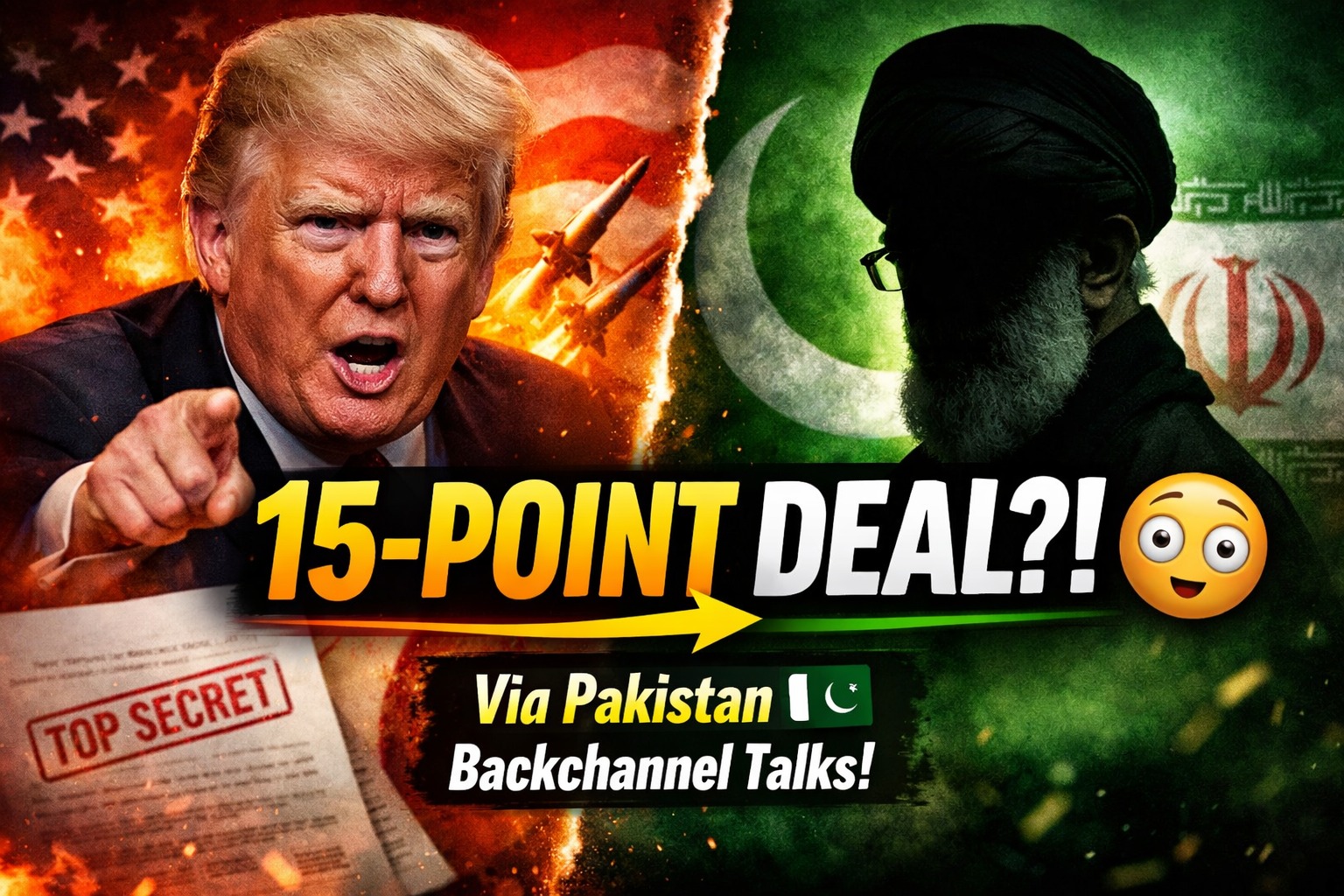
In a dramatic shift that has jolted global markets and raised cautious hopes for an end to nearly a month of intense fighting, US President Donald Trump has publicly highlighted “very good talks” with Iranian officials, framing them as a pathway to de-escalation in the volatile West Asia conflict. The Trump administration has formally transmitted a detailed 15-point ceasefire plan to Tehran through Pakistani intermediaries, with Islamabad now positioning itself as a potential venue for direct negotiations. This development comes as the United States has paused threatened strikes on Iranian energy infrastructure for five days, buying time for diplomacy amid a war that has already claimed over 2,000 lives and displaced millions.
The announcement marks a notable pivot from earlier aggressive posturing. Just days ago, Trump had issued a 48-hour ultimatum to Iran to fully reopen the Strait of Hormuz—a critical chokepoint carrying one-fifth of the world’s oil supply—or face devastating attacks on its power plants and energy facilities. On March 23, 2026, standing beside Air Force One in Memphis, Tennessee, the president instead declared that productive conversations were underway, stating, “We’re doing a five-day period. We’ll see how that goes, and if it goes well, we’re going to end up with settling this.” He emphasized that both sides were eager for a resolution, adding that Iran “want[s] to make a deal very badly.”
At the heart of this diplomatic opening is the 15-point ceasefire framework, which US officials have described as comprehensive and non-negotiable on core security issues. According to sources familiar with the proposal, the plan—delivered to Iranian counterparts via Pakistan—centers on Iran’s complete nuclear disarmament as its top priority. Key elements reportedly include the full dismantlement of Iran’s nuclear capabilities, a permanent commitment to zero uranium enrichment, the handover of all highly enriched uranium stockpiles (often referred to by Trump as “nuclear dust”), the shutdown of key facilities such as Natanz, Isfahan, and Fordow, and unrestricted access for the International Atomic Energy Agency (IAEA) for verification. Additional demands address Iran’s ballistic missile program, limits on its conventional defense capabilities, an end to support for regional proxy groups, guaranteed safe passage for all vessels through the Strait of Hormuz, and formal acknowledgment of Israel’s right to exist. In exchange, the proposal envisions a one-month ceasefire period for further talks, potential sanctions relief, and broader regional stability measures.
Pakistan has emerged as the pivotal player in this high-stakes shuttle diplomacy. Pakistani Prime Minister Shehbaz Sharif took to social media to affirm his country’s readiness, posting: “Pakistan welcomes and fully supports ongoing efforts to pursue dialogue to end the WAR in Middle East… Subject to concurrence by the US and Iran, Pakistan stands ready and honoured to be the host to facilitate meaningful and conclusive talks.” Foreign Office spokesperson Tahir Hussain Andrabi echoed this, telling reporters, “If both sides agree, Pakistan is always ready to host talks.” Sources indicate that Pakistan has already passed multiple messages between Washington and Tehran over recent days and is coordinating with allies including Egypt, Turkey, and Oman. An in-person summit in Islamabad could occur as early as this week, potentially involving US Vice President JD Vance, special envoys Steve Witkoff and Jared Kushner, Secretary of State Marco Rubio, and senior Iranian figures.
This mediation effort builds on Pakistan’s unique position: it maintains longstanding ties with both the US and Iran, shares a border with the Islamic Republic, and depends heavily on oil shipments routed through the Strait of Hormuz. Pakistani Army Chief General Asim Munir, who has cultivated close relations with the Trump administration, is understood to have played a behind-the-scenes role in arranging communications.
The broader context of the conflict underscores the urgency. Hostilities erupted on February 28, 2026, following the collapse of earlier US-Iran nuclear negotiations that had begun in April 2025. Coordinated US-Israeli strikes targeted Iranian nuclear sites, military installations, and proxy networks, escalating into a full-scale confrontation involving missile exchanges, drone attacks, and naval disruptions. Iran has retaliated by targeting Israeli cities and US-aligned Gulf infrastructure, while closing or restricting access to the Strait of Hormuz, sending oil prices soaring and rattling global energy markets. The war has also strained Iran’s economy and domestic stability, with reports of internal leadership challenges surrounding Supreme Leader Ali Khamenei’s successor and the health of key figures.
Iranian officials have pushed back against Trump’s optimistic narrative. Parliament Speaker Mohammad Bagher Ghalibaf, rumored to be the “respected” Iranian contact referenced by the US side, flatly denied any direct negotiations on social media, calling the pause in strikes an attempt by Washington and Israel to “escape the quagmire.” Iranian state media and Foreign Minister Abbas Araghchi have similarly labeled reports of talks as “fake news” designed to manipulate markets, while insisting that fighting will continue until victory unless core demands—such as reparations and guarantees against future aggression—are met. Despite the public denials, analysts note that indirect messaging through third parties has clearly occurred, as evidenced by Iran’s recent announcement allowing “non-hostile” oil vessels through the Strait of Hormuz.
Israel, a key partner in the initial strikes, has expressed surprise and skepticism over the US overture. Prime Minister Benjamin Netanyahu was briefed by Trump and Vance but has advocated for pressing the military advantage, viewing any ceasefire as premature without ironclad dismantling of Iran’s threats. Gulf states, meanwhile, have welcomed the diplomatic track, warning that further escalation against Iranian power plants could trigger catastrophic regional fallout, including refugee crises and energy blackouts.
Market reactions have been swift and positive. Wall Street rallied sharply following Trump’s announcements, with Brent crude prices easing as fears of prolonged disruption to global oil supplies receded. Treasury Secretary Scott Bessent captured the administration’s tactical thinking: “Sometimes you have to escalate to de-escalate.” Yet experts caution that the five-day window is fragile. “Diplomacy is being conducted as we speak, there are multiple proposals in play,” a regional source told CNN, but “none of the proposals discussed have reached a stage of maturing or general acceptance.” Trust deficits run deep—past rounds of talks in 2025 ended in surprise US-Israeli attacks—and Iran’s leadership remains divided on concessions.
From a geopolitical standpoint, success could reshape West Asia dynamics. A deal might stabilize energy markets, reduce proxy conflicts involving Hezbollah, the Houthis, and other groups, and open avenues for wider normalization between Israel and Arab states. Failure, however, risks renewed escalation, with the US already preparing to deploy additional troops—including elements of the 82nd Airborne Division and Marine Expeditionary Units—to bolster its roughly 50,000 personnel already in the region.
Trump, drawing on his self-described lifelong expertise in negotiation, has projected confidence. “My whole life has been a negotiation… this time, they mean business,” he remarked. Envoys Witkoff and Kushner are leading the US effort, leveraging personal rapport built during previous diplomatic initiatives. For Tehran, any agreement would require balancing regime survival with national pride, potentially trading nuclear ambitions and regional influence for sanctions relief and security assurances.
As the clock ticks on the five-day pause—set to expire around March 28—global attention turns to Islamabad. Whether Pakistan’s offer materializes into face-to-face talks or remains limited to backchannel exchanges will determine if this moment represents a genuine off-ramp or merely a tactical breather. Regional analysts emphasize that while the 15-point plan sets ambitious parameters, flexibility on sequencing—such as an initial one-month ceasefire focused on Hormuz reopening and nuclear freezes—could bridge gaps.
In the end, this episode highlights the complex interplay of military pressure and diplomacy in Trump’s second-term foreign policy. With lives, economies, and strategic alliances hanging in the balance, the coming days could prove decisive for peace in West Asia—or set the stage for further confrontation. The world watches closely as intermediaries shuttle proposals and leaders weigh the costs of continued war against the uncertainties of compromise.
Disclaimer
This article is based on official statements and publicly available information at the time of publication. The global energy situation is dynamic and may change with evolving geopolitical developments.
The content is intended for informational purposes only and should not be considered financial or policy advice. Readers are encouraged to refer to official sources for the latest updates.
NoCap Times does not independently verify all claims and shall not be held responsible for any inaccuracies or omissions.