

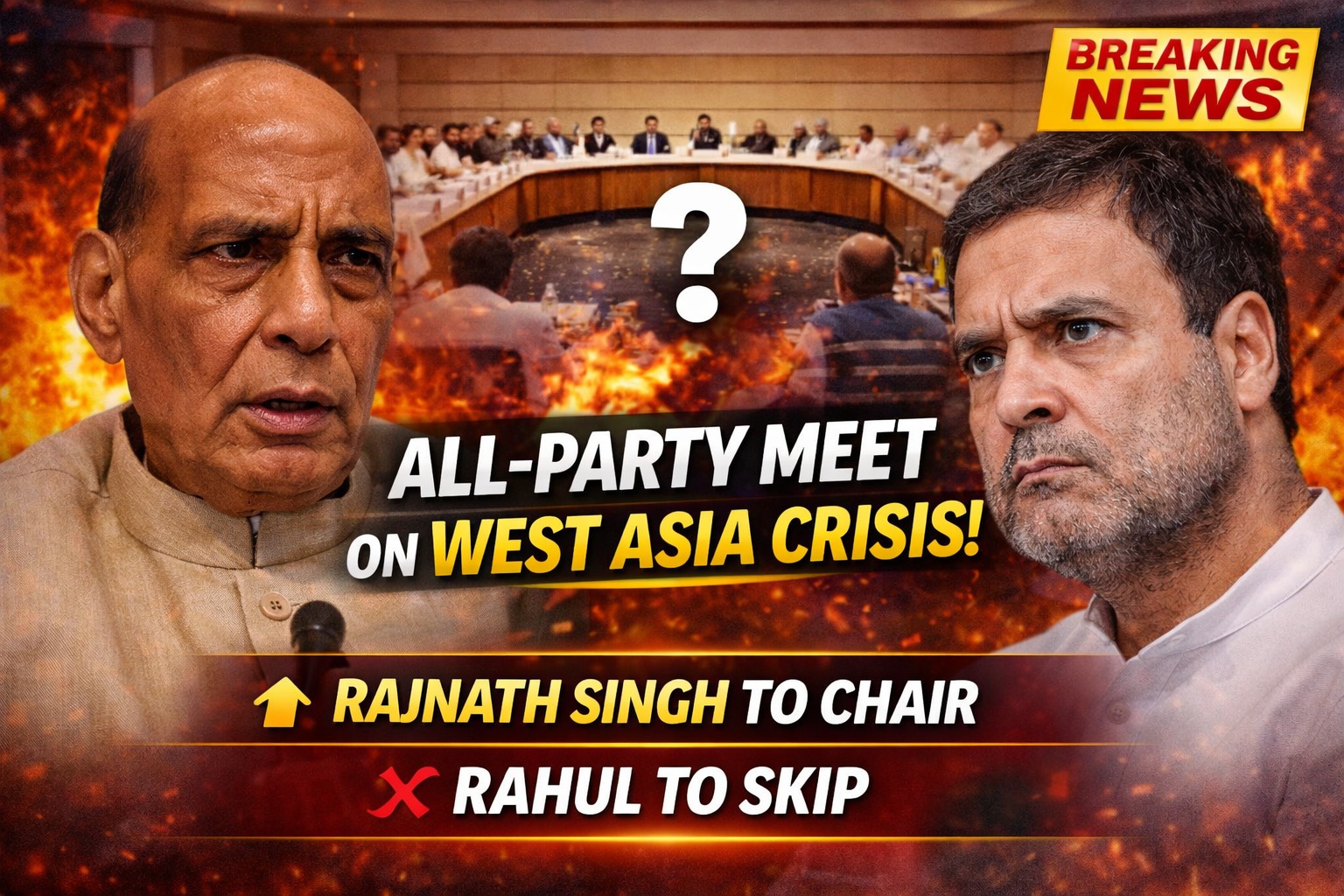
Rajnath Singh to Chair All-Party Meet on West Asia Crisis; Rahul Gandhi to Skip
New Delhi, March 25, 2026: Amid escalating concerns over the ongoing West Asia conflict and its ripple effects on India’s energy security, supply chains, and the welfare of nearly one crore Indian nationals in the Gulf region, the Central government has scheduled an all-party meeting this evening at 5 PM in the Parliament complex. Defence Minister Rajnath Singh is expected to chair the session, with External Affairs Minister S Jaishankar and other senior ministers likely to be present to brief opposition leaders on the ground situation and the government’s preparedness measures.
The meeting assumes significance as it follows Prime Minister Narendra Modi’s detailed addresses in both houses of Parliament earlier this week, where he described the conflict—now in its fourth week—as a “serious global energy crisis” with potentially prolonged implications for fuel prices, fertiliser availability, and overall economic stability. Sources indicate the all-party consultation aims to forge a unified national response and send a strong message of collective resolve to the international community, emphasising that dialogue and diplomacy remain the only sustainable path forward.
Rahul Gandhi to Skip the Meeting
Leader of Opposition in the Lok Sabha, Rahul Gandhi, informed reporters at the Parliament House complex that he would not be able to attend the all-party meeting due to a pre-scheduled programme in Kerala. “I would not be able to attend because I have a programme in Kerala,” Gandhi stated, while adding that such consultations are important. He is expected to launch the Congress party’s campaign for the upcoming Assembly elections in Kerala with a major public rally in Kozhikode today.
Congress sources clarified that the party would still be represented by other senior leaders, including possibly Mallikarjun Kharge, the Leader of Opposition in the Rajya Sabha. The absence of the prominent face of the opposition has drawn mixed reactions, with some viewing it as a missed opportunity for direct engagement while others see it as consistent with his prior commitments.
Government’s Proactive Measures Outlined by PM Modi
In his addresses to the Lok Sabha on Monday and the Rajya Sabha on Tuesday, Prime Minister Modi provided a comprehensive update on the government’s response to the crisis triggered by disruptions in the Strait of Hormuz—the critical waterway through which a large share of India’s crude oil, natural gas, and fertiliser imports pass. He categorically stated that attacks on commercial shipping and blockades of international sea lanes are “unacceptable” and warned that the difficult conditions could persist for some time.
Highlighting the human dimension, the Prime Minister noted that nearly one crore Indians live and work in Gulf countries, with many Indian crew members serving on commercial vessels plying these waters. He assured Parliament that the government is closely monitoring their safety and has readied contingency plans for evacuation if required, having already facilitated the return of several thousand nationals in recent weeks.
On the economic front, Modi revealed that the government has constituted seven empowered groups comprising domain experts and senior officials to devise swift strategies across critical sectors. These groups are focusing on fuel supply (petrol, diesel, and LPG), gas procurement, fertiliser availability for the upcoming kharif season, supply chain resilience, price stabilisation, power sector contingencies, and broader inflation management.
The Prime Minister urged state governments to act firmly against black-marketing and hoarding of essential commodities, stressing that any such attempts would be dealt with strictly. He informed lawmakers that Indian-flagged LPG carriers had successfully navigated the strait recently, delivering over 92,000 metric tonnes of cooking gas, and that strategic petroleum reserves currently stand at approximately 53 lakh metric tonnes—providing a crucial buffer. Efforts are underway to diversify sourcing from over 40 countries, including ramped-up imports from Russia, the United States, Saudi Arabia, and other friendly nations.
Modi drew parallels with India’s collective resilience during the COVID-19 pandemic, calling upon all sections of society to remain united and prepared. “A unified voice from Parliament should go out to the world,” he emphasised, reiterating India’s consistent position that dialogue, not escalation, is the way forward.
Opposition’s Response and Criticism
The Congress party, while welcoming the all-party meeting in principle, criticised the Prime Minister’s parliamentary statements as largely self-congratulatory and focused on highlighting achievements of the past 11 years rather than offering a detailed roadmap for the current challenges. Rahul Gandhi, in his remarks to the media, accused the government of following a “personalised” foreign policy and questioned the structural approach to handling the crisis.
Other opposition parties are expected to raise concerns about the impact on domestic fuel prices, potential shortages in fertilisers affecting farmers, and the safety of Indian expatriates during the meeting. They may also seek clarity on India’s diplomatic engagements with all parties involved in the conflict, including the recent Modi-Trump telephone conversation that underscored the need to keep the Strait of Hormuz open and accessible.
Broader Context of the Crisis
The West Asia conflict, which intensified following the collapse of nuclear talks and subsequent military actions involving the US, Israel, and Iran, has already led to restrictions on shipping through the Strait of Hormuz, sending global oil prices soaring by over 40-50 per cent in a short span. For India—the world’s third-largest oil importer—the situation poses risks to energy affordability, agricultural inputs, and overall inflation control.
A Group of Ministers meeting chaired by Home Minister Amit Shah, attended by Jaishankar, Petroleum Minister Hardeep Singh Puri, and others, was held earlier to assess the evolving scenario. Defence Minister Rajnath Singh has also reviewed India’s defence preparedness in light of regional security developments.
Analysts note that the all-party meeting reflects the government’s intent to build bipartisan consensus at a time when national interests—energy security, economic stability, and citizen safety—transcend political divides. With the five-day US pause in potential strikes on Iranian infrastructure creating a narrow window for diplomacy (including backchannel efforts via Pakistan), India’s balanced approach—maintaining strong ties with the US and Israel while preserving relations with Iran and Gulf partners—will be under scrutiny.
As the meeting convenes this evening, expectations are high for a constructive exchange that strengthens India’s preparedness and projects a united front internationally. Whether it leads to further parliamentary debate or additional policy announcements remains to be seen.
In the meantime, the nation continues to monitor developments closely. The government has appealed for calm, urging citizens to avoid panic buying and trust in the robust contingency mechanisms put in place. For millions of Indian families dependent on stable fuel and fertiliser prices, and for the large Indian diaspora in the Gulf, these coordinated efforts aim to minimise disruption and safeguard livelihoods amid one of the most challenging geopolitical scenarios in recent years.
The outcome of today’s all-party meeting could set the tone for India’s continued response—balancing immediate crisis management with long-term strategic resilience in an increasingly uncertain global landscape.
Disclaimer
This article is based on official statements and publicly available information at the time of publication. The global energy situation is dynamic and may change with evolving geopolitical developments.
The content is intended for informational purposes only and should not be considered financial or policy advice. Readers are encouraged to refer to official sources for the latest updates.
NoCap Times does not independently verify all claims and shall not be held responsible for any inaccuracies or omissions.