

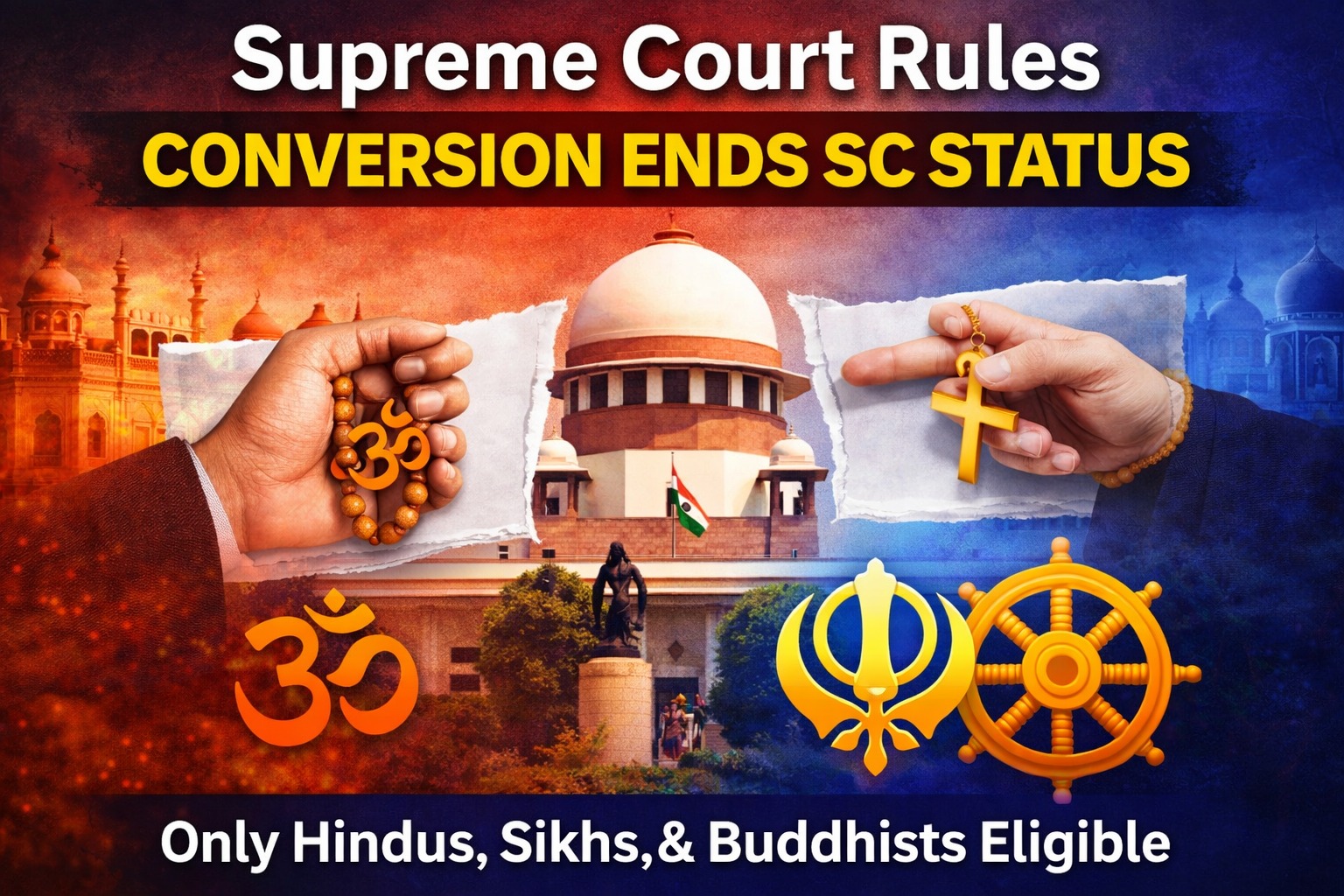
Supreme Court Rules Conversion Ends SC Status, Limits Eligibility to Hindus, Sikhs, and Buddhists
In a significant legal ruling, the Supreme Court of India has clarified that individuals who convert to religions outside Hinduism, Sikhism, or Buddhism are no longer eligible to claim Scheduled Caste (SC) status.
The judgment, delivered by a bench comprising Justice PK Mishra and Justice NV Anjaria, upholds an earlier decision by the Andhra Pradesh High Court and reinforces the legal framework governing caste-based reservations and protections in India.
Key Takeaway of the Verdict
The Supreme Court ruled that:
- SC status is restricted to individuals practicing Hinduism, Sikhism, or Buddhism
- Conversion to any other religion results in automatic loss of SC status
- The restriction applies regardless of a person’s caste by birth
This interpretation is rooted in the provisions of the Constitution (Scheduled Castes) Order, 1950, which defines eligibility criteria for Scheduled Caste recognition.
Background of the Case
The case originated from a dispute involving a pastor named Anand, who alleged that he had been assaulted on the basis of his caste.
He filed a complaint under the SC/ST (Prevention of Atrocities) Act, which provides legal protection against caste-based discrimination and violence.
However, the accused argued that:
- Anand had converted to Christianity
- He was actively practicing as a pastor
- Therefore, he was no longer eligible for SC status or protection under the Act
Andhra Pradesh High Court’s Earlier Ruling
The Andhra Pradesh High Court had previously ruled that:
- The caste system is not recognized within Christianity
- Individuals who convert and actively practice Christianity cannot retain SC status
- Such individuals are not entitled to protections under the SC/ST Act
Based on this reasoning, the High Court quashed the charges filed under the Act.
The petitioner then approached the Supreme Court, challenging this decision.
Supreme Court’s Observations
While upholding the High Court’s ruling, the Supreme Court made several critical observations:
- Absolute Nature of the 1950 Order
The court emphasized that the Constitution (Scheduled Castes) Order, 1950 clearly states that:
- SC status is limited to specific religions
- Conversion to any other religion results in immediate and absolute loss of status
- Religion and Caste Linkage
The judgment highlighted the legal understanding that the caste system, as recognized under Indian law, is historically associated with:
- Hinduism
- Sikhism
- Buddhism
Therefore, individuals practicing other religions cannot claim benefits tied to caste-based classifications under this framework.
- No Evidence of Reconversion
The court noted that the petitioner:
- Continued to practice Christianity
- Had been functioning as a pastor for over a decade
- Had not re-converted to his original religion
As a result, he could not claim to be part of a Scheduled Caste community.
Implications for SC/ST Act Protection
The ruling has direct implications for the applicability of the SC/ST (Prevention of Atrocities) Act.
Key points include:
- Only individuals recognized as Scheduled Castes under the 1950 Order can invoke the Act
- Conversion to a non-recognized religion removes eligibility for such protections
- Legal claims under the Act may be dismissed if eligibility criteria are not met
This reinforces the importance of legal status in determining access to protections and benefits.
Legal and Constitutional Context
The Constitution (Scheduled Castes) Order, 1950 remains the foundational legal instrument governing SC classification.
Originally, the Order restricted SC status to Hindus. It was later amended to include:
- Sikhs (in 1956)
- Buddhists (in 1990)
However, it does not extend SC status to individuals practicing other religions such as Christianity or Islam.
Broader Social and Policy Debate
The issue of caste and religion has long been a subject of debate in India.
Arguments Supporting the Current Framework
- SC status is linked to historical social discrimination rooted in specific religious contexts
- Extending benefits beyond these contexts may dilute the purpose of affirmative action
Arguments for Reform
- Some groups argue that caste-based discrimination persists even after conversion
- There have been demands to extend SC status irrespective of religion
While the Supreme Court’s ruling adheres to existing legal provisions, the broader debate remains ongoing.
Impact on Reservation and Welfare Benefits
Scheduled Caste status provides access to various benefits, including:
- Educational reservations
- Employment quotas
- Legal protections
- Welfare schemes
The ruling clarifies that these benefits are contingent upon both:
- Caste identity
- Religious affiliation
This may affect individuals who have converted but continue to face social disadvantages.
Judicial Consistency and Precedent
The judgment aligns with previous legal interpretations of the 1950 Order.
By reaffirming the “absolute” nature of the rule, the Supreme Court has:
- Strengthened legal clarity
- Reduced ambiguity in similar cases
- Set a clear precedent for future disputes
Challenges and Future Considerations
Despite the clarity provided by the ruling, certain challenges remain:
- Addressing discrimination faced by converted individuals
- Balancing legal definitions with social realities
- Evaluating potential policy reforms
These issues may require legislative intervention rather than judicial interpretation.
The Road Ahead
The ruling underscores the importance of adhering to constitutional provisions while also highlighting the evolving nature of social justice debates in India.
Future developments may include:
- Policy discussions on extending benefits
- Further legal challenges
- Societal dialogue on caste and religion
For now, the Supreme Court’s decision provides a definitive interpretation of the existing legal framework.
Summary
The Supreme Court of India has ruled that individuals who convert to religions other than Hinduism, Sikhism, or Buddhism lose their Scheduled Caste status. Upholding the Andhra Pradesh High Court’s decision, the court stated that this restriction under the Constitution (Scheduled Castes) Order, 1950 is absolute.
The judgment also clarified that such individuals cannot invoke protections under the SC/ST (Prevention of Atrocities) Act. The ruling reinforces existing legal provisions while continuing to fuel broader debates on caste, religion, and social justice in India.
Disclaimer
This article is based on publicly available court proceedings and legal reports at the time of publication. It is intended for informational and educational purposes only and should not be construed as legal advice.
Legal interpretations may evolve, and readers are advised to refer to official court documents or consult legal professionals for detailed understanding.
NoCap Times does not independently verify all claims and shall not be held responsible for any inaccuracies or omissions.