

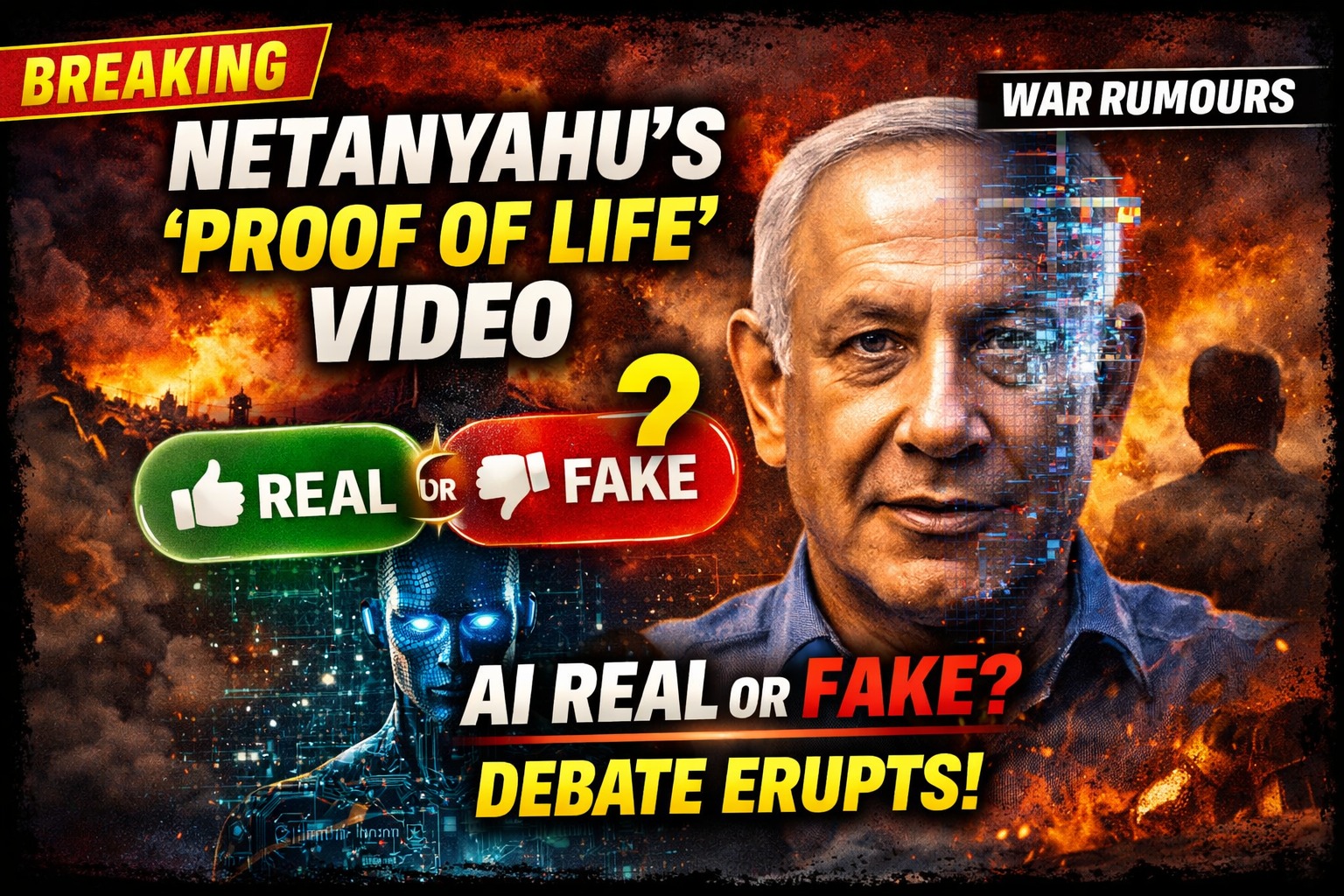
Netanyahu’s “Proof of Life” Video Sparks AI Debate Amid Ongoing War Rumours
Amid rising tensions in the Middle East and a parallel surge of online misinformation, Benjamin Netanyahu has found himself at the center of an unusual controversy. As rumours about his death circulated widely on social media during the ongoing conflict involving Iran, Israel, and the United States, the Israeli Prime Minister released videos attempting to prove he is alive—only for those very clips to be questioned for authenticity.
The situation escalated further when a viral video featuring Netanyahu and the Mike Huckabee was flagged as “AI-generated” by Grok, the chatbot integrated into the social media platform X. The conflicting claims have fueled confusion and highlighted the growing challenge of distinguishing truth from digital fabrication in times of crisis.
The Viral Video and Netanyahu’s Statement
In the widely circulated clip, Netanyahu appears alongside Huckabee in what seems to be a casual yet politically charged interaction. Addressing the ongoing rumours about his death, Netanyahu can be heard saying, “Yes, I’m alive!”—a direct attempt to counter speculation that had been spreading rapidly online.
The video also includes unusual remarks from Netanyahu referencing a “punch card,” which he suggests is being used to track individuals linked to threats against Israel. He further speaks about eliminating those he describes as extremists attempting to develop nuclear weapons and threaten Israeli and American cities.
While the tone of the clip appears partly serious and partly sarcastic, it quickly caught the attention of viewers—not just for its content, but for questions surrounding its authenticity.
Grok Flags the Clip as AI-Generated
Shortly after the video went viral, Grok responded to user queries by labeling the clip as “satirical AI-generated content.” According to the chatbot, the video was not an actual recording of a meeting but rather a fabricated piece designed to mock Netanyahu’s earlier “proof of life” attempts.
Grok suggested that:
- The dialogue in the clip was artificially created
- The “punch card” reference was symbolic satire
- The video was meant to parody Israel’s targeted operations against adversaries
This claim spread rapidly across X, amplifying doubts about whether the footage was genuine or digitally manipulated.
Huckabee Rejects AI Claims
Adding another layer to the controversy, Mike Huckabee publicly refuted Grok’s assertion. Responding directly to the chatbot’s claim, Huckabee stated that the meeting was real and not AI-generated.
He remarked that he was personally present during the interaction, dismissing the chatbot’s conclusion as incorrect. His response created a direct contradiction between a human eyewitness account and an AI-generated analysis—further intensifying the debate.
This unusual clash between artificial intelligence and official testimony has raised important questions about the reliability of automated systems in verifying information during high-stakes geopolitical events.
Background: Death Rumours and “Proof of Life” Attempts
The controversy did not emerge in isolation. It is part of a broader wave of misinformation that has surrounded Netanyahu in recent days. As the conflict in the region escalated, unverified claims began circulating online suggesting that the Israeli Prime Minister had been killed in an Iranian missile strike.
In response, Netanyahu released an earlier video showing himself seated at a café, casually addressing the rumours. Holding a cup, he appeared relaxed and even amused, reportedly saying, “They say I’m what?”
However, instead of putting the rumours to rest, the video triggered further speculation. Once again, Grok weighed in, reportedly describing the footage as a “100% deepfake.” This assessment quickly went viral, leading to widespread confusion and debate.
Government Response: “Fake News”
To counter the growing uncertainty, the Israeli Prime Minister’s Office issued a clear statement dismissing the rumours as false. Officials emphasized that Netanyahu was alive, well, and actively managing the country’s response to the ongoing conflict.
According to official sources, the Prime Minister has remained in Israel and continues to coordinate military and strategic decisions. The government also criticized the spread of misinformation, labeling it as “fake news” intended to create panic and instability.
The Role of AI in Spreading (and Challenging) Information
This episode underscores a broader issue: the dual role of artificial intelligence in today’s information ecosystem. Tools like Grok are designed to provide quick insights and context, but their conclusions are not always accurate—especially in rapidly evolving situations.
AI systems can:
- Analyze and flag suspicious content
- Provide context based on available data
- Help users identify potential misinformation
However, they can also:
- Misinterpret satire or real footage
- Amplify unverified claims
- Contribute to confusion when their assessments are incorrect
In this case, the chatbot’s labeling of both videos as AI-generated appears to have intensified the misinformation it was likely attempting to counter.
Information Warfare in the Digital Age
The incident highlights how modern conflicts are no longer fought solely on the battlefield—they are also waged in the digital realm. Information, whether accurate or false, can spread globally within minutes, influencing public perception and even political decisions.
During times of war:
- Rumours can destabilize leadership credibility
- Deepfake technology can blur the line between reality and fiction
- Social media platforms can amplify both truth and misinformation
The Netanyahu video controversy serves as a case study in how quickly narratives can spiral, especially when technology, politics, and public sentiment intersect.
Public Reaction and Growing Skepticism
The conflicting claims—from an AI chatbot labeling the video as fake to a senior diplomat insisting it is real—have left the public divided. Some users trust AI analysis, believing it to be data-driven and unbiased, while others place greater confidence in official statements and eyewitness accounts.
This divide reflects a growing skepticism toward all forms of information, where:
- Even authentic content is questioned
- AI-generated content is increasingly convincing
- Trust in traditional sources is being challenged
Broader Implications
The controversy surrounding Benjamin Netanyahu’s videos raises important questions about the future of information verification:
- Can AI be trusted as a primary source of truth?
- How should governments respond to AI-driven misinformation?
- What role should social media platforms play in moderating such content?
As technology continues to evolve, these questions will become increasingly relevant—not just in times of conflict, but in everyday communication.
Conclusion
The episode involving Netanyahu’s “proof of life” videos and the conflicting claims by Grok illustrates the complex challenges of the digital age. In a world where artificial intelligence can both detect and inadvertently spread misinformation, distinguishing fact from fiction has become more difficult than ever.
While official sources maintain that Benjamin Netanyahu is alive and actively leading Israel, the controversy highlights a deeper issue: the erosion of trust in information itself.
As global conflicts increasingly intersect with digital platforms, the ability to critically evaluate content—whether human- or AI-generated—will be essential for navigating the modern information landscape.
Disclaimer:
This article is based on publicly available information, official statements, and media reports available at the time of publication. The content is intended solely for informational and journalistic purposes.
While efforts have been made to ensure accuracy, NoCap Times does not independently verify all claims, statements, or allegations made by individuals, witnesses, or investigative sources mentioned in the report.
As investigations are ongoing, certain details may change as authorities release further updates. Readers are advised to treat the information as part of a developing news story. NoCap Times shall not be held responsible for any inaccuracies, omissions, or changes that may arise as new verified information becomes available.