

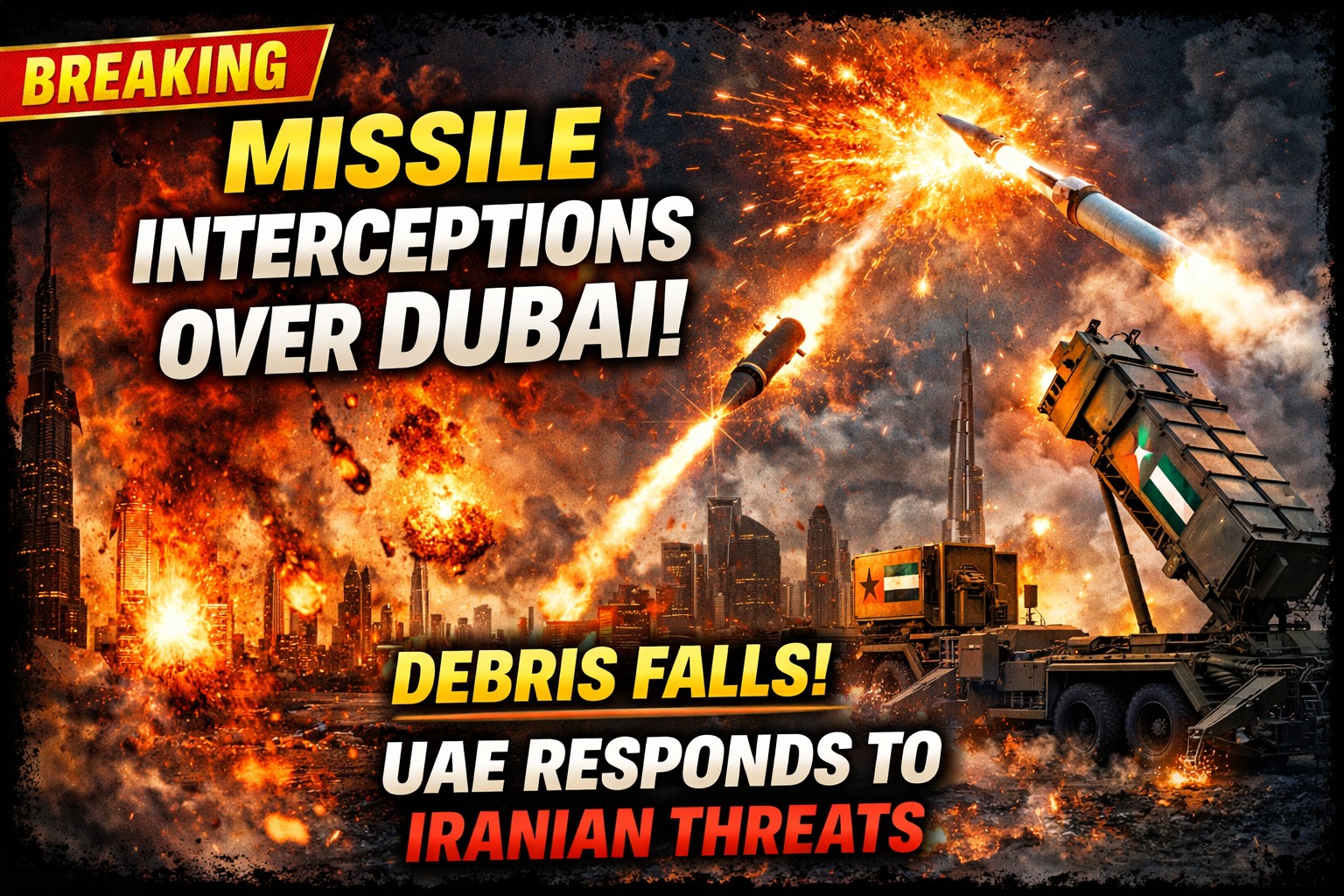
Missile Interceptions Over Dubai: Debris Falls as UAE Air Defences Respond to Iranian Threats
Tensions in the Middle East escalated further as burning debris from intercepted missiles was seen falling over parts of Dubai on Wednesday. The dramatic scenes unfolded after air defence systems in the United Arab Emirates were activated to neutralize incoming missile and drone threats reportedly launched from Iran.
Eyewitness accounts and videos circulating on social media captured interceptor missiles streaking across the sky, followed by fiery fragments descending over urban areas. The incident has raised fresh concerns about civilian safety and the widening scope of the ongoing regional conflict.
Interceptions Over a Major Urban Hub
Residents across Dubai reported hearing loud explosions as air defence systems engaged hostile projectiles mid-air. According to multiple eyewitness videos, interceptors were launched rapidly, successfully striking incoming missiles before they could reach their intended targets.
However, the destruction of these threats in the sky led to an unintended consequence—burning debris falling over populated areas. Some of these fragments were seen descending near the Dubai International Convention and Exhibition Centre, a key location in the city.
While no immediate large-scale damage was reported in Dubai itself, the visuals of falling debris highlighted the risks associated with aerial interceptions in densely populated regions.
Official Confirmation from Authorities
Shortly after the incident, the Dubai Media Office issued a statement confirming that the explosions heard across the city were the result of successful air defence operations.
Authorities urged residents to rely on verified sources for information and avoid spreading unconfirmed reports. The message was aimed at maintaining calm and preventing panic amid the unfolding situation.
Simultaneously, the UAE Ministry of Defence confirmed that its air defence systems were actively intercepting missiles and drones. The ministry emphasized that the loud sounds heard across various parts of the city were linked to these defensive measures.
Temporary Airspace Disruptions
The incident also had an immediate impact on aviation. Dubai, one of the world’s busiest international transit hubs, briefly suspended its airspace as a precautionary measure.
This marked the second disruption to flight operations in as many days, underscoring the growing impact of the conflict on global travel and logistics. Airlines were forced to reroute flights, while passengers experienced delays and uncertainty.
Such disruptions not only affect regional connectivity but also have ripple effects across international travel networks.
Wider Impact Across the UAE
While Dubai avoided major casualties, other parts of the United Arab Emirates were less fortunate. Authorities reported that an oil facility in Fujairah was struck during the attacks, raising concerns about energy infrastructure security.
In Abu Dhabi, a man was killed after being hit by debris from an intercepted missile. This tragic incident brought the total number of fatalities in the UAE since the start of the conflict to eight.
These developments highlight the increasing human and economic cost of the ongoing hostilities, even in countries not directly engaged in frontline combat.
Iran’s Position and Retaliation Strategy
Iran has stated that its recent missile and drone launches are part of a broader retaliatory strategy. Iranian officials claim these actions are in response to airstrikes conducted by the United States and Israel, which they say resulted in the deaths of key leaders and military commanders, including their supreme leader.
Tehran has maintained that it is targeting strategic assets linked to its adversaries, particularly American interests in the Gulf region. This approach signals a shift toward a wider regional confrontation, where multiple countries are being drawn into the conflict.
Rising Risks for Civilian Areas
The incident in Dubai underscores a critical concern: the increasing overlap between military operations and civilian spaces. While air defence systems are designed to protect lives and infrastructure, interceptions over populated areas carry inherent risks.
Key concerns include:
- Falling debris causing injuries or fatalities
- Damage to buildings and infrastructure
- Panic and disruption among residents
Urban centers like Dubai, with dense populations and critical infrastructure, are particularly vulnerable to such unintended consequences.
Strategic Importance of the UAE
The United Arab Emirates holds significant strategic importance in the region. It serves as:
- A global aviation hub
- A major center for trade and finance
- A key player in the global energy market
Any instability in the UAE has far-reaching implications, not just for the Middle East but for the global economy. The targeting of infrastructure in cities like Fujairah further amplifies these concerns, particularly in relation to oil supply chains.
Escalation of Regional Conflict
The missile interceptions over Dubai are part of a broader pattern of escalating hostilities across the Middle East. The conflict, initially centered around direct confrontations between Iran and its adversaries, is now affecting multiple countries and critical infrastructure.
Key developments include:
- Missile and drone attacks across Gulf nations
- Airstrikes in various parts of the region
- Increasing involvement of global powers
This expansion raises the risk of a prolonged and more complex conflict, with potentially severe humanitarian and economic consequences.
Global Implications
The events in Dubai are not isolated—they reflect a growing global concern. The Middle East plays a crucial role in:
- Energy production and supply
- International trade routes
- Geopolitical stability
Disruptions in the region can lead to:
- Rising fuel prices worldwide
- Increased shipping costs
- Market volatility
As tensions continue to rise, the international community is closely monitoring the situation, with calls for restraint and diplomatic resolution becoming increasingly urgent.
Conclusion
The interception of Iranian missiles over Dubai and the resulting debris falling across parts of the city mark an escalation in the ongoing Middle East conflict. While the UAE Ministry of Defence successfully neutralized incoming threats, the incident highlights the growing risks faced by civilian populations.
As Iran continues its retaliatory actions and regional tensions intensify, the possibility of further incidents remains high. The situation underscores the urgent need for diplomatic efforts to prevent further escalation and ensure stability in a region that is vital to the global economy.
Disclaimer:
This article is based on publicly available information, official statements, and media reports available at the time of publication. The content is intended solely for informational and journalistic purposes.
While efforts have been made to ensure accuracy, NoCap Times does not independently verify all claims, statements, or allegations made by individuals, witnesses, or investigative sources mentioned in the report.
As investigations are ongoing, certain details may change as authorities release further updates. Readers are advised to treat the information as part of a developing news story. NoCap Times shall not be held responsible for any inaccuracies, omissions, or changes that may arise as new verified information becomes available.