

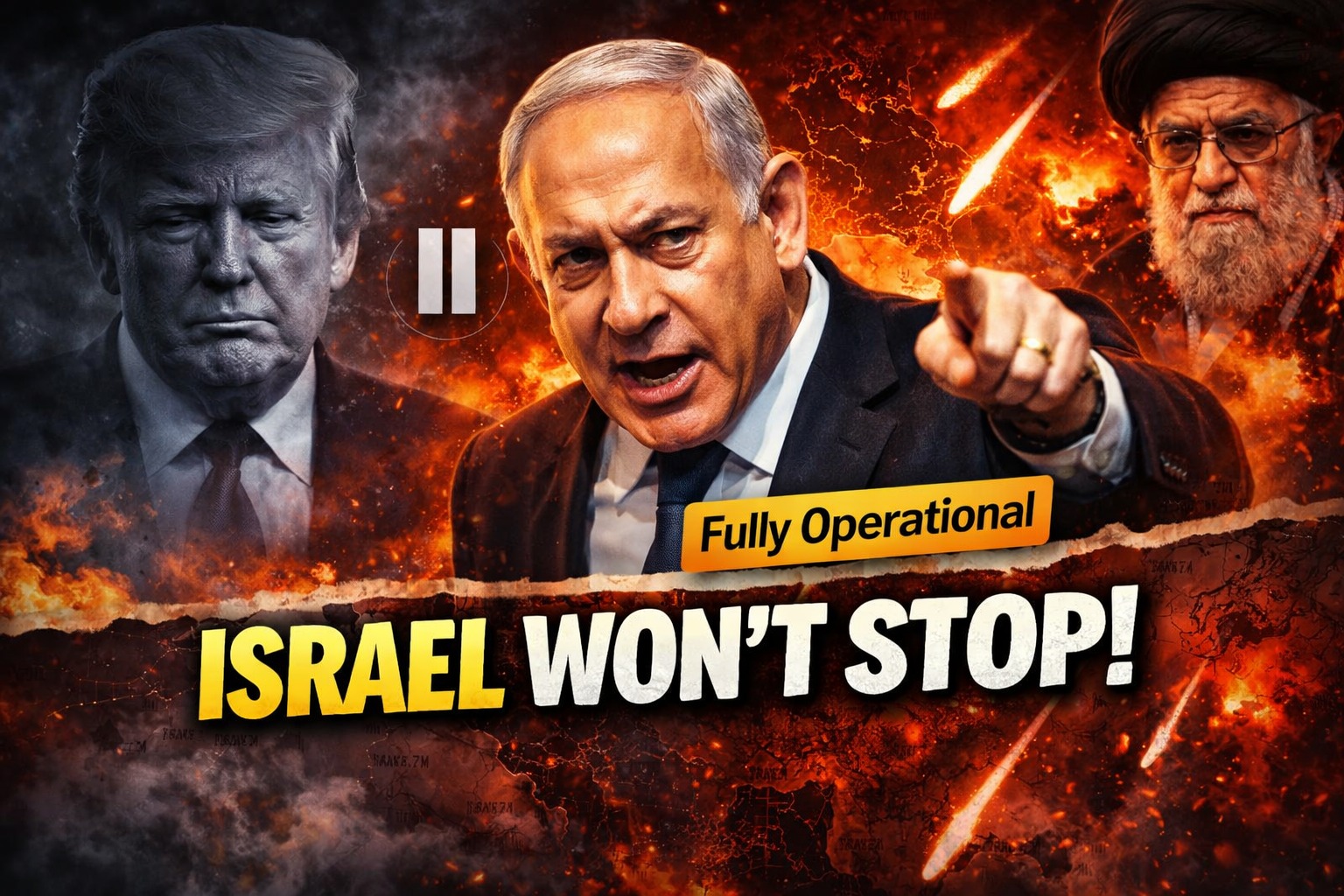
Netanyahu Breaks Silence After Trump’s Surprise Iran Strike Pause: “Israel Remains Fully Operational”
In a dramatic turn of events amid the escalating Middle East conflict, Benjamin Netanyahu has issued his first public response following an unexpected announcement by Donald Trump to temporarily halt planned military strikes against Iran. The five-day pause, declared on March 23, has stirred intense global reactions, with Israel signaling that its military operations are far from over.
Netanyahu, in a firm and calculated statement, reassured both domestic and international audiences that Israel’s strategic objectives remain unchanged. Emphasizing national security priorities, he stated that Israel will continue to act decisively to protect its “vital interests,” particularly in the face of ongoing threats from Iran and its regional allies.
Netanyahu’s Strong Message: “We Are Still Active”
Breaking his silence, Netanyahu delivered a video address underscoring Israel’s unwavering military stance. While acknowledging ongoing diplomatic developments, he made it clear that Israel is not stepping back from its operations.
“We are actively working to dismantle threats posed by Iran’s missile and nuclear programs,” Netanyahu said. “Our forces are also continuing targeted operations against Hezbollah. Just days ago, we eliminated two key nuclear scientists. Our reach remains extended, and our mission continues.”
His remarks reflect Israel’s continued reliance on both defensive and offensive strategies in the region. The mention of eliminating nuclear scientists highlights Israel’s long-standing policy of preemptive action against perceived existential threats.
Netanyahu’s tone suggested cautious optimism about diplomatic efforts but made it evident that Israel will not compromise on its security concerns.
Behind Closed Doors: Netanyahu and Trump in Constant Contact
The Israeli Prime Minister also revealed that he has been in close communication with President Trump throughout the evolving situation. According to Netanyahu, the two leaders discussed the possibility of leveraging recent military gains to reach a broader agreement with Iran.
Trump reportedly conveyed his belief that the combined pressure exerted by both Israeli and American forces could create an opportunity for a negotiated settlement—one that aligns with Israel’s security priorities.
Netanyahu described Trump as a “friend of Israel” and emphasized the importance of coordination between the two nations. Reports indicate that Israeli leadership was not caught off guard by Trump’s announcement. Instead, they had prior knowledge of backchannel communications between Washington and Tehran.
Israeli media sources suggest that initial awareness of potential diplomatic engagement surfaced around March 19, when signals of indirect talks began emerging.
Further reinforcing the depth of coordination, Netanyahu is also believed to have spoken with JD Vance regarding efforts to revive negotiations with Iran.
Trump’s Surprise Move: A Strategic Pause or Tactical Gamble?
President Trump’s decision to halt military strikes came as a surprise to many observers. Just hours before the announcement, tensions were at a boiling point, with the United States preparing for targeted attacks on Iran’s critical infrastructure, including energy facilities and power plants.
In a sudden shift, Trump declared a five-day suspension of these operations, citing “very good” and “constructive” discussions with an unnamed Iranian official.
He further stated that diplomatic engagement would continue throughout the week, raising hopes—albeit cautiously—of a possible breakthrough.
The timing of this announcement is particularly significant. Trump had previously issued a stern ultimatum to Iran: reopen the strategically vital Strait of Hormuz or face devastating military consequences. The Strait, a critical artery for global oil supply, has been a focal point of the conflict.
By pausing military action just before the deadline, Trump appears to be testing diplomatic waters while maintaining leverage.
Iran’s Firm Denial: “No Talks, No Compromise”
While Washington portrayed the situation as a step toward de-escalation, Tehran responded with outright rejection.
Ibrahim Rezaei, spokesperson for Iran’s National Security Commission, dismissed Trump’s claims as baseless. He described the idea of negotiations under current conditions as illogical and accused the United States of attempting to impose its will through coercion.
According to Rezaei, Iran does not engage in dialogue under pressure. He emphasized that the country views the current U.S. approach as aggressive and insincere.
Adding to the rejection, Mohammad Bagher Ghalibaf labeled reports of negotiations as “fake news.” He further accused Trump of using such claims to manipulate global energy markets, suggesting that the announcement might be driven by economic considerations rather than genuine diplomatic intent.
Iranian officials have consistently maintained that their strategic positions remain unchanged. They reiterated that any attack on the nation’s infrastructure—especially energy facilities—would provoke a swift and forceful military response.
War of Narratives: Diplomacy vs. Deterrence
The stark contrast between U.S. claims and Iranian denials highlights a broader battle—not just on the battlefield, but in the realm of narratives.
On one side, the United States presents the pause as a window for peace, a chance to convert military pressure into diplomatic gains. On the other, Iran frames it as a sign of weakness, asserting that Washington is seeking an exit from a conflict it cannot control.
This divergence raises important questions:
Is the pause a genuine attempt at de-escalation, or a tactical maneuver to regroup?
Are backchannel negotiations actually taking place, or is this a strategic information play?
For Israel, the answer seems secondary. Netanyahu’s message indicates that regardless of diplomatic developments, Israel will continue its operations independently if necessary.
The Role of Hezbollah and Regional Implications
Another critical dimension of the conflict is Israel’s ongoing confrontation with Hezbollah. Backed by Iran, Hezbollah represents a significant threat on Israel’s northern border.
Netanyahu confirmed that Israeli forces are continuing to target Hezbollah positions, signaling that the conflict is not limited to Iran alone but extends to its regional network.
This multi-front engagement increases the risk of a broader regional war. Any escalation involving Hezbollah could draw in Lebanon more directly, further destabilizing the already volatile Middle East.
Strait of Hormuz: The Global Stakes
At the heart of the crisis lies the Strait of Hormuz, one of the most critical chokepoints for global oil transportation. Any disruption in this narrow passage can have far-reaching consequences for the global economy.
Iran has repeatedly used the threat of closing the Strait as leverage in its standoff with the West. The U.S. ultimatum to reopen the route underscores its importance not just strategically, but economically.
Trump’s decision to pause strikes just before enforcing his deadline suggests a calculated approach—balancing military pressure with the need to avoid triggering a global energy crisis.
What Lies Ahead?
As the five-day pause unfolds, the situation remains highly fluid. Several scenarios could emerge:
- Diplomatic Breakthrough: If backchannel talks materialize into formal negotiations, the region could see a temporary easing of tensions.
- Renewed Escalation: Failure to achieve progress may lead to resumed military action, potentially more intense than before.
- Prolonged Standoff: A middle path where neither side escalates significantly, but tensions remain high.
For now, Israel appears prepared for all outcomes. Netanyahu’s assertive stance signals that Israel will not rely solely on diplomacy and will continue to pursue its objectives through military means if required.
Summary
The ongoing conflict involving the United States, Israel, and Iran has entered a complex and uncertain phase. Following President Donald Trump’s unexpected decision to pause planned military strikes on Iran for five days, Israeli Prime Minister Benjamin Netanyahu reaffirmed that Israel remains fully active in its military operations.
Netanyahu emphasized that Israel will continue targeting Iran’s missile and nuclear programs, as well as Hezbollah, regardless of diplomatic developments. While Trump claimed that constructive talks with Iran are underway, Iranian officials strongly denied any negotiations, dismissing the claims as false and politically motivated.
The situation reflects a broader clash between diplomacy and military strategy, with each side presenting contrasting narratives. As tensions remain high and the global community watches closely, the next few days will be crucial in determining whether the region moves toward de-escalation or deeper conflict.
Disclaimer:
This article is based on publicly available information, official statements, and media reports available at the time of publication. The content is intended solely for informational and educational purposes.
While efforts have been made to ensure accuracy, NoCap Times does not independently verify all claims, statements, or allegations made by individuals, witnesses, or investigative sources mentioned in the report.
NoCap Times shall not be held responsible for any inaccuracies, omissions, or changes that may arise as new verified information becomes available.