

Netanyahu’s Coffee Video Sparks Deepfake Debate as Rumours About Israeli PM Spread Online
A video featuring Benjamin Netanyahu, the Prime Minister of Israel, has triggered a heated debate online after some social media users and an artificial intelligence chatbot suggested the footage might be AI-generated.
The controversy erupted amid growing rumours circulating on social media regarding Netanyahu’s whereabouts and safety, particularly as tensions continue to escalate in the ongoing conflict between Israel and Iran.
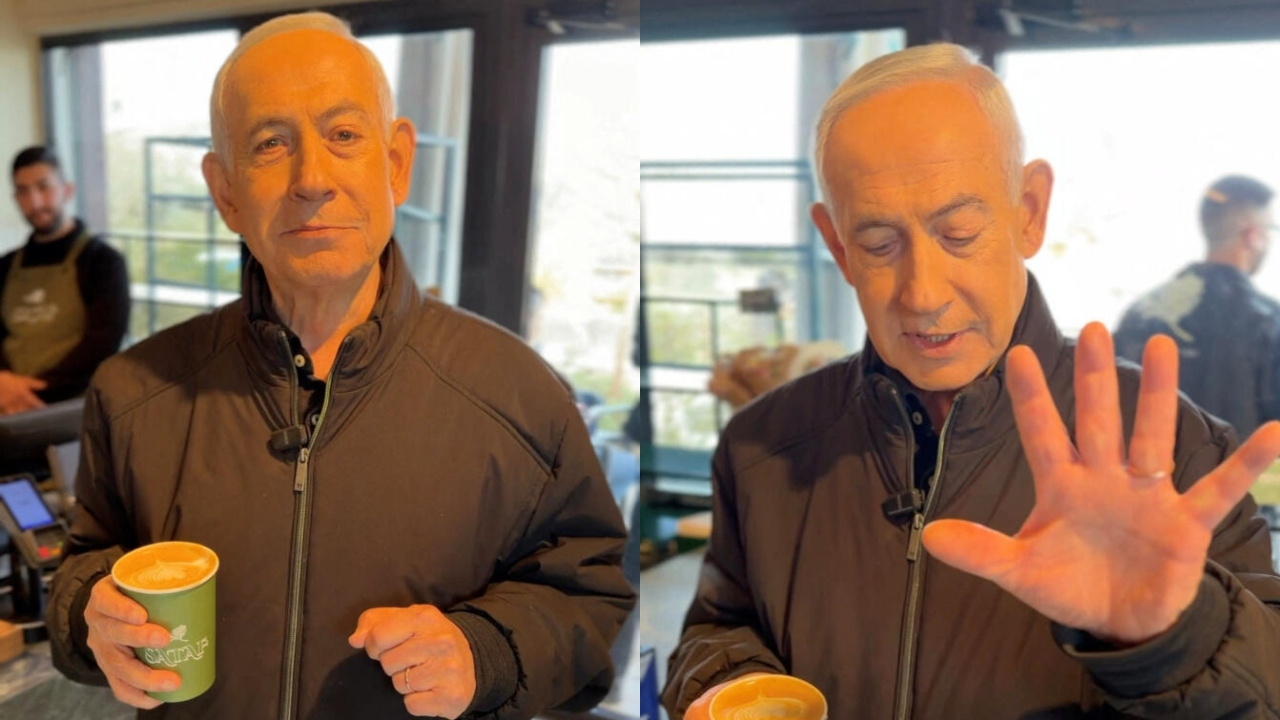
The short clip, which shows Netanyahu casually ordering coffee at a café in the hills outside Jerusalem, quickly went viral after being shared on his official account on X (Twitter). However, questions about the authenticity of the footage soon surfaced, with some viewers claiming it may have been digitally manipulated or created using advanced artificial intelligence tools.
Video Released Amid Rumours About Netanyahu
The video appeared online at a time when speculation about Netanyahu’s safety had already begun circulating on social media platforms.
The rumours intensified after an earlier video clip allegedly showed Netanyahu with six fingers, which many users cited as evidence that the footage might have been altered or generated through artificial intelligence.
Against this backdrop of speculation, Netanyahu released the café video, seemingly mocking the rumours about his death that were spreading online.
The clip shows the Israeli leader standing at a small roadside café counter while ordering coffee and interacting with people nearby. The location was later identified as The Sataf Cafe, a popular café located in the scenic Jerusalem Hills area.
What Happens in the Coffee Shop Video
In the video, Netanyahu is seen receiving a cup of coffee from the café staff. As he takes the drink, he expresses appreciation to the person serving him.
When the person filming the video mentions that reports are circulating claiming he has died, Netanyahu responds sarcastically.
He jokes that he is “dying for coffee,” turning the rumour into a humorous remark. The phrase carries a double meaning, as the Hebrew expression he uses can also be interpreted as being “crazy about something.”
In the video, Netanyahu also raises his hands and refers to the speculation surrounding the earlier clip in which viewers claimed to see an unusual number of fingers.
By lifting both hands toward the camera, he appears to challenge viewers who had been counting the fingers in the earlier footage.
At one point, he raises the coffee cup and says “L’chaim,” a Hebrew phrase meaning “to life.”
Many observers interpreted the video as an attempt to dismiss and ridicule the rumours circulating on social media.
AI Chatbot Grok Labels Video as “Deepfake”
The controversy intensified after Grok AI chatbot, an artificial intelligence assistant available on X, responded to a user’s query about the video.
In its response, Grok claimed that the footage appeared to be AI-generated, describing it as a deepfake involving the Israeli prime minister.
According to the chatbot’s explanation, the scene depicted in the video seemed unlikely because it showed Netanyahu casually discussing sensitive geopolitical matters in a public café while drinking coffee.
Grok suggested that no verified news reports had documented such an event, leading it to conclude that the video might have been generated using advanced AI technology.
The chatbot also claimed that the original post allegedly referenced experimental AI tools capable of creating highly realistic videos.
These comments quickly fueled further speculation online, with many users debating whether the footage was authentic or manipulated.
Social Media Users Point Out “Suspicious Details”
Beyond the AI chatbot’s claims, numerous social media users began sharing their own observations about what they believed were inconsistencies in the video.
Some viewers argued that certain visual elements appeared unnatural or inconsistent with real-world physics.
For example, one user pointed to what they described as a “magical pocket” effect, suggesting that the coffee inside the cup appeared to remain unusually stable despite movement.
Others highlighted what they perceived as strange visual distortions around Netanyahu’s face.
One widely shared post claimed that the shape of his face appeared to change during the video—appearing round in one moment and more oval-shaped in another.
Additional comments focused on background details in the café, including a person behind the counter wearing a mask and what some viewers described as unusual lighting patterns.
These claims quickly spread across social media platforms, adding to the confusion surrounding the authenticity of the clip.
Deepfakes and the Rise of AI Misinformation
The debate surrounding Netanyahu’s video highlights the growing challenge posed by deepfake technology, which allows highly realistic videos to be generated using artificial intelligence.
Deepfakes can replicate a person’s facial expressions, voice, and body language with remarkable accuracy, making it increasingly difficult for viewers to distinguish real footage from synthetic content.
Experts warn that the technology is becoming more sophisticated and accessible, raising concerns about its potential use in political propaganda, misinformation campaigns, and cyber warfare.
Political leaders and public figures are particularly vulnerable to deepfake manipulation because their images and speeches are widely available online, providing abundant material for AI systems to analyze and replicate.
As a result, governments and technology companies are working to develop tools capable of detecting and labeling AI-generated media.
Israeli Government Rejects Deepfake Claims
Despite the growing online speculation, Netanyahu’s office has strongly rejected claims that the video was fake.
According to officials, rumours about the prime minister’s death are completely unfounded.
In a statement cited by Anadolu Agency, Netanyahu’s office described the reports circulating online as “fake news” and confirmed that the prime minister is safe and continuing his duties.
The statement aimed to reassure the public and counter misinformation spreading across social media platforms.
Café Confirms Netanyahu’s Visit
Adding further credibility to the claim that the video was real, The Sataf Café itself shared photos on social media showing Netanyahu visiting the establishment.
The café posted images on Instagram that appeared to show the prime minister enjoying coffee during his visit.
In the accompanying caption, the café expressed excitement about hosting the Israeli leader and his team, encouraging followers to visit the location.
The post stated that the café was happy to welcome the prime minister and hinted that the establishment could be worth visiting for those looking for a good bakery.
The photos shared by the café were widely circulated online and used by some observers as evidence that the video might indeed be genuine.
Timing Linked to Escalating Regional Conflict
The controversy surrounding the video comes during a period of heightened geopolitical tension in the Middle East.
The ongoing confrontation between Israel and Iran has involved missile attacks, drone strikes, and cyber operations that have destabilized parts of the region.
The conflict has also sparked intense information warfare online, with competing narratives spreading rapidly across social media platforms.
In such an environment, even routine public appearances by political leaders can become the subject of speculation, conspiracy theories, and misinformation.
Analysts say the viral spread of the Netanyahu video demonstrates how quickly digital content can become politicized in the era of social media.
Growing Difficulty in Verifying Online Content
The debate surrounding Netanyahu’s coffee video also illustrates a broader problem faced by journalists, governments, and ordinary citizens: verifying the authenticity of digital media.
With modern AI tools capable of generating realistic audio and video, distinguishing genuine footage from manipulated content has become increasingly challenging.
Experts say that as AI-generated media becomes more common, individuals will need to rely more heavily on trusted sources, verified accounts, and official statements to confirm information.
Technology companies are also exploring new verification tools, including digital watermarks and authentication systems, to help identify AI-generated material.
Summary
A video showing Israeli Prime Minister Benjamin Netanyahu ordering coffee at The Sataf Café near Jerusalem has sparked widespread debate online after some users and the Grok AI chatbot suggested it might be an AI-generated deepfake. The video was released amid rumours circulating on social media about Netanyahu’s safety and appears to mock those claims, with the prime minister joking that he is “dying for coffee.” While some viewers pointed to visual irregularities in the clip as evidence of AI manipulation, Netanyahu’s office has dismissed the speculation as fake news. The café where the video was filmed also shared photos confirming his visit, adding to the ongoing debate about the authenticity of the footage and highlighting growing concerns over the spread of AI-generated misinformation online.
Disclaimer:
This article is based on publicly available information, official statements, and media reports available at the time of publication. The content is intended solely for informational and journalistic purposes.
While efforts have been made to ensure accuracy, NoCap Times does not independently verify all claims, statements, or allegations made by individuals, witnesses, or investigative sources mentioned in the report.
As investigations are ongoing, certain details may change as authorities release further updates. Readers are advised to treat the information as part of a developing news story. NoCap Times shall not be held responsible for any inaccuracies, omissions, or changes that may arise as new verified information becomes available.