

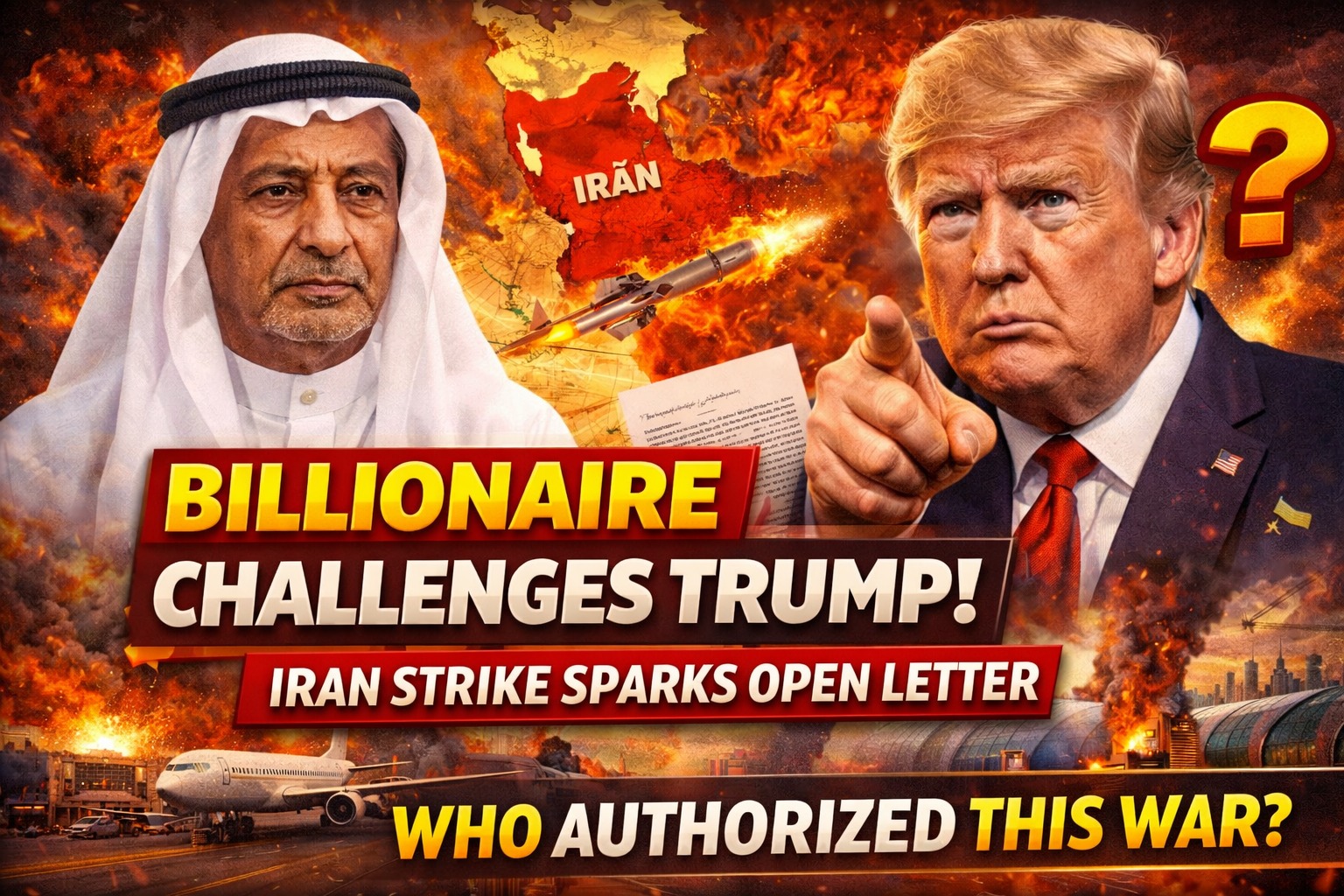
UAE Billionaire Khalaf Al Habtoor Questions Donald Trump Over Iran Strike in Open Letter
Prominent Khalaf Al Habtoor, a leading businessman from the United Arab Emirates, has publicly questioned Donald Trump over the decision to launch military strikes against Iran, warning that the move has dragged the Middle East into a dangerous conflict that many regional nations did not choose.
In an open letter addressed to the US president and shared on the social media platform X (Twitter), the billionaire founder of Al Habtoor Group raised serious concerns about the geopolitical and economic consequences of the escalating war.
The letter, originally written in Arabic, questioned whether the decision to go to war with Iran was taken independently by Trump or influenced by Benjamin Netanyahu, the Prime Minister of Israel.
Concerns Over Escalating Regional Conflict
The remarks come after the United States and Israel carried out coordinated strikes against Iran, targeting military installations and members of the country’s leadership.
In retaliation, Iran reportedly launched a series of missile and drone attacks against the UAE and other Gulf countries, significantly escalating tensions across the region.
Although many of these projectiles were intercepted by air defence systems, the attacks heightened fears about the possibility of a wider regional war involving multiple nations.
Governments across the Gulf have since called for restraint and urged all parties to pursue diplomatic solutions instead of military escalation.
“Who Gave You the Authority?” Al Habtoor Asks
In his open letter, Khalaf Al Habtoor strongly criticised the decision to initiate military action, arguing that it placed Gulf countries at risk without their consent.
He wrote that the conflict had effectively turned the region into a battlefield for geopolitical rivalries among global powers.
According to Al Habtoor, the people of the Gulf and the wider Arab world should not be forced to bear the consequences of decisions made by foreign leaders.
He questioned whether the US president had the moral or political authority to involve the region in a war that could destabilise economies and threaten the safety of millions of people.
Despite expressing confidence in the defensive capabilities of Gulf states, he warned that the conflict still poses a serious danger to regional stability.
Impact on the Gulf and Arab Nations
Al Habtoor’s criticism reflects broader concerns among business leaders and policymakers in the Gulf region.
The Gulf Cooperation Council (GCC) countries have long sought to position themselves as hubs of economic growth, trade, and investment.
However, escalating military tensions threaten to disrupt these ambitions by creating uncertainty in global markets and deterring investors.
The UAE, in particular, has built its economy around tourism, financial services, logistics, and international trade—sectors that depend heavily on stability and open global connections.
A prolonged conflict could therefore have far-reaching economic consequences not only for the Gulf but also for global energy markets.
Financial Cost of the War
In his letter, Al Habtoor also highlighted the enormous financial cost of the conflict.
Citing estimates from the Institute for Policy Studies, he said that direct military operations could cost between $40 billion and $65 billion, with the total economic impact potentially reaching $210 billion if the war continues for several weeks.
These figures include indirect economic losses, disruptions to trade, and long-term financial consequences for the region.
Al Habtoor argued that such enormous expenses would ultimately be borne by American taxpayers as well as the global economy.
He pointed out that ordinary citizens—both in the United States and in the Middle East—would suffer the consequences of a war they did not choose.
Accusations of Breaking Campaign Promises
Another major point raised in the letter was Trump’s earlier promises to avoid foreign wars.
Al Habtoor accused the US president of contradicting those commitments by ordering military interventions in multiple countries.
According to the UAE businessman, the United States has conducted operations during Trump’s second term in several nations, including Somalia, Iraq, Yemen, Nigeria, Syria, Iran, and Venezuela.
He also referred to naval operations in regions such as the Caribbean Sea and the eastern Pacific Ocean, suggesting that the scale of military engagement had increased significantly.
The businessman further claimed that Trump authorised more than 658 foreign airstrikes during his first year in office, a figure he compared with the total number of strikes carried out during the entire presidency of Joe Biden.
These remarks were intended to highlight what Al Habtoor described as a growing gap between the president’s promises and his actions.
Declining Approval Ratings in the US
Al Habtoor also warned that the decision to engage in another major conflict could have political consequences for the US president at home.
He pointed to reports suggesting that Trump’s approval ratings among American voters had fallen significantly over the past year.
According to the letter, support for the president had declined by around nine percentage points in roughly 400 days, partly due to concerns about foreign policy decisions.
Al Habtoor argued that many Americans are increasingly worried about being drawn into another costly and prolonged war overseas.
He suggested that public opinion in the United States reflects growing unease about the risks posed by the escalating conflict.
Call for Transparency and Accountability
In addition to criticising the war itself, the UAE billionaire demanded greater transparency from political leaders involved in the conflict.
He argued that governments should clearly explain the objectives and consequences of military actions, particularly when they risk affecting millions of people across multiple countries.
If the interventions were truly intended to promote peace and security, he said, leaders should be willing to provide full accountability for their decisions.
Al Habtoor emphasised that people across the Middle East deserve clear answers about why the conflict began and how it will be resolved.
Question of Who Will Pay the Price
In a separate message posted on X, Al Habtoor raised another crucial question: who will ultimately bear the cost of the conflict.
He argued that Gulf countries and other regional states are being forced to deal with the consequences of a war in which they have little direct involvement.
According to him, the economic stability, security, and prosperity of the region are being jeopardised by the geopolitical rivalry between Iran, the United States, and Israel.
He warned that the Middle East should not be treated as a stage for major powers to settle their differences.
Instead, he said, regional countries have worked hard to promote peace, development, and cooperation.
A Call for Calm and Diplomacy
Al Habtoor concluded his message with a call for cooler heads and renewed diplomatic efforts.
He stressed that escalating military responses could push the region toward a broader and more destructive war.
The Middle East, he argued, needs thoughtful leadership and diplomatic dialogue rather than actions that intensify tensions.
For Gulf nations striving to maintain economic growth and political stability, avoiding a wider war is a top priority.
Al Habtoor’s remarks therefore reflect a growing sentiment among regional leaders and business figures who fear that continued escalation could undermine decades of progress.
Summary
UAE billionaire Khalaf Al Habtoor has criticised US President Donald Trump in an open letter over the decision to launch strikes against Iran, questioning who authorised turning the Middle East into a battlefield. The founder of Al Habtoor Group warned that the conflict risks destabilising Gulf countries and imposing huge economic costs on both the region and the United States. Citing estimates from the Institute for Policy Studies, he said the war could cost up to $210 billion if it continues for several weeks. Al Habtoor also accused Trump of breaking promises to avoid foreign wars and urged global leaders to prioritise diplomacy and transparency instead of escalating military tensions.
Disclaimer:
This article is based on publicly available information, official statements, and media reports available at the time of publication. The content is intended solely for informational and journalistic purposes.
While efforts have been made to ensure accuracy, NoCap Times does not independently verify all claims, statements, or allegations made by individuals, witnesses, or investigative sources mentioned in the report.
As investigations are ongoing, certain details may change as authorities release further updates. Readers are advised to treat the information as part of a developing news story. NoCap Times shall not be held responsible for any inaccuracies, omissions, or changes that may arise as new verified information becomes available.