

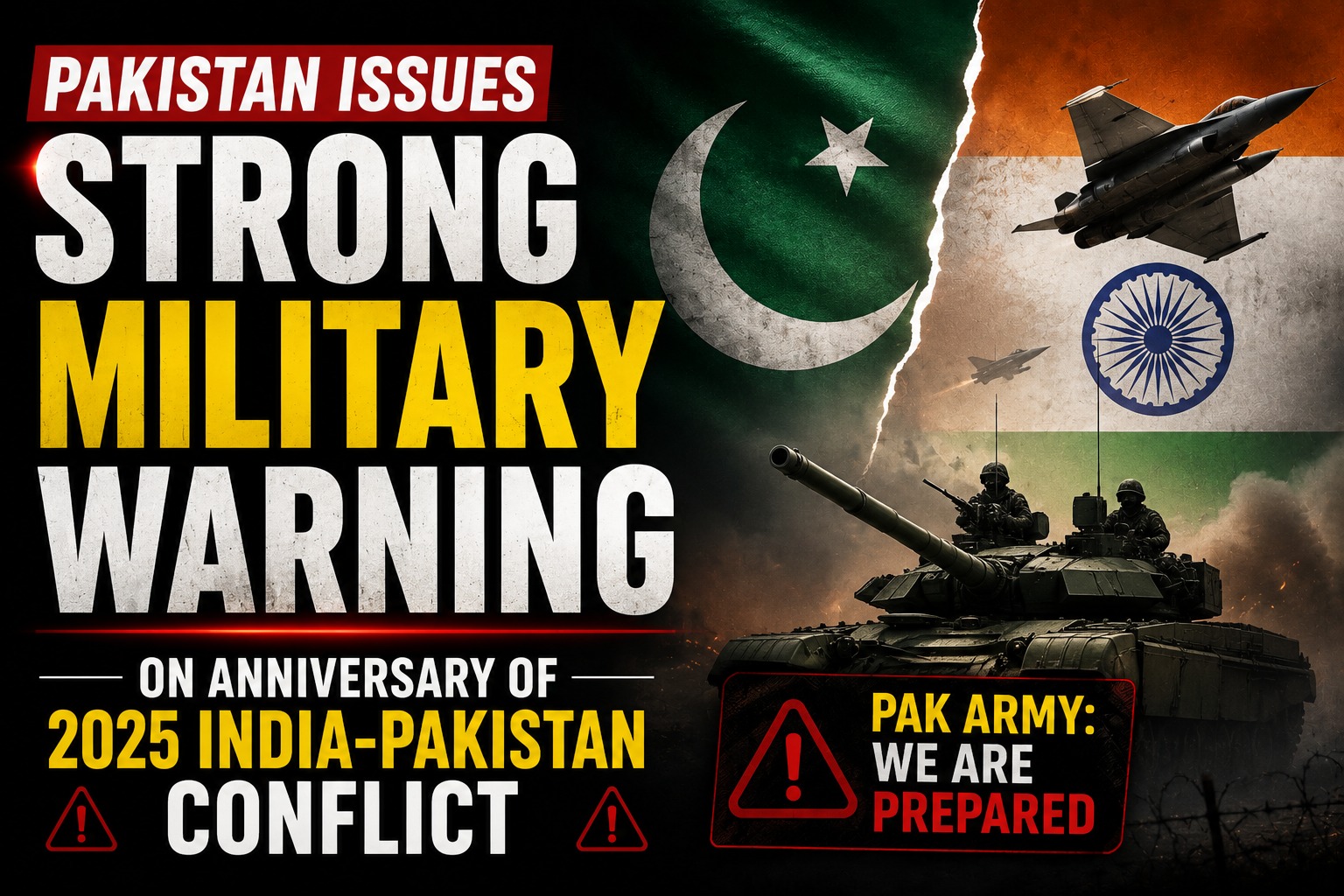
Pakistan Issues Strong Military Warning on Anniversary of 2025 India-Pakistan Conflict
Tensions between India and Pakistan have once again come into sharp focus as Pakistan’s military issued a stern warning while marking the anniversary of the intense four-day military confrontation between the two nuclear-armed neighbors in May 2025. The statement, delivered during a high-profile press conference by senior Pakistani military officials, underscored Islamabad’s readiness to respond forcefully to any future military escalation with India.
The anniversary of the conflict — referred to by Pakistan as “Marka-e-Haq” or “Battle of Truth” — has revived memories of one of the most dangerous military standoffs in recent South Asian history. The confrontation, which involved missile strikes, drone attacks, aerial combat, and military mobilization, pushed both countries dangerously close to full-scale war before a ceasefire was brokered with international intervention.
Pakistan’s latest warning reflects the fragile state of India-Pakistan relations and highlights the continued volatility surrounding the Kashmir dispute, cross-border militancy allegations, and regional security dynamics.
(Source: Times Now)
Pakistan Warns of Stronger Response to Any Future Attack
During a televised media briefing on Thursday, Pakistan’s military leadership declared that any future “hostile design” against the country would be met with “greater strength, precision, and resolve” than what occurred during the May 2025 conflict.
The message was delivered by Pakistan Army spokesperson Lt. Gen. Ahmad Sharif Chaudhry, who was accompanied by senior officials from the navy and air force. The military leadership emphasized that Pakistan remains fully prepared to defend itself against any perceived aggression.
According to Chaudhry, Pakistan has carefully reviewed the events of the 2025 conflict and significantly strengthened its military preparedness since then.
He stated that while Pakistan does not seek war or conflict, the country would respond decisively to any military action threatening its sovereignty or territorial integrity.
The strong rhetoric signals that tensions between the neighboring countries remain unresolved despite the ceasefire agreement reached last year.
The Kashmir Attack That Triggered the Crisis
The military confrontation between India and Pakistan in 2025 was triggered by a deadly terrorist attack in the Indian-administered region of Jammu and Kashmir.
Gunmen attacked civilians in the Pahalgam area, killing 26 people, most of whom were Hindu tourists visiting the region. The incident shocked the country and sparked nationwide outrage in India.
Indian authorities accused Pakistan-backed militant groups of orchestrating the attack, claiming that cross-border terrorism was responsible for the violence. Pakistan strongly denied the allegations and demanded an independent international investigation into the incident.
The Pahalgam attack rapidly escalated diplomatic tensions between the two countries, leading to aggressive rhetoric, military alerts, and heightened security measures along the Line of Control (LoC).
India’s Military Response and Pakistan’s Counterattack
Following the Kashmir attack, India launched military strikes inside Pakistani territory on May 7, targeting what it described as militant infrastructure and terror launch pads.
The Indian government stated that the strikes were intended to dismantle terrorist networks allegedly operating from Pakistan. The military action marked one of the most significant cross-border operations in recent years.
Pakistan responded swiftly with retaliatory military operations that reportedly included missile strikes, drone incursions, and intensified military activity along sensitive border regions.
Over the next four days, both nations exchanged heavy fire, leading to casualties on both sides and creating fears of a broader regional conflict.
The escalation drew global concern due to the nuclear capabilities of both countries and the possibility that the conflict could spiral beyond conventional warfare.
Ceasefire Brokered by the United States
As the conflict intensified, international pressure mounted on both governments to de-escalate tensions.
The United States reportedly played a key role in facilitating diplomatic communication between New Delhi and Islamabad. On May 10, both countries agreed to a ceasefire arrangement aimed at preventing further escalation.
The ceasefire halted active military operations, but political and diplomatic tensions remained high. Since then, both nations have continued accusing each other of destabilizing regional peace and security.
The anniversary statements from Pakistan’s military indicate that despite the ceasefire, deep mistrust continues to define bilateral relations.
Pakistan Questions India’s Evidence
During the press conference, Lt. Gen. Ahmad Sharif Chaudhry criticized India’s handling of the Pahalgam attack investigation.
He claimed that India blamed Pakistan almost immediately after the attack without presenting conclusive evidence to support its accusations.
“It has been one year since the Pahalgam incident, yet the questions Pakistan raised remain unanswered,” Chaudhry reportedly stated.
Pakistan has consistently maintained that it had no involvement in the attack and has repeatedly called for an impartial inquiry into the incident.
The disagreement over accountability for the Kashmir attack remains one of the central points of tension between the two countries.
Pakistan Says It Is Prepared for Any “Misadventure”
Pakistan’s military leadership stressed that the country is fully prepared for any future military confrontation.
Lt. Gen. Chaudhry stated that Pakistan does not underestimate India’s military capabilities but remains confident in its own defense preparedness.
“We are prepared; if anyone wishes to test us, they are more than welcome,” he said during the briefing.
At the same time, he emphasized that Pakistan does not seek war and prefers peace and regional stability.
According to the military spokesperson, Pakistan’s armed forces are committed to defending the country “with honor and dignity” if provoked.
The remarks appear aimed both at domestic audiences and at signaling deterrence to India amid continuing geopolitical tensions.
Pakistan Navy Highlights Maritime Strategy
Senior Pakistan Navy official Rear Admiral Shifaat Ali also addressed the media during the briefing.
He claimed that India attempted to deploy naval assets in the northern Arabian Sea during the 2025 conflict in an effort to exert strategic pressure on Pakistan.
According to Ali, the Pakistan Navy successfully protected maritime trade routes and ensured uninterrupted shipping activity despite the heightened military situation.
He stated that Pakistan’s naval preparedness and strategic deployment prevented disruptions to maritime commerce and safeguarded critical economic interests.
The naval dimension of the conflict highlighted the broader strategic competition between India and Pakistan beyond land borders and Kashmir.
Pakistan Air Force Claims Combat Success
Air Vice Marshal Tariq Ghazi, representing the Pakistan Air Force, also spoke during the press conference and reiterated Pakistan’s military claims regarding aerial engagements during the conflict.
He stated that Pakistan had shot down eight Indian fighter aircraft during the confrontation.
India has not officially confirmed Pakistan’s claims regarding the loss of aircraft, and the exact details of aerial combat operations remain disputed.
Ghazi asserted that Pakistan’s air force possesses the capability to inflict “substantial damage” on adversaries while maintaining operational restraint.
The air battles during the 2025 conflict became a major focus of military analysis and demonstrated the increasingly sophisticated technological capabilities possessed by both nations.
Longstanding India-Pakistan Rivalry
India and Pakistan have shared a deeply contentious relationship since their partition in 1947.
The two nations have fought three major wars, with two of them centered around the disputed Kashmir region. Both countries claim Kashmir in full but administer different portions of the territory.
Cross-border terrorism, ceasefire violations, political disputes, and military tensions have repeatedly strained relations between New Delhi and Islamabad.
Despite occasional diplomatic engagements and peace initiatives, mistrust continues to dominate bilateral ties.
The 2025 conflict further deepened hostility and reinforced concerns about regional instability in South Asia.
Global Concerns Over Nuclear Escalation
Whenever tensions rise between India and Pakistan, the international community closely monitors developments due to the nuclear capabilities of both countries.
Strategic analysts warn that even limited military confrontations between the two nations carry the risk of unintended escalation.
The 2025 conflict once again highlighted how quickly regional crises can intensify, especially in the absence of sustained diplomatic dialogue and crisis-management mechanisms.
Countries including the United States, China, Russia, and members of the European Union have repeatedly urged both nations to maintain restraint and prioritize diplomatic solutions.
Regional Security and Geopolitical Implications
The renewed military rhetoric from Pakistan comes at a time of evolving geopolitical dynamics in South Asia.
India continues strengthening its defense infrastructure and expanding strategic partnerships with countries such as the United States, France, Japan, and Australia.
Pakistan, meanwhile, has deepened military and economic ties with China while also seeking to modernize its defense systems.
The strategic rivalry between India and Pakistan increasingly intersects with broader regional and global power dynamics, making South Asian stability an important international concern.
Diplomatic Challenges Ahead
Although both countries currently maintain a ceasefire along the Line of Control, political relations remain fragile.
Diplomatic engagement between India and Pakistan has been limited in recent years, with both sides frequently exchanging accusations over terrorism, security issues, and regional interference.
Analysts believe meaningful dialogue remains difficult unless there is progress on counterterrorism concerns and confidence-building measures.
The latest warning from Pakistan’s military is likely to further complicate already strained diplomatic relations.
Conclusion
Pakistan’s strong military warning on the anniversary of the 2025 India-Pakistan conflict underscores the continuing volatility in relations between the two neighboring nuclear powers.
The memories of the four-day confrontation, triggered by the deadly Pahalgam attack and followed by military strikes and counterattacks, remain fresh on both sides of the border.
While Pakistan insists it does not seek war, its military leadership has made it clear that any future aggression will be met with a more forceful response. At the same time, unresolved disputes over Kashmir, terrorism allegations, and regional security continue to fuel mistrust between New Delhi and Islamabad.
As both nations strengthen military preparedness while navigating complex geopolitical realities, the need for sustained diplomatic engagement and crisis management mechanisms has become more critical than ever for maintaining peace and stability in South Asia.
Disclaimer:
This article is based on publicly available information, official statements, and media reports available at the time of publication. The content is intended for informational purposes only and should not be considered financial or policy advice. Readers are encouraged to refer to official sources for the latest updates.
The content is solely for educational and informational purposes. Whether it is global news, indian news, political news or any other sort of content, we do not independently verify the content or claims.
While efforts have been made to ensure accuracy, the information presented may change as new developments emerge. Readers are advised to conduct their own research and consult financial advisors before making any investment decisions.
NoCap Times does not independently verify all claims or statements and shall not be held responsible for any inaccuracies or omissions.
Stay updated with the latest and breaking news on NoCap Times. Get the latest India News, World News, Business News, Sports News, Viral News and Research Articles for various competitive Exams & UPSC Aspirants.