

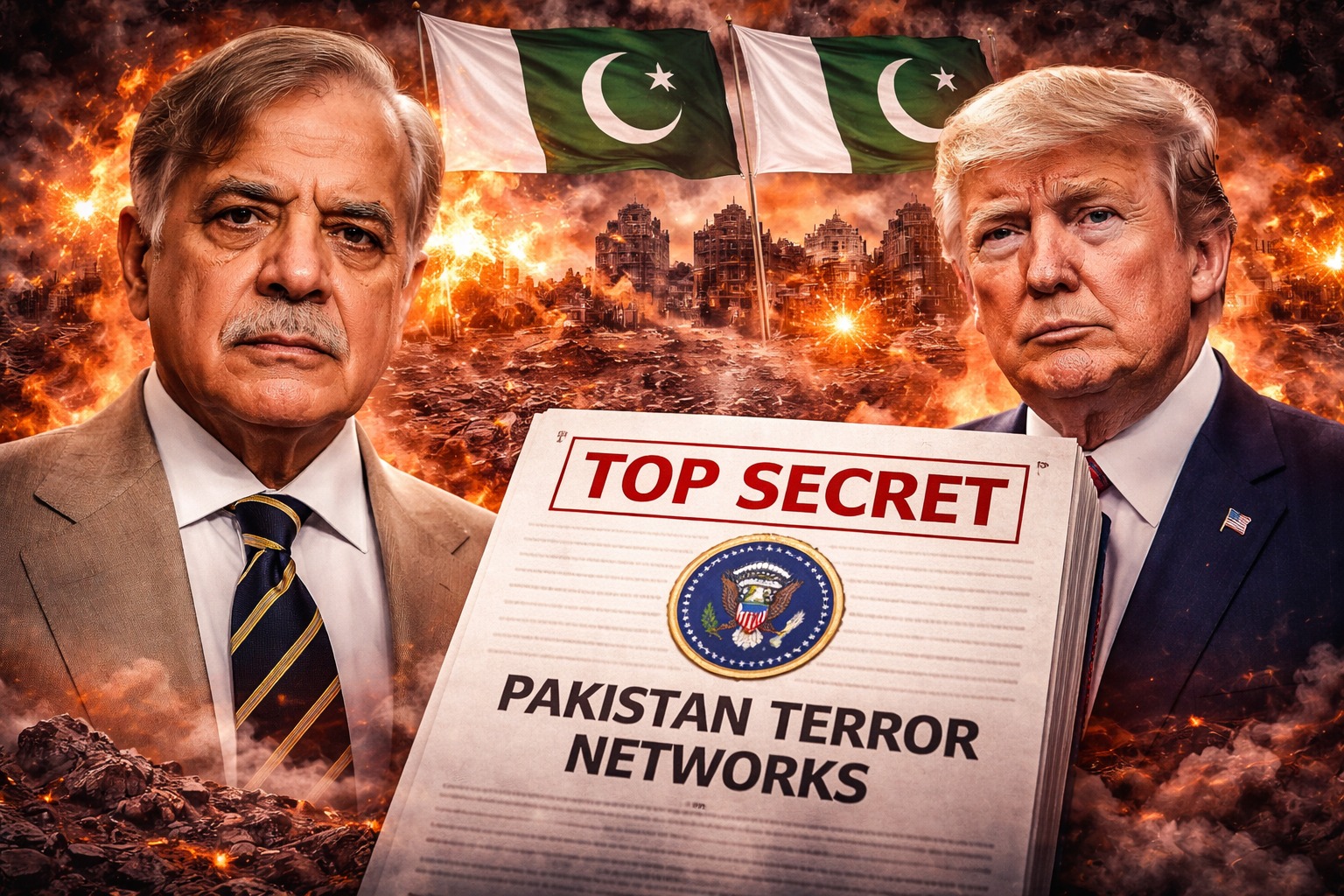
US Report Exposes Pakistan Terror Networks, Raising Global Security Concerns
A recent report by the United States Congress has reignited global concerns over the presence of terrorist groups operating from Pakistan. The findings, which highlight the persistence of extremist organizations within the country, have once again brought the Pakistan Terror Networks into sharp international attention.
According to media reports, the US Congress report, released on March 25, paints a troubling picture of Pakistan’s long-standing struggle—or failure—to dismantle terror infrastructure within its borders. It also raises serious questions about regional stability, especially in the context of South Asia’s complex security dynamics.
US Report Flags Pakistan as Terror Base

According to the Congressional research findings, U.S. officials have identified Pakistan as a hub for multiple armed terrorist groups. These organizations reportedly operate across different spectrums—ranging from global jihadist networks to region-specific groups focused on Afghanistan and India.
The report categorizes these groups into several types: globally oriented, Afghanistan-centric, India-focused, sectarian, and domestic militant organizations. Notably, at least 12 of these groups have been designated as Foreign Terrorist Organizations (FTOs) under U.S. law.
This revelation significantly strengthens concerns about Pakistan Terror Networks, especially at a time when Pakistan has been attempting to position itself as a mediator in international conflicts, including offering to host peace talks between Iran and the United States.
Persistent Failure to Eliminate Terror Groups
Despite multiple military operations, Pakistan has struggled to dismantle these networks effectively. The report notes that several large-scale offensives, including airstrikes and extensive intelligence-based operations, have failed to eradicate terrorist groups operating within the country.
Over the years, Pakistan has launched numerous counter-terror campaigns. However, the continued presence of these organizations suggests deep-rooted structural and strategic challenges in addressing the issue.
The persistence of Pakistan Terror Networks raises concerns not only for neighboring countries but also for global security, as many of these groups have transnational reach.
Lashkar-e-Taiba and the Rise of Extremist Groups
One of the most prominent groups mentioned in the report is Lashkar-e-Taiba (LeT). Established in the late 1980s, LeT has been a key player in regional militancy and was designated as a Foreign Terrorist Organization in 2001.
The group is led by Hafiz Saeed and operates primarily from Pakistan’s Punjab province and Pakistan-administered Kashmir. Over the years, it has rebranded itself under different names, including Jamaat-ud-Dawa, to evade international sanctions.
LeT gained global notoriety for its involvement in the 2008 Mumbai Attacks, which resulted in widespread casualties and international condemnation. The group continues to remain a central concern in discussions around Pakistan Terror Networks.
Jaish-e-Mohammed and Other Militant Organizations
Another major organization highlighted in the report is Jaish-e-Mohammed (JeM), founded in 2000 by Masood Azhar. Like LeT, JeM was designated as a Foreign Terrorist Organization in 2001.
JeM is believed to have hundreds of armed members operating across India, Afghanistan, and Pakistan. The group has been linked to several high-profile attacks and continues to pose a significant threat to regional stability.
In addition to these groups, the report also mentions other organizations such as Harkat-ul-Jihad al-Islami, Harkat-ul-Mujahideen, and Hizbul Mujahideen. These groups further reinforce the extensive network of militant organizations operating within Pakistan.
India’s Stand Strengthened
The findings of the U.S. report align closely with the long-standing position of India, which has consistently raised concerns about cross-border terrorism originating from Pakistan.
One recent example cited is the attack in Pahalgam, carried out by a group identifying itself as “The Resistance Front” (TRF), believed to be an offshoot of Lashkar-e-Taiba. The attack resulted in the deaths of 26 individuals and drew widespread condemnation.
The continued existence of such groups underscores the ongoing threat posed by Pakistan Terror Networks and validates India’s concerns on international platforms.
Operation Sindoor: India’s Military Response
In response to escalating terror activities, India launched Operation Sindoor on May 6, 2025. This operation targeted multiple terrorist camps located in Pakistan and Pakistan-occupied Jammu and Kashmir (PoJK).
The Indian Armed Forces carried out precision strikes on nine identified locations, reportedly eliminating over 100 terrorists, including trainers and handlers. The operation was designed to minimize civilian casualties while maximizing the impact on terrorist infrastructure.
Organizations such as Lashkar-e-Taiba, Jaish-e-Mohammed, and Hizbul Mujahideen were among those affected by the strikes. Operation Sindoor marked a significant escalation in India’s counter-terrorism strategy and demonstrated its willingness to take decisive action.
Escalation and Retaliation
Following Operation Sindoor, tensions between India and Pakistan escalated sharply. On May 10, Pakistan launched a series of attacks targeting Indian military installations, including air force bases and ammunition depots.
However, India’s advanced air defense and counter-drone systems successfully intercepted these attacks, preventing any significant damage. In response, the Indian Air Force conducted retaliatory strikes on key Pakistani military infrastructure.
Targets included major airbases such as Chaklala, Sargodha, Rafiqui, Rahim Yar Khan, Jacobabad, Sukkur, and Bholari. These strikes aimed to neutralize Pakistan’s offensive capabilities and send a strong message regarding India’s defense preparedness.
Ceasefire and De-escalation Efforts
Amid rising tensions, both nations moved toward de-escalation. On May 10, Pakistan’s Director General of Military Operations (DGMO) reached out to his Indian counterpart, requesting a halt to military actions.
Subsequent talks between the two sides on May 12 resulted in an agreement to cease military operations. While the immediate crisis was contained, the underlying issues remain unresolved.
The continued presence of Pakistan Terror Networks, as highlighted in the U.S. report, suggests that long-term peace in the region remains uncertain.
Global Implications
The revelations from the U.S. Congressional report have far-reaching implications for global security. The persistence of terrorist groups in Pakistan not only threatens regional stability but also poses risks to international peace.
Countries around the world are likely to reassess their strategic and diplomatic engagements with Pakistan in light of these findings. The report may also influence future counter-terrorism policies and international cooperation efforts.
What Lies Ahead?
The issue of Pakistan Terror Networks remains a critical challenge for the international community. While military actions and diplomatic efforts have achieved temporary results, a comprehensive and sustained approach will be required to address the root causes of extremism.
For India, the report reinforces its position on cross-border terrorism and may strengthen its case in global forums. For Pakistan, it presents an opportunity—and a necessity—to take decisive action against terrorist organizations operating within its territory.
The coming months will be crucial in determining whether these revelations lead to meaningful change or remain another chapter in the ongoing struggle against global terrorism.
Summary
A U.S. Congressional report has identified Pakistan as a base for multiple terrorist organizations, bringing renewed focus on Pakistan Terror Networks. The report highlights the continued presence of groups like Lashkar-e-Taiba and Jaish-e-Mohammed, despite repeated military operations. It supports India’s long-standing concerns about cross-border terrorism and references incidents like the Pahalgam attack. India’s response through Operation Sindoor and subsequent military exchanges with Pakistan underscore the seriousness of the issue. While a ceasefire was eventually reached, the persistence of terror networks raises ongoing concerns for regional and global security.
Disclaimer
This article is based on official statements and publicly available information at the time of publication. The global energy situation is dynamic and may change with evolving geopolitical developments.
The content is intended for informational purposes only and should not be considered financial or policy advice. Readers are encouraged to refer to official sources for the latest updates.
NoCap Times does not independently verify all claims and shall not be held responsible for any inaccuracies or omissions.