

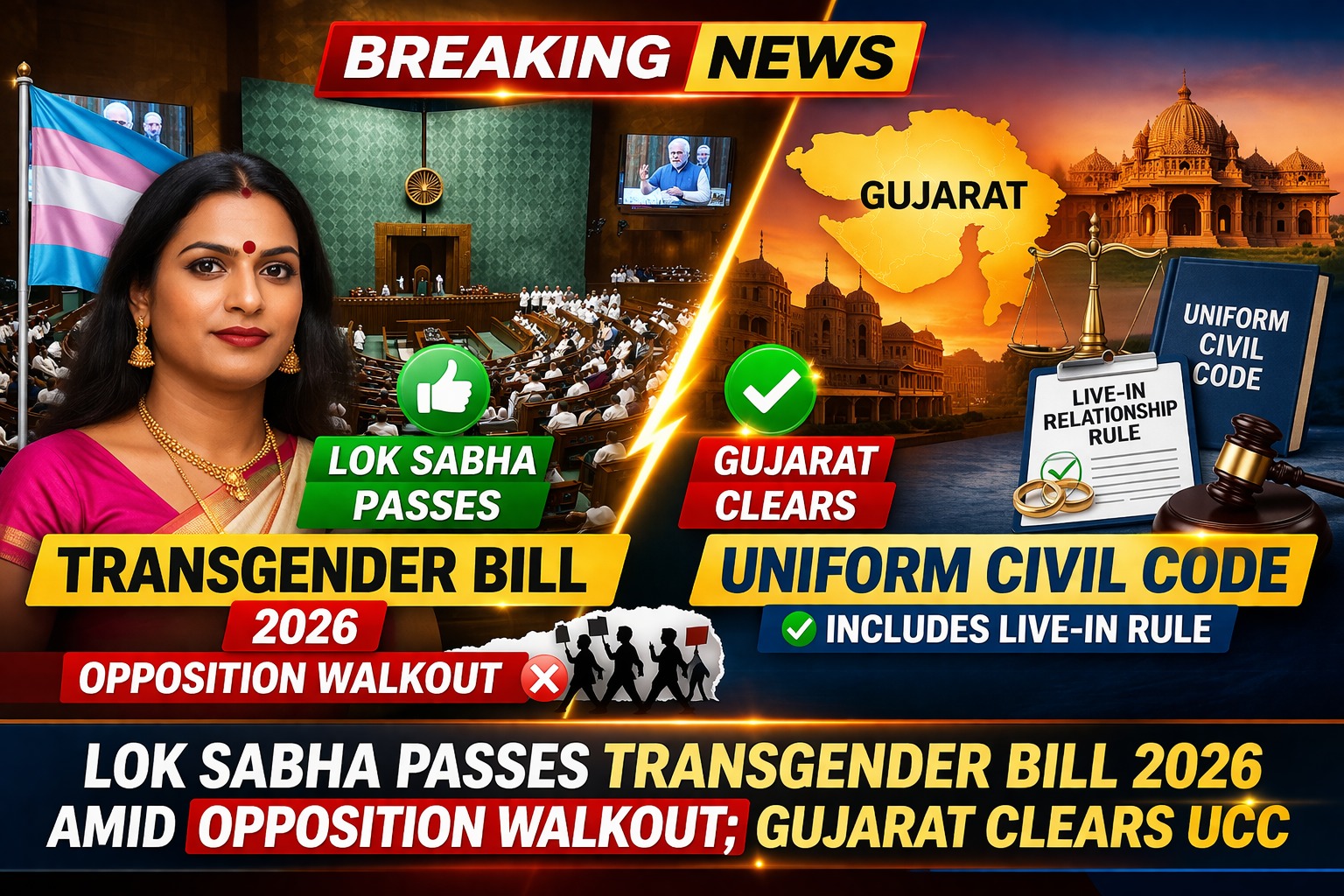
Lok Sabha Passes Transgender Bill 2026 Amid Opposition Walkout; Gujarat Clears UCC with Live-In Rule
New Delhi/ Gandhinagar, March 25, 2026: In a significant legislative development on Tuesday, March 24, the Lok Sabha passed the Transgender Persons (Protection of Rights) Amendment Bill, 2026 by voice vote, even as sections of the Opposition staged a walkout protesting the government’s refusal to refer the legislation to a parliamentary committee for detailed scrutiny. On the same day, the Gujarat Assembly, after a marathon seven-hour debate, passed the Gujarat Uniform Civil Code (UCC) Bill, 2026, making the state the second in the country after Uttarakhand to adopt a common legal framework governing marriage, divorce, succession, and live-in relationships irrespective of religion. The UCC legislation notably mandates compulsory registration of live-in relationships, drawing both praise for promoting gender justice and sharp criticism for potential intrusion into personal freedoms.
The twin developments reflect the ruling dispensation’s push to advance long-pending reforms in personal laws and rights-based legislation, even as they ignite fresh debates on inclusivity, federalism, and constitutional rights in a diverse democracy.
Transgender Persons Amendment Bill: Narrowing Definitions Sparks Controversy
Introduced in the Lok Sabha on March 13-14, 2026 by Union Minister for Social Justice and Empowerment Dr. Virendra Kumar, the amendment bill seeks to refine the definition of “transgender” under the 2019 Act. The proposed changes aim to provide a more precise legal framework by limiting the term primarily to traditional socio-cultural identities such as hijra, aravani, and other recognised third-gender communities, while explicitly excluding “different sexual orientations and self-perceived sexual identities” from its ambit.
Government sources argue that the amendment is intended to prevent misuse of the law, streamline certification processes through district magistrates, and ensure targeted welfare benefits reach genuine beneficiaries without diluting the focus on historically marginalised transgender groups. Proponents claim it strengthens implementation of existing rights related to education, employment, healthcare, and anti-discrimination measures while addressing practical challenges faced by implementing agencies.
However, the bill has triggered strong backlash from transgender rights activists, LGBTQ+ organisations, and several opposition parties. Critics contend that narrowing the definition undermines the landmark 2014 NALSA Supreme Court judgment, which recognised the right to self-identification of gender. They argue the amendments represent a regressive step that could exclude many individuals who identify as transgender based on self-perception, potentially affecting access to legal documents, reservations, and protection from discrimination.
During the debate in the Lok Sabha, opposition MPs raised concerns over the “haste” with which the bill was brought and questioned the absence of wider consultations with the transgender community. Several members demanded that the legislation be sent to a standing or select committee for stakeholder inputs. When the government declined, a section of the Opposition, including Congress and AAP members, walked out in protest. The bill was subsequently passed by voice vote in the absence of dissenting voices on the floor.
Transgender community representatives across the country have expressed alarm, warning that the changes could roll back hard-won legal gains and create new barriers for individuals outside traditional categories. Some activists have announced plans to challenge the provisions in court if the bill becomes law after Rajya Sabha approval.
Social Justice Minister Dr. Virendra Kumar defended the bill, stating it aims to bring clarity and effective implementation rather than dilute rights. He emphasised that the core protections under the 2019 Act—prohibiting discrimination, ensuring welfare schemes, and establishing national and state councils—remain intact.
Gujarat UCC Bill 2026: Compulsory Live-In Registration and Common Personal Laws
In Gandhinagar, the Gujarat Assembly witnessed intense deliberations as Chief Minister Bhupendra Patel tabled and piloted the Gujarat Uniform Civil Code Bill, 2026. After over seven hours of debate, the bill was passed by a majority voice vote, with the ruling BJP emphasising its commitment to “national unity, equality, and gender justice.” The Congress and Aam Aadmi Party opposed the legislation, demanding it be referred to a select committee, citing concerns over constitutional validity and potential impact on minority communities.
The UCC Bill establishes a uniform legal framework for marriage, divorce, succession, and live-in relationships that applies to all residents of Gujarat, irrespective of religion. Key highlights include:
- Mandatory registration of marriages and divorces within 60 days, with penalties of up to ₹10,000 for non-compliance. Religious or customary ceremonies are permitted, but legal recognition requires registration.
- Compulsory registration of live-in relationships: Couples must submit a joint declaration to the district registrar within whose jurisdiction they reside. Failure to register can attract imprisonment of up to three months or a fine. For individuals aged 18-21, parents or guardians will be informed. Termination of live-in relationships must also be formally notified.
- Prohibition of bigamy and polygamy: A marriage is valid only if neither party has a living spouse.
- Inheritance and succession reforms aimed at gender equality.
- Child legitimacy: Children born from live-in relationships are recognised as legitimate.
- Exemptions: The provisions do not apply to members of Scheduled Tribes (STs) in the state.
Chief Minister Bhupendra Patel, while introducing the bill, invoked Sanatan values and references from the Rigveda, describing the UCC as a step rooted in India’s civilisational ethos of unity in diversity and equality before the law. He stressed that registration of live-in relationships is not intended to curtail personal freedom but to provide legal protection, especially to women and children, including rights to maintenance and inheritance.
The government highlighted that the bill draws inspiration from the Uttarakhand UCC Act passed in 2024 and recommendations of a state-appointed committee that submitted its report recently. Officials argue it will reduce disputes, ensure women’s rights, and promote a progressive, uniform legal order.
Opposition parties criticised the move as politically motivated, potentially targeting specific communities and violating the spirit of secularism and fundamental rights under Articles 25-26 of the Constitution. Some leaders termed it an “anti-minority” measure and raised fears of misuse of registration provisions for surveillance or harassment. Minority rights groups have also voiced strong opposition, describing the bill as “unconstitutional” and urging judicial review.
Legal experts note that while the Supreme Court has repeatedly urged states to consider a Uniform Civil Code as envisaged under Article 44 of the Directive Principles, implementation at the state level raises complex questions of federalism, personal laws, and individual liberties. The mandatory live-in registration, in particular, has sparked nationwide debate on privacy versus protection.
Gujarat becomes only the second state after Uttarakhand to enact such comprehensive UCC legislation. The law will extend to the entire state and reportedly apply even to Gujarat residents living outside its territorial limits, subject to certain conditions.
Broader Implications
These legislative actions come at a time when the country is navigating multiple global and domestic challenges, including the West Asia conflict and its economic fallout. Supporters view them as bold steps towards modernisation, gender justice, and constitutional goals. Critics see them as majoritarian assertions that risk deepening social divides without adequate consensus-building.
Both bills are likely to face further scrutiny. The Transgender Amendment Bill will now proceed to the Rajya Sabha, while the Gujarat UCC law may encounter legal challenges in higher courts.
As India debates the contours of equality, identity, and personal freedoms in the 21st century, Tuesday’s developments in Parliament and the Gujarat Assembly have once again brought these contentious yet crucial issues to the forefront of national discourse. The coming weeks will reveal whether these laws foster greater inclusion and harmony or intensify existing fault lines in the world’s largest democracy.
Disclaimer
This article is based on official statements and publicly available information at the time of publication. The global energy situation is dynamic and may change with evolving geopolitical developments.
The content is intended for informational purposes only and should not be considered financial or policy advice. Readers are encouraged to refer to official sources for the latest updates.
NoCap Times does not independently verify all claims and shall not be held responsible for any inaccuracies or omissions.