

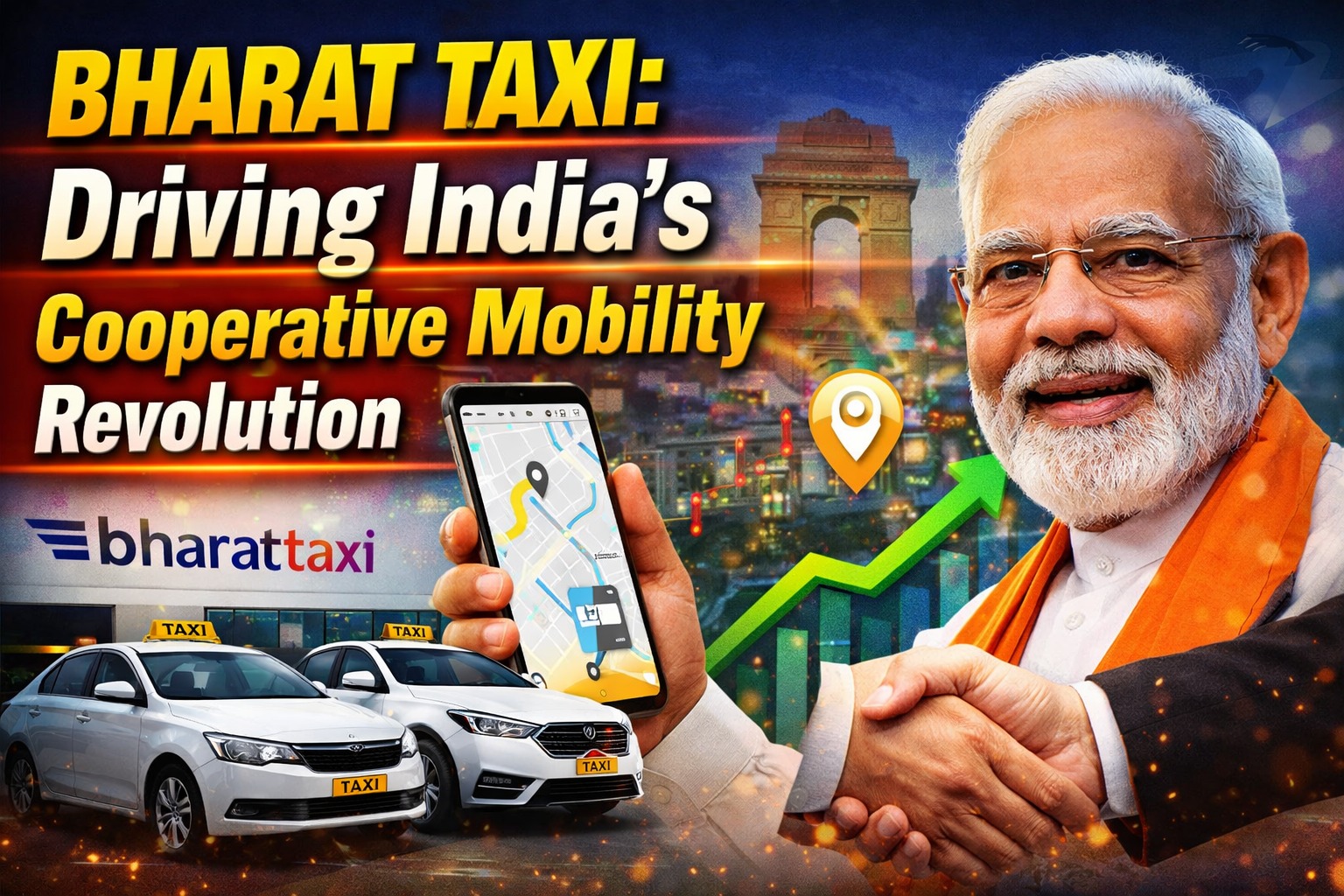
Bharat Taxi: Driving India’s Cooperative Mobility Revolution
Aligned with the Government of India’s vision of “Sahkar se Samriddhi” (prosperity through cooperation), the Ministry of Cooperation has been actively promoting cooperative-led economic models across sectors. One of the most notable initiatives in the mobility space is Bharat Taxi, a cooperative-based ride-hailing platform established on June 6, 2025, under the Multi-State Cooperative Societies Act, 2002.
Bharat Taxi represents a fundamental shift from traditional aggregator-driven mobility platforms toward a driver-owned, democratically governed ecosystem, aiming to create a more inclusive, transparent, and sustainable transport solution in India.
Genesis and Strategic Vision
The creation of Bharat Taxi is rooted in the broader national objective of strengthening India’s cooperative movement. Over the years, policymakers have increasingly emphasized cooperatives as a means to:
- Promote inclusive economic growth
- Strengthen grassroots participation
- Enhance livelihood security
Urban mobility, dominated by private aggregators, has often raised concerns about:
- High commission charges
- Limited driver control
- Lack of long-term income stability
Bharat Taxi directly addresses these concerns by introducing a cooperative ownership model, where drivers and vehicle owners become stakeholders rather than mere service providers.
Core Objectives:
- Enhancing income security for gig workers
- Promoting equitable wealth distribution
- Building community-driven enterprises
- Leveraging digital platforms for inclusive growth
Cooperative Ownership and Democratic Governance
A defining feature of Bharat Taxi is its multi-state cooperative structure, which fundamentally changes how mobility platforms operate.
Key Governance Features:
- Drivers and vehicle owners are members (not contractors)
- A democratically elected Board of Directors governs the platform
- Representation of drivers (“Sarthis”) in decision-making
Benefits of This Model:
1. Shared Ownership
Drivers benefit directly from the platform’s growth and profitability.
2. Participative Decision-Making
Policies reflect real on-ground challenges and operational realities.
3. Transparency and Accountability
Democratic governance ensures responsible management.
4. Reduced Exploitation
Eliminates unilateral decisions common in centralized corporate structures.
This model ensures that those who power the platform also shape its future.
Driver-Centric and Transparent Operating Model
One of the most disruptive aspects of Bharat Taxi is its zero-commission structure.
How It Works:
Unlike traditional ride-hailing platforms that charge commissions on every ride, Bharat Taxi allows drivers to:
- Retain 100% of their earnings
- Avoid fluctuating commission rates
Impact on Drivers:
- Improved income stability
- Higher take-home earnings
- Increased motivation and retention
Transparent Fare Mechanism
The platform adopts a clear and structured pricing model, based on:
- Distance traveled
- Fuel and maintenance costs
- Market demand
Regular fare reviews ensure:
- Fair pricing for passengers
- Sustainable earnings for drivers
Driver Welfare Initiatives
Bharat Taxi goes beyond earnings by focusing on driver well-being:
- Access to social security benefits
- Insurance coverage
- Financial inclusion programs
- Better working conditions
This transforms drivers into empowered economic participants, rather than gig workers with limited protections.
Technology-Enabled Mobility Ecosystem
Despite being a cooperative, Bharat Taxi leverages modern digital infrastructure to deliver a seamless user experience.
Key Features:
- Easy ride booking interface
- Real-time vehicle tracking
- Digital payment integration
- Customer support systems
Integration with ONDC
A major differentiator is Bharat Taxi’s integration with Open Network for Digital Commerce (ONDC).
What This Enables:
- Connectivity with multiple platforms like DigiHaat, Bob Rides, and OneTicket
- Reduced dependence on a single app
- Open and competitive ecosystem
Strategic Advantages:
- Wider customer reach
- Better price discovery
- Platform interoperability
- Increased visibility for drivers
Fintech and Digital Integration
Bharat Taxi also collaborates with fintech providers to offer:
- Banking access
- Digital payments
- Insurance services
This integration enhances:
- Financial inclusion
- Operational transparency
- Ease of transactions
Geographic Presence and Expansion Strategy
Bharat Taxi has already launched operations in key regions:
Current Presence:
Delhi NCR:
- Delhi
- Gurugram
- Noida
- Faridabad
- Ghaziabad
Gujarat:
- Ahmedabad
- Rajkot
- Somnath
- Dwarka
Expansion Roadmap:
- Entry into Tier 2 and Tier 3 cities
- Expansion to tehsil and semi-urban regions
- Phased rollout over the next three years
Strategic Importance:
- Addresses underserved mobility markets
- Generates employment opportunities
- Promotes formalization of local transport systems
Comparison with Traditional Aggregators
| Parameter | Traditional Platforms | Bharat Taxi |
| Ownership | Corporate | Cooperative |
| Revenue Model | Commission-based | Zero commission |
| Governance | Centralized | демократически elected |
| Driver Role | Service provider | Stakeholder |
| Pricing | Often opaque | Transparent |
| Ecosystem | Closed apps | Open (ONDC-integrated) |
This comparison highlights Bharat Taxi’s inclusive and equitable business model.
Economic and Social Impact
Bharat Taxi has the potential to create wide-ranging impact:
1. Livelihood Enhancement
Drivers retain full earnings, improving financial security.
2. Inclusive Growth
Wealth is distributed among members rather than concentrated.
3. Formalization of Gig Economy
Introduces structure, governance, and benefits to gig workers.
4. Digital Empowerment
Encourages adoption of digital tools and financial services.
5. Regional Development
Improves connectivity and economic activity in smaller cities.
Challenges and Considerations
Despite its strong model, Bharat Taxi faces certain challenges:
1. Scaling Governance
Managing democratic decision-making with a growing member base.
2. Technology Investment
Keeping pace with private competitors in tech innovation.
3. Market Competition
Competing with well-funded ride-hailing giants.
4. Operational Coordination
Ensuring efficiency across decentralized operations.
Addressing these challenges will be critical for long-term success.
Future Outlook
Bharat Taxi represents a transformational shift in India’s mobility landscape, combining:
- Cooperative ownership
- Digital technology
- Inclusive economic principles
Its success will depend on:
- Strong governance systems
- Continuous technological upgrades
- Effective expansion strategy
- Ongoing policy support
If executed well, Bharat Taxi could become a blueprint for cooperative models in other gig economy sectors.
Summary
- Bharat Taxi is a cooperative ride-hailing platform promoted under the vision of Ministry of Cooperation.
- It follows a driver-owned, zero-commission model, ensuring higher earnings and ownership.
- The platform features democratic governance, with driver participation in decision-making.
- Integration with Open Network for Digital Commerce enables an open and scalable digital ecosystem.
- Currently operational in Delhi NCR and Gujarat, with plans to expand across India.
- The initiative aims to create a more inclusive, transparent, and sustainable mobility system while improving livelihoods and promoting cooperative growth.
Disclaimer:
This article is based on publicly available information, official statements, and media reports available at the time of publication. The content is intended solely for informational and educational purposes.
While efforts have been made to ensure accuracy, NoCap Times does not independently verify all claims, statements, or allegations made by individuals, witnesses, or investigative sources mentioned in the report.
NoCap Times shall not be held responsible for any inaccuracies, omissions, or changes that may arise as new verified information becomes available.