

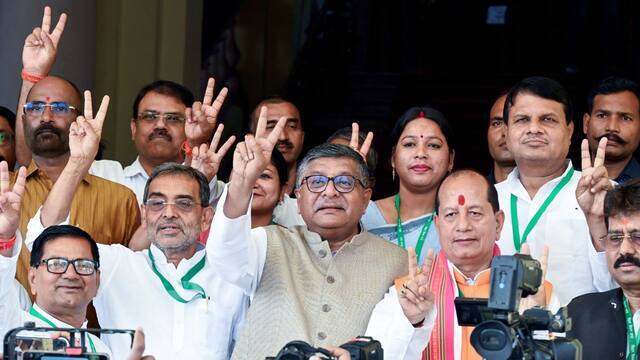
NDA Sweeps Bihar Rajya Sabha Polls as Opposition Absentees Tilt the Balance
The ruling National Democratic Alliance (NDA) secured a decisive victory in the Bihar Rajya Sabha elections, winning all five seats in what political observers are calling a carefully calculated and strategically executed contest. The outcome, however, was equally shaped by unexpected absences within the Opposition camp, which weakened its chances at a crucial stage of voting.
The elections not only showcased the NDA’s numerical strength but also exposed cracks within the Opposition alliance, particularly in its ability to maintain unity among its legislators.
NDA Registers Clean Sweep
The NDA’s winning candidates include Bihar Chief Minister Nitish Kumar, who is set to enter the Rajya Sabha for the first time, along with Nitin Nabin, Ram Nath Thakur, Shivesh Kumar, and Upendra Kushwaha.
With a comfortable majority in the 243-member Bihar Legislative Assembly, the NDA was already assured of four seats. However, the real contest revolved around the fifth seat, where the alliance adopted a tactical approach instead of attempting to secure additional first-preference votes.
Strategy Behind the Fifth Seat Victory
Rather than scrambling to gather the required numbers for an outright win in the first round, the NDA relied on a strategic use of second-preference votes. This approach proved decisive.
In Rajya Sabha elections, candidates must secure a minimum number of first-preference votes to win outright. If no candidate reaches that threshold, second-preference votes come into play.
In this case, neither the NDA nor the Opposition candidate managed to reach the required figure in the first round. However, the NDA had already planned for this scenario.
During the second-preference vote count, Shivesh Kumar comfortably crossed the required mark, securing victory in the third round itself. This demonstrated the alliance’s strong internal coordination and understanding of the electoral arithmetic.
Opposition Hit by Absentees
A key factor that tilted the balance in favor of the NDA was the absence of four Opposition legislators during voting. These included three members from the Congress and one from the Rashtriya Janata Dal (RJD).
Their absence reduced the Opposition’s effective strength, significantly weakening its chances in the contest.
Despite having the support of additional legislators from smaller parties such as AIMIM and BSP, the Opposition failed to reach the required numbers due to these absences.
Notably, Congress MLAs Manohar Prasad Singh, Surendra Prasad, and Manoj Biswas did not participate in the voting. Their absence did not come as a complete surprise, given their history of shifting political loyalties.
Embarrassment for RJD
The situation became even more awkward for the Opposition when an RJD legislator, Faisal Rahman, also failed to turn up for voting. Rahman, considered close to Tejashwi Yadav, was reportedly in Delhi at the time.
His absence added to the Opposition’s troubles and raised questions about internal discipline within the alliance.
The RJD had fielded a candidate in an attempt to force a contest for the fifth seat, hoping to leverage support from allied parties. However, the strategy fell short due to the lack of full attendance.
War of Words Between NDA and Opposition
Following the results, political leaders from both sides engaged in a sharp exchange of allegations.
Leaders from the Opposition accused the NDA, particularly the Bharatiya Janata Party (BJP), of engaging in “poaching” and influencing legislators. They also raised concerns about alleged intimidation and misuse of power.
On the other hand, NDA leaders dismissed these claims, arguing that the Opposition’s defeat was a result of its own internal weaknesses.
Senior leaders from the Janata Dal (United) (JD(U)) emphasized that the alliance had simply executed a well-planned strategy, while the Opposition failed to maintain unity.
Numbers Game in the Assembly
The NDA currently holds a dominant position in the Bihar Assembly with over 200 MLAs. This numerical strength ensured that the alliance had a clear advantage from the outset.
However, for the fifth seat, it was initially short of the required majority. Instead of attempting to bridge this gap through last-minute efforts, the alliance chose to rely on the second-preference voting mechanism.
This approach not only ensured victory but also highlighted the importance of strategic planning in indirect elections like those to the Rajya Sabha.
Congress Faces Internal Challenges
The absence of Congress legislators has once again brought attention to internal challenges within the party in Bihar.
There have been growing concerns about a possible split within the state unit, especially after the NDA’s strong performance in recent elections.
The party’s inability to appoint a legislature party leader for several months has further fueled speculation about organizational weaknesses.
Some senior Congress leaders have warned that the party risks losing its relevance in Bihar if corrective steps are not taken soon.
Broader Political Implications
The outcome of the Rajya Sabha elections is likely to have wider political implications in the state.
For the NDA, the clean sweep reinforces its dominance and strengthens its position ahead of future electoral contests.
For the Opposition, the results highlight the need for greater coordination and discipline. The inability to ensure full attendance during a crucial vote has raised questions about its readiness to challenge the ruling alliance.
JD(U) Leadership Developments
Meanwhile, the Janata Dal (United) has initiated the process for electing its party president. Nominations are open until March 22, and if required, voting will take place on March 27.
However, party sources suggest that an election is unlikely, as Nitish Kumar is expected to continue as president unopposed.
His move to the Rajya Sabha is seen as a strategic shift that will allow him to play a larger role at the national level while continuing to guide the party.
Conclusion
The Bihar Rajya Sabha elections have once again demonstrated that political outcomes are shaped not just by numbers but also by strategy and discipline.
While the NDA capitalized on its strengths and executed a well-planned approach, the Opposition’s internal divisions proved costly.
As Bihar’s political landscape continues to evolve, the results serve as a reminder of the importance of unity and coordination in electoral politics.
Summary
The NDA won all five Rajya Sabha seats in Bihar through strategic use of second-preference votes, despite initially lacking numbers for the fifth seat. The Opposition’s chances were weakened after four of its MLAs, including three from Congress and one from RJD, abstained from voting. The results exposed internal divisions within the Opposition while reinforcing NDA’s dominance in the state.
Disclaimer:
This article is based on publicly available information, official statements, and media reports available at the time of publication. The content is intended solely for informational and journalistic purposes.
While efforts have been made to ensure accuracy, NoCap Times does not independently verify all claims, statements, or allegations made by individuals, witnesses, or investigative sources mentioned in the report.
As investigations are ongoing, certain details may change as authorities release further updates. Readers are advised to treat the information as part of a developing news story. NoCap Times shall not be held responsible for any inaccuracies, omissions, or changes that may arise as new verified information becomes available.