

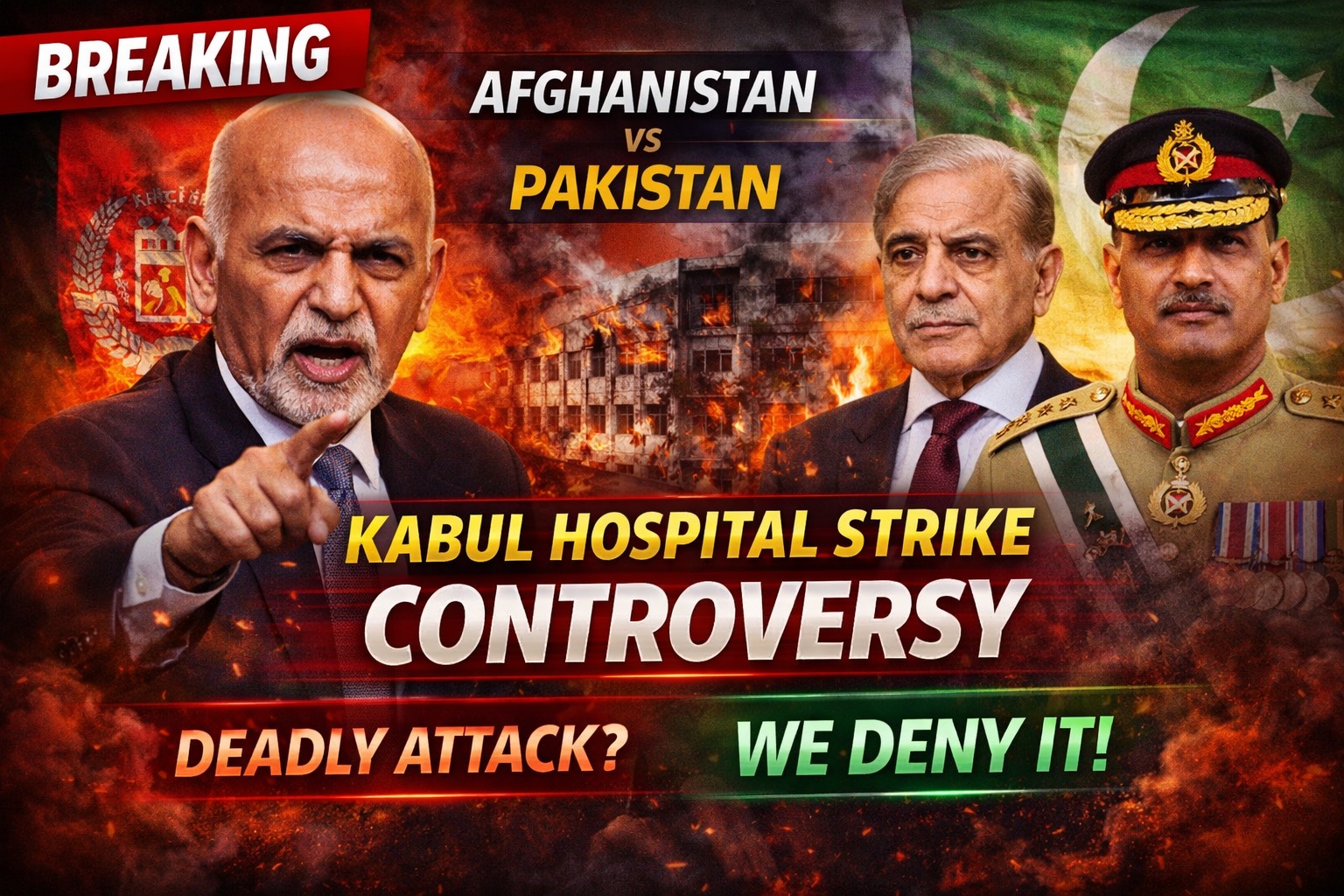
Kabul Strike Controversy: Afghanistan Accuses Pakistan of Deadly Hospital Attack, Islamabad Denies Claims
Tensions between Afghanistan and Pakistan have escalated dramatically after Kabul accused Islamabad of carrying out a devastating airstrike on a major hospital, allegedly killing hundreds of civilians. The incident, described by Afghan authorities as one of the deadliest in recent years, has further intensified an already volatile conflict between the two neighboring nations.
While Afghan officials claim the attack resulted in massive casualties and destruction, Pakistan has strongly denied targeting any civilian infrastructure, calling the allegations “false” and “misleading.”
Afghanistan’s Allegation: A Devastating Airstrike
According to Afghan authorities, the airstrike struck a large drug rehabilitation hospital in Kabul late in the evening. The facility, reportedly with a capacity of around 2,000 beds, suffered extensive damage, with entire sections reduced to rubble.
Afghan government spokesperson Hamdullah Fitrat stated that the death toll had reached at least 400, with approximately 250 people injured. He described the attack as a humanitarian catastrophe, emphasizing that many of the victims were patients undergoing treatment.
Visuals circulating on local media platforms showed scenes of chaos, with emergency responders struggling to rescue survivors from the debris. Firefighters worked through the night to control flames, while security personnel used flashlights to search for bodies trapped under collapsed structures.
Rescue operations were reportedly ongoing, with authorities fearing that the number of casualties could rise further.
Pakistan’s Response: “Baseless and Misleading”
Pakistan has categorically rejected Afghanistan’s accusations. Officials from Islamabad, including representatives of Prime Minister Shehbaz Sharif, denied that any hospital or civilian site was targeted.
A statement from Pakistan’s information ministry asserted that its military operations were aimed exclusively at militant infrastructure. According to the statement, the strikes were “precise” and focused on eliminating terrorist networks and their logistical bases.
Pakistan claimed that the targets included:
- Storage facilities for weapons and ammunition
- Technical equipment used by militant groups
- Infrastructure linked to cross-border terrorism
The government further argued that all necessary precautions were taken to avoid civilian casualties, and it accused Afghan authorities of spreading misinformation to influence public opinion.
Conflicting Narratives Deepen Crisis
The stark contrast between the claims made by Afghanistan and Pakistan highlights the complexity of the situation. While Kabul insists that a civilian hospital was hit, Islamabad maintains that only militant targets were engaged.
This divergence has made it difficult for independent observers to verify the exact sequence of events. International organizations have yet to provide a confirmed account, leaving the situation clouded in uncertainty.
Escalating Border Conflict
The alleged airstrike comes amid a broader escalation of hostilities along the Afghanistan-Pakistan border. Just hours before the incident, officials reported exchanges of fire between the two sides, resulting in casualties.
The current round of conflict began in late February and has since intensified into one of the most serious confrontations between the two countries in recent years.
The clashes have disrupted a fragile ceasefire that was brokered months earlier with the help of international mediators.
From Skirmishes to “Open War”
Pakistan has described the situation as an “open war,” indicating a significant escalation from previous cross-border skirmishes. Both nations have accused each other of initiating hostilities and supporting militant groups.
Pakistani authorities have long alleged that Afghanistan provides safe haven to the Tehrik-i-Taliban Pakistan (TTP), which has carried out numerous attacks inside Pakistan.
In addition, Islamabad has accused Kabul of harboring Baloch separatist groups and other militant organizations targeting Pakistani interests.
Afghanistan, however, has consistently denied these allegations, asserting that it does not support cross-border militancy.
Rising Casualty Claims
Both sides have released conflicting casualty figures, further complicating the situation.
Pakistan claims that its military operations have resulted in the deaths of hundreds of Afghan Taliban fighters. Afghan officials have rejected these figures, calling them exaggerated.
Conversely, Afghanistan has stated that its forces have inflicted significant losses on Pakistani troops, including the killing of over 100 soldiers.
These competing narratives reflect the broader information war accompanying the military conflict.
Regional and Global Concerns
The escalating tensions have raised alarms across the international community. The Afghanistan-Pakistan border region has historically been a hotspot for militant activity, with groups such as Al-Qaeda and Islamic State attempting to expand their influence.
A prolonged conflict between the two nations could create opportunities for such groups to regroup and strengthen their presence.
Analysts warn that continued instability in the region could have far-reaching consequences, affecting not only South Asia but also global security dynamics.
Humanitarian Impact
Beyond the political and military implications, the reported hospital strike has raised serious humanitarian concerns.
If confirmed, the targeting of a medical facility would represent a grave violation of international humanitarian law, which mandates the protection of civilian infrastructure during armed conflict.
The high number of casualties reported by Afghan authorities underscores the potential scale of the tragedy.
Human rights organizations are likely to call for an independent investigation to determine the facts and assign responsibility.
Information Warfare and Propaganda
Experts note that conflicts of this nature often involve competing narratives aimed at shaping public perception.
Both Afghanistan and Pakistan have used official statements and media channels to present their versions of events, making it challenging to establish an objective account.
Such information warfare can further inflame tensions, as each side seeks to rally domestic and international support.
What Lies Ahead
The situation remains highly volatile, with the potential for further escalation. Diplomatic efforts may be required to prevent the conflict from spiraling out of control.
Key questions remain unanswered:
- Was a civilian hospital actually targeted?
- What evidence exists to support either claim?
- Can international mediation help de-escalate tensions?
Until these questions are addressed, the crisis is likely to continue generating uncertainty and concern.
Conclusion
The alleged airstrike on a Kabul hospital has brought Afghanistan-Pakistan relations to a critical juncture. With both sides presenting sharply different accounts, the truth remains contested.
What is clear, however, is that the conflict has entered a dangerous phase, with rising casualties, deepening mistrust, and growing international concern.
As the situation unfolds, the need for transparency, accountability, and diplomatic engagement will be more important than ever to prevent further loss of life and regional instability.
Summary
Afghanistan has accused Pakistan of carrying out an airstrike on a Kabul hospital that reportedly killed 400 people, calling it one of the deadliest incidents in recent years. Pakistan has denied the आरोप, stating that its strikes targeted only militant infrastructure. The incident comes amid escalating border clashes between the two countries, raising serious concerns about regional stability and humanitarian consequences.
Disclaimer:
This article is based on publicly available information, official statements, and media reports available at the time of publication. The content is intended solely for informational and journalistic purposes.
While efforts have been made to ensure accuracy, NoCap Times does not independently verify all claims, statements, or allegations made by individuals, witnesses, or investigative sources mentioned in the report.
As investigations are ongoing, certain details may change as authorities release further updates. Readers are advised to treat the information as part of a developing news story. NoCap Times shall not be held responsible for any inaccuracies, omissions, or changes that may arise as new verified information becomes available.