

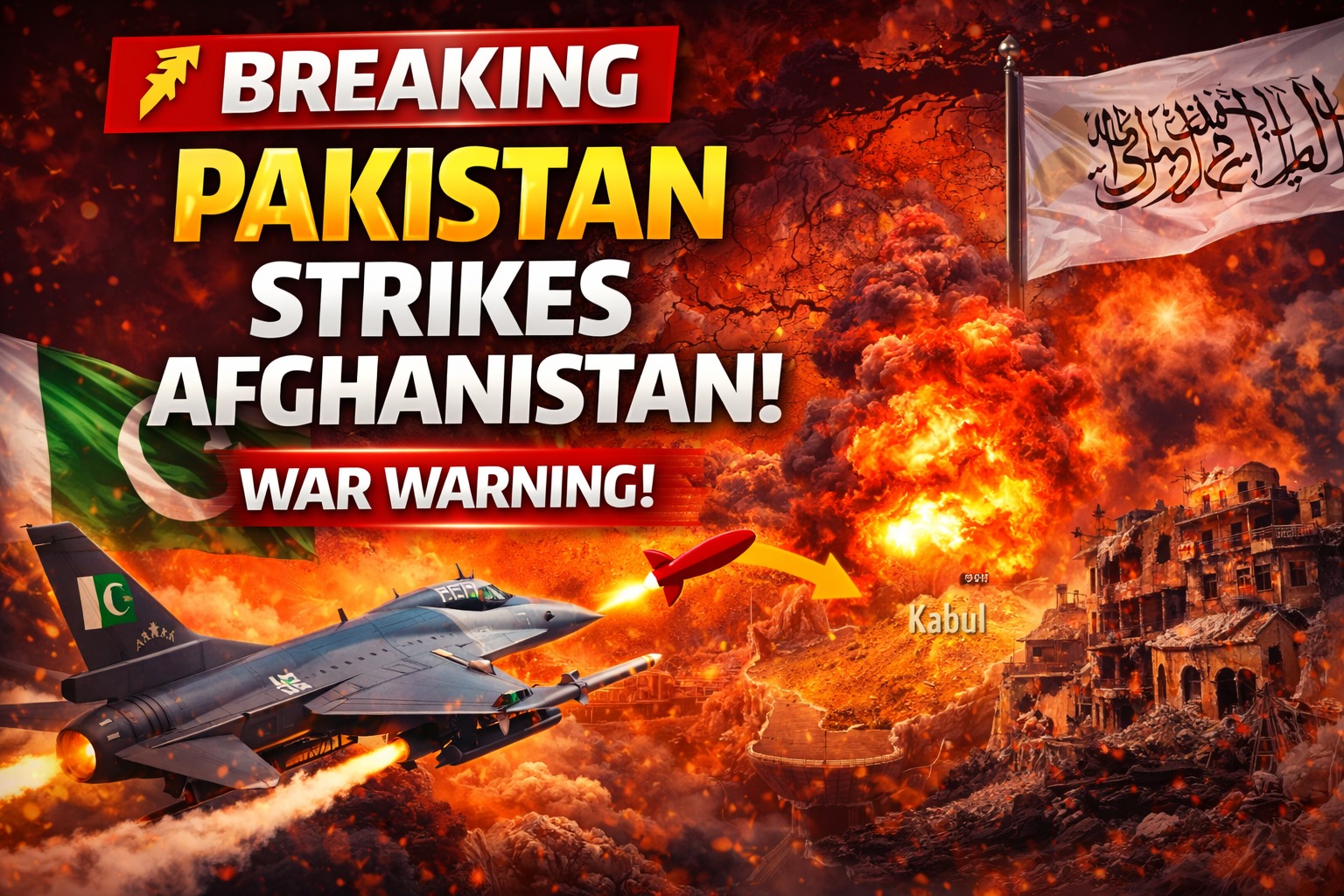
Pakistan Launches Fresh Airstrikes in Afghanistan as Tensions Escalate Toward Possible Open War
Tensions between Pakistan and Afghanistan have intensified dramatically after Pakistani forces carried out another round of airstrikes inside Afghan territory, targeting several locations including the cities of Kabul, Kandahar, Paktia Province, and Paktika Province.
Afghan authorities say the strikes hit multiple areas, including residential neighborhoods, resulting in civilian casualties. The Taliban-led government in Kabul has strongly condemned the attacks, describing them as “blatant aggression” and warning that such actions will not remain unanswered.
The renewed violence has raised fears that the long-standing tensions between the two neighbors could escalate into a broader military conflict.
Collapse of the Fragile Ceasefire
The latest escalation comes months after a temporary ceasefire between Pakistan and Afghanistan collapsed, ending a brief period of calm that followed intense cross-border clashes in late 2025.
The ceasefire agreement had been established after fighting erupted in October 2025 along the disputed frontier between the two countries. Although the deal initially reduced hostilities, a series of militant attacks and retaliatory military operations gradually eroded the fragile truce.
Recent developments indicate that both countries are now moving closer to open confrontation, with military operations increasing in frequency and intensity.
Pakistan has intensified its cross-border strikes as part of a campaign it calls Operation Ghazab lil Haq, aimed at targeting militant groups believed to be operating from Afghan territory.
What Is Operation Ghazab lil Haq?
Operation Ghazab lil Haq is the name given by Pakistani authorities to their retaliatory operations against militant groups along the Durand Line, the disputed border separating Pakistan and Afghanistan.
According to Pakistani officials, the operation is intended to eliminate militant bases and infrastructure used by insurgent groups responsible for attacks inside Pakistan.
However, Afghan authorities have accused Pakistan of targeting civilian areas rather than militant installations, leading to significant casualties among ordinary residents.
A report from the United Nations Assistance Mission in Afghanistan revealed that the recent escalation resulted in 185 civilian deaths in Afghanistan between February 26 and March 5.
Many of those killed were women and children, raising serious concerns about the humanitarian impact of the cross-border attacks.
Pakistan Blames Militants Operating from Afghanistan
Pakistan maintains that its military operations are aimed at dismantling the network of militants belonging to Tehreek-e-Taliban Pakistan (TTP).
Islamabad has repeatedly accused the Afghan Taliban government of allowing the TTP to operate safe havens within Afghanistan, from where militants allegedly plan and execute attacks on Pakistani soil.
The Afghan government, led by the Taliban movement, has strongly rejected these accusations. Officials in Kabul insist that they do not support militant activities against Pakistan and have urged Islamabad to resolve disputes through diplomatic channels rather than military action.
The disagreement over militant activity has become one of the central points of tension between the two neighboring countries.
The Durand Line: A Longstanding Source of Conflict
The roots of the current confrontation lie partly in the disputed Durand Line, a 2,600-kilometre frontier that separates Afghanistan and Pakistan.
The border has historically been difficult to control due to several factors:
- Rugged mountainous terrain
- Porous crossing points
- Ethnic Pashtun communities living on both sides
Militant groups have frequently exploited these conditions to move across the border and launch attacks, complicating efforts by both governments to maintain security.
Because Afghanistan has never formally recognized the Durand Line as an international border, the issue has remained a source of political and military tension for decades.
Deadly Attacks Inside Pakistan Triggered Escalation
The recent surge in violence was triggered by several deadly militant attacks inside Pakistan earlier this year.
One of the most devastating incidents occurred when a suicide bomber targeted a Shia mosque in Islamabad, killing dozens of worshippers.
Pakistani authorities claimed that the attackers had links to militant groups based in Afghanistan, further inflaming tensions between the two countries.
Additional attacks followed in the northwestern province of Khyber Pakhtunkhwa, where militants targeted security forces and military convoys.
Another deadly incident occurred in the Bajaur District, where a suicide bombing killed several soldiers and civilians.
Pakistan blamed militants associated with the Tehreek-e-Taliban Pakistan and accused Kabul of failing to control their activities.
Airstrikes and Counterattacks Intensify Conflict
In response to these attacks, Pakistan launched airstrikes across the border in late February, claiming that it had targeted militant training camps.
However, Afghan officials said the strikes instead hit civilian areas, resulting in dozens of deaths and injuries.
The United Nations mission later confirmed that at least 13 civilians were killed in one of the strikes, intensifying international concern over the escalating conflict.
The Afghan Taliban government subsequently retaliated with cross-border attacks against Pakistani military positions along the frontier.
Afghan forces claimed that they had captured several Pakistani military installations and inflicted heavy casualties on security personnel.
Pakistan disputed those claims but acknowledged that fighting had taken place across multiple sectors of the border.
Pakistan Warns of Possible Open War
Amid the escalating violence, Pakistan’s Defence Minister Khawaja Asif warned that the situation could deteriorate into what he described as “open war.”
Pakistan has continued conducting air and ground operations in areas believed to host militant groups, while Afghan leaders have vowed to defend their territory.
The Taliban’s supreme leader Hibatullah Akhundzada condemned the airstrikes and warned that Afghanistan would respond to any violation of its sovereignty.
Such statements have further heightened fears that the conflict could spiral into a full-scale confrontation between the two countries.
Diplomatic Efforts Struggle to Contain Crisis
Despite growing concerns about regional stability, diplomatic efforts to reduce tensions have so far produced limited results.
Afghan officials say they remain willing to engage in dialogue to resolve the dispute peacefully.
However, Pakistani authorities have signaled that meaningful talks will only occur if Kabul takes stronger action against militant groups operating within Afghan territory.
With both sides continuing military operations and exchanging accusations, analysts warn that the conflict could expand further if diplomatic solutions are not found soon.
The situation remains highly volatile, and the risk of a broader regional conflict continues to grow.
Summary
Tensions between Pakistan and Afghanistan have escalated after Pakistan launched new airstrikes targeting several Afghan cities including Kabul and Kandahar. Afghan authorities say the strikes caused civilian casualties and have condemned them as aggression.
Pakistan says the operations are part of Operation Ghazab lil Haq, targeting militants linked to the Tehreek-e-Taliban Pakistan. However, Afghanistan denies supporting such groups and accuses Pakistan of hitting civilian areas.
The escalating violence along the disputed Durand Line has raised fears of a wider conflict, with Pakistani officials warning that the situation could develop into open war if hostilities continue.
Disclaimer:
This article is based on publicly available information, official statements, and media reports available at the time of publication. The content is intended solely for informational and journalistic purposes.
While efforts have been made to ensure accuracy, NoCap Times does not independently verify all claims, statements, or allegations made by individuals, witnesses, or investigative sources mentioned in the report.
As investigations are ongoing, certain details may change as authorities release further updates. Readers are advised to treat the information as part of a developing news story. NoCap Times shall not be held responsible for any inaccuracies, omissions, or changes that may arise as new verified information becomes available.