

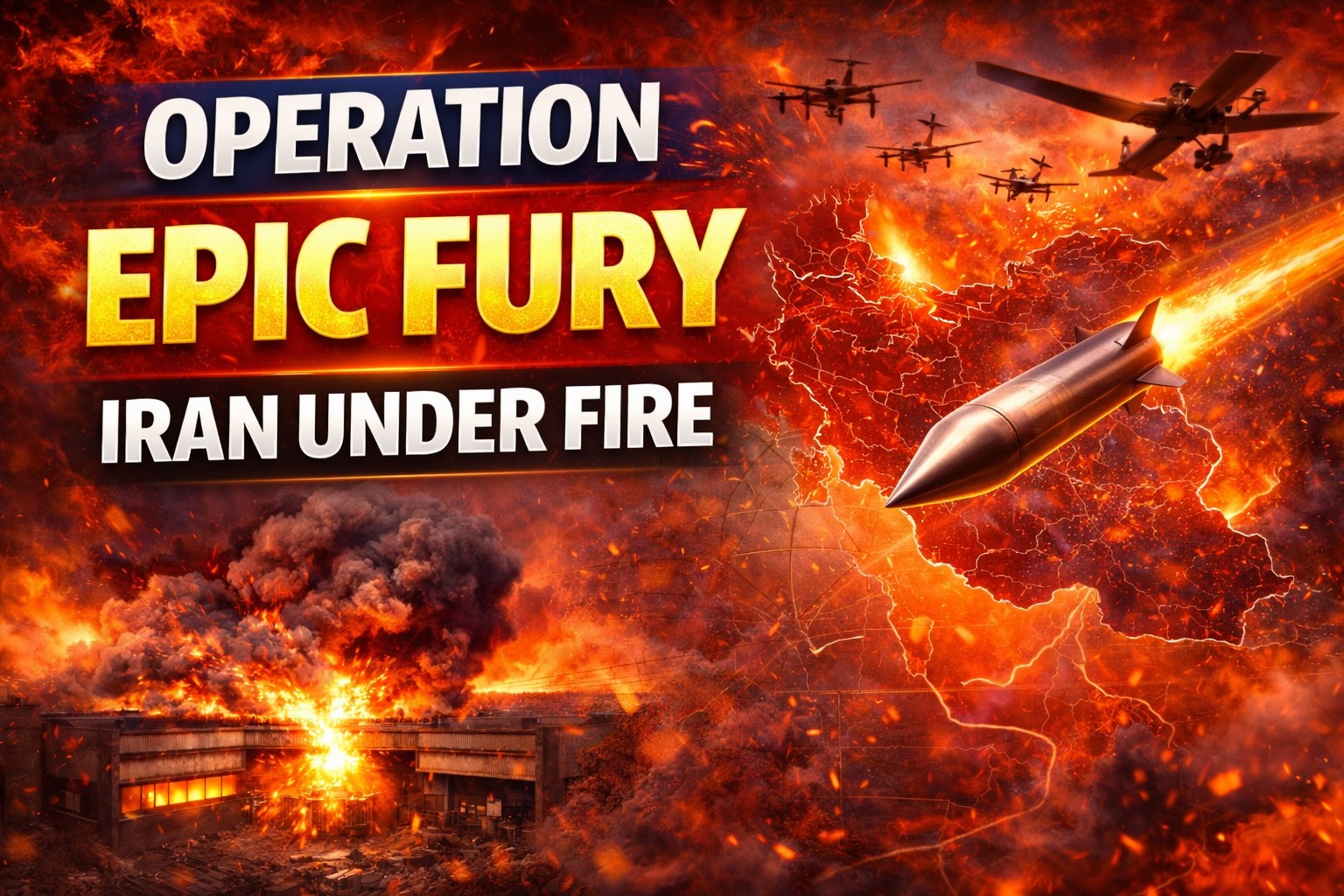
Operation Epic Fury: Drones, Hypersonic Missiles and Bunker-Buster Bombs Shaping the Iran War
The conflict unfolding across the Middle East has rapidly evolved into a complex technological battle, where both sides are deploying vastly different military strategies and weapons systems.
While Iran has focused on launching large numbers of relatively inexpensive drones and missiles to overwhelm defensive systems, the United States and its allies are relying on advanced aircraft, precision-guided cruise missiles and sophisticated missile defence networks.
This contrast has turned the conflict—often referred to as Operation Epic Fury—into a contest not only of military power but also of technological capability, cost efficiency and long-term endurance.
Shahed-136: Iran’s Primary Attack Drone
One of the most prominent weapons shaping the battlefield is the Shahed‑136 loitering munition developed by Iran.
The drone measures roughly three metres in length and features a distinctive delta-wing design. It carries an explosive payload estimated between 40 and 60 kilograms and is programmed to strike predetermined coordinates before detonating on impact.
What makes the system particularly effective is its relatively low cost—estimated between $20,000 and $50,000—combined with a long operational range that can approach 2,000 kilometres. Iran frequently deploys these drones in large coordinated swarms targeting military installations, energy infrastructure and urban areas across the Gulf region.
Even when most are intercepted, a small number can still penetrate defensive systems.
Shahed-131: Smaller Drone Used for Swarm Tactics
Iran also uses the smaller Shahed‑131 drone alongside the Shahed-136. Although it has a shorter range and smaller warhead, its primary role is tactical.
These drones are often launched in large numbers together with strike drones or ballistic missiles. By creating dozens of simultaneous targets on radar screens, they complicate defensive decisions for air defence operators. In many cases, the smaller drones serve as decoys, increasing the likelihood that more destructive weapons reach their intended targets.
Shahab-3 Missile: Iran’s Long-Range Strike Capability
Despite the growing attention on drones, ballistic missiles remain a core element of Iran’s military strategy.
The Shahab‑3 medium-range ballistic missile has a range of approximately 2,000 kilometres, enabling Iran to strike targets across much of the Middle East. The missile carries a warhead weighing around 770 kilograms and travels at extremely high speeds along steep trajectories.
In many cases during the conflict, Shahab-series missiles have been launched simultaneously with drone swarms, creating layered attacks that are difficult for air defence systems to counter.
Fattah Hypersonic Missile
Iran has also presented the Fattah hypersonic missile as one of its most advanced weapons.
According to Iranian officials, the missile can travel at speeds exceeding Mach 15 and has the ability to manoeuvre during flight. Such manoeuvrability makes hypersonic weapons significantly harder to intercept than traditional ballistic missiles.
However, Western defence analysts say the full capabilities of the system have yet to be independently verified.
B-2 Spirit and the Massive Ordnance Penetrator
On the American side, one of the most strategically important platforms involved in the conflict is the B‑2 Spirit stealth bomber.
Its flying-wing design and radar-absorbing materials allow it to penetrate heavily defended airspace. The aircraft is also the only platform capable of deploying the GBU‑57 Massive Ordnance Penetrator, a 30,000-pound bunker-buster bomb designed to destroy deeply buried facilities such as underground command centres or nuclear sites.
Tomahawk Cruise Missiles
Another key weapon used by the United States is the Tomahawk cruise missile.
These land-attack missiles are typically launched from warships or submarines operated by the United States Navy. They can travel more than 1,500 kilometres and fly at low altitude while following complex pre-programmed routes.
This capability allows Tomahawk missiles to evade radar systems and strike high-value targets such as radar installations, missile launch sites or command facilities with high precision.
LUCAS Drone: A Low-Cost American Counter
To counter the widespread use of drones, the United States has also introduced the Low‑cost Unmanned Combat Attack System (LUCAS).
The system is designed as a relatively inexpensive one-way attack drone that can target radar stations or missile launchers. By using lower-cost drones instead of expensive cruise missiles, military planners can conduct sustained strikes without exhausting high-value munitions.
Patriot Missile Defence and Drone Interceptors
Defending against drone swarms has required the use of advanced air defence systems such as the Patriot missile system.
However, intercepting low-cost drones with expensive missiles can quickly become unsustainable. To address this challenge, US forces have increasingly used the Advanced Precision Kill Weapon System (APKWS), which converts standard Hydra rockets into laser-guided munitions.
At roughly $25,000 per shot, APKWS offers a far cheaper method of neutralising drones compared with firing high-cost missile interceptors.
A War Defined by Technology and Cost
Beyond the weapons themselves, the conflict highlights a deeper strategic competition.
Iran’s approach relies on launching large numbers of relatively inexpensive drones and missiles designed to overwhelm defences. The United States and its allies, by contrast, depend on advanced precision weapons and layered defensive systems that are technologically superior but significantly more expensive.
Ultimately, the outcome of the conflict may depend not only on military technology but also on which side can sustain its arsenal and economic resources over the long term.
Disclaimer
This article is based on publicly available information and official statements. The content is intended for informational purposes only. The publication does not independently verify third-party claims or assertions mentioned in the developments.