

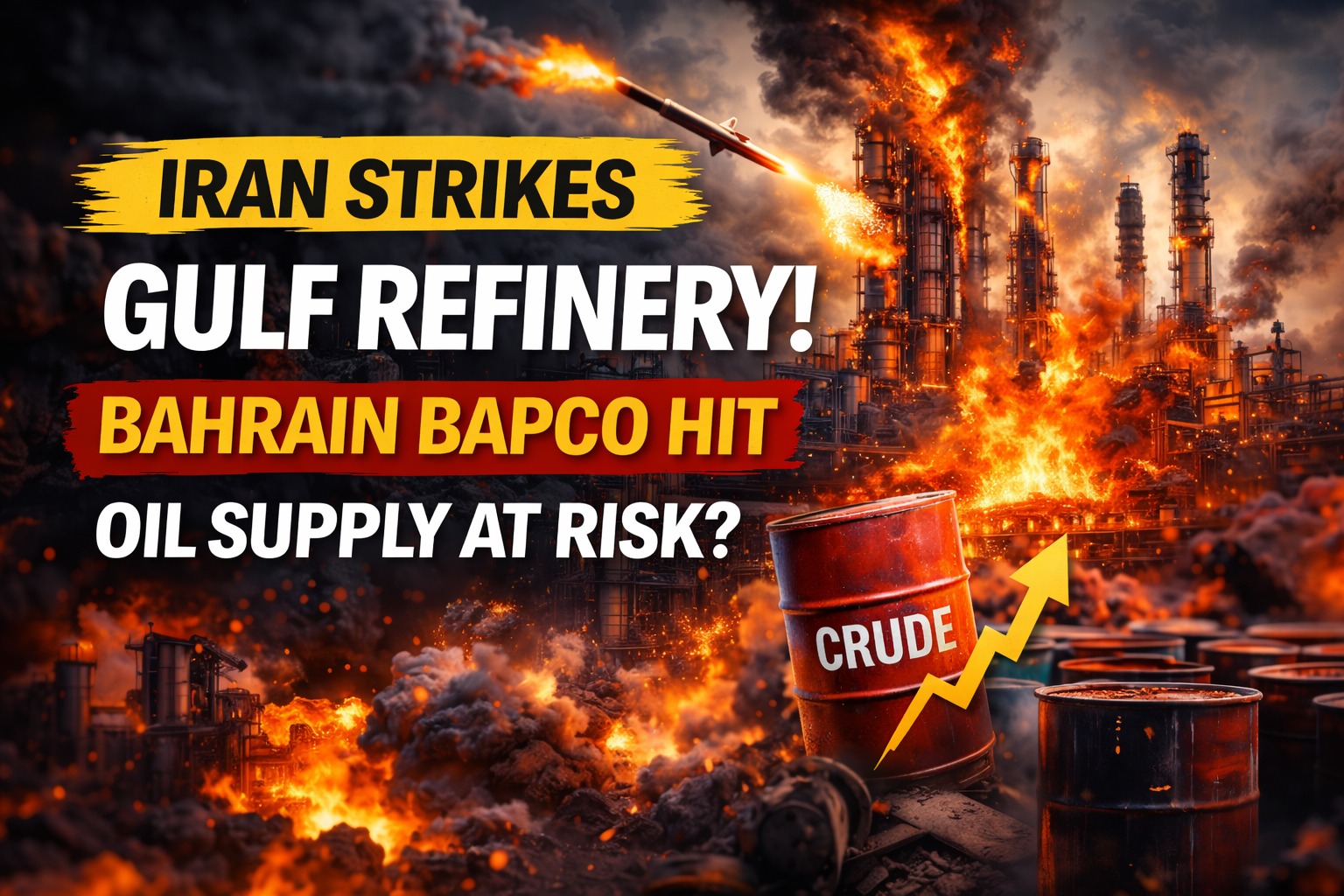
Bahrain’s BAPCO Refinery Hit in Iran Strike; Operations Disrupted Amid Escalating Gulf Conflict
Bahrain’s state-owned energy company Bapco Energies has declared force majeure after a strike linked to Iran damaged its main refinery complex on Sitra Island. The incident comes as tensions across the Middle East intensify following a series of Israeli airstrikes on Iranian targets and retaliatory attacks across the Gulf region. While Bahraini authorities say the fire at the refinery has been contained and there were no casualties, the attack has raised concerns over regional energy supply and shipping routes, contributing to a surge in global oil prices.
Iranian Strike Damages Bahrain’s Key Oil Refinery
Bahrain’s largest oil refinery, operated by Bapco Energies, has been hit during the escalating conflict in the Middle East, prompting the company to declare force majeure on its operations.
The refinery complex, located on Sitra Island near the Al Ma’ameer industrial area, reportedly suffered damage following a missile or drone strike attributed to Iranian forces.
According to statements released on March 9, 2026, the company invoked force majeure due to the “ongoing regional conflict” and the attack on its refinery infrastructure. The declaration allows the company to temporarily suspend certain contractual obligations because of circumstances beyond its control.
Fire Contained, No Casualties Reported
The strike triggered a significant fire at the refinery, sending thick plumes of smoke into the sky around the facility.
Bahraini authorities confirmed that emergency response teams managed to contain the blaze and that no casualties were reported.
Officials also indicated that domestic fuel supplies remain secure, as contingency plans have been activated to maintain energy availability within the country.
However, the attack could affect export operations from Bahrain’s energy sector, raising concerns among global energy markets.
Regional Energy Infrastructure Under Threat
The refinery attack is part of a wider wave of retaliatory strikes across the Gulf region as tensions between Iran, Israel, and their allies continue to escalate.
In recent days, energy infrastructure in several Gulf countries — including Saudi Arabia, the United Arab Emirates, Kuwait, and Qatar — has reportedly faced attacks targeting refineries, storage facilities, and energy transport systems.
These incidents have disrupted shipments and prompted some operators to declare force majeure, particularly in areas connected to the Strait of Hormuz, one of the world’s most critical oil shipping routes.
Israel Intensifies Airstrikes Inside Iran
At the same time, Israel has expanded its military campaign inside Iran, launching a new wave of large-scale airstrikes targeting multiple locations across the country.
Reports indicate that the strikes have focused on military facilities, energy infrastructure, and sites linked to Iran’s nuclear programme, including areas near Tehran.
The offensive follows earlier joint operations by the United States and Israel that began in late February 2026, which targeted Iranian missile and drone capabilities.
Explosions were reportedly seen near oil storage sites and refinery facilities in parts of the Iranian capital during the latest attacks.
Retaliation and Wider Regional Escalation
Iran has responded by launching missile attacks toward Israel, although many of these projectiles were reportedly intercepted by Israeli defence systems.
The conflict has also spread to neighbouring regions, with Israel conducting fresh strikes in Lebanon amid continuing confrontations with Hezbollah.
The widening conflict has heightened fears of a prolonged regional crisis with major implications for global energy markets.
Oil Prices Surge Amid Supply Concerns
Energy markets have reacted sharply to the growing instability in the Gulf.
Oil prices have surged as traders and analysts assess the risk of disruptions to production facilities and shipping routes in one of the world’s most important oil-exporting regions.
Market experts warn that prices could rise further if the conflict threatens critical transit points such as the Strait of Hormuz, through which a significant share of global oil supply passes.
Global Calls for De-escalation
The rapid escalation of hostilities has triggered concern among international leaders and diplomatic bodies.
Several governments have urged all parties involved to pursue de-escalation and diplomatic solutions to prevent the conflict from expanding further.
Despite these calls, military operations across the region show no immediate signs of slowing, keeping the Middle East on high alert.
Disclaimer
The information in this article is based on publicly available reports and official statements released by authorities and organisations. Due to the rapidly evolving nature of the conflict, some details may change as new information emerges. This publication does not independently verify all claims made during ongoing geopolitical developments.