

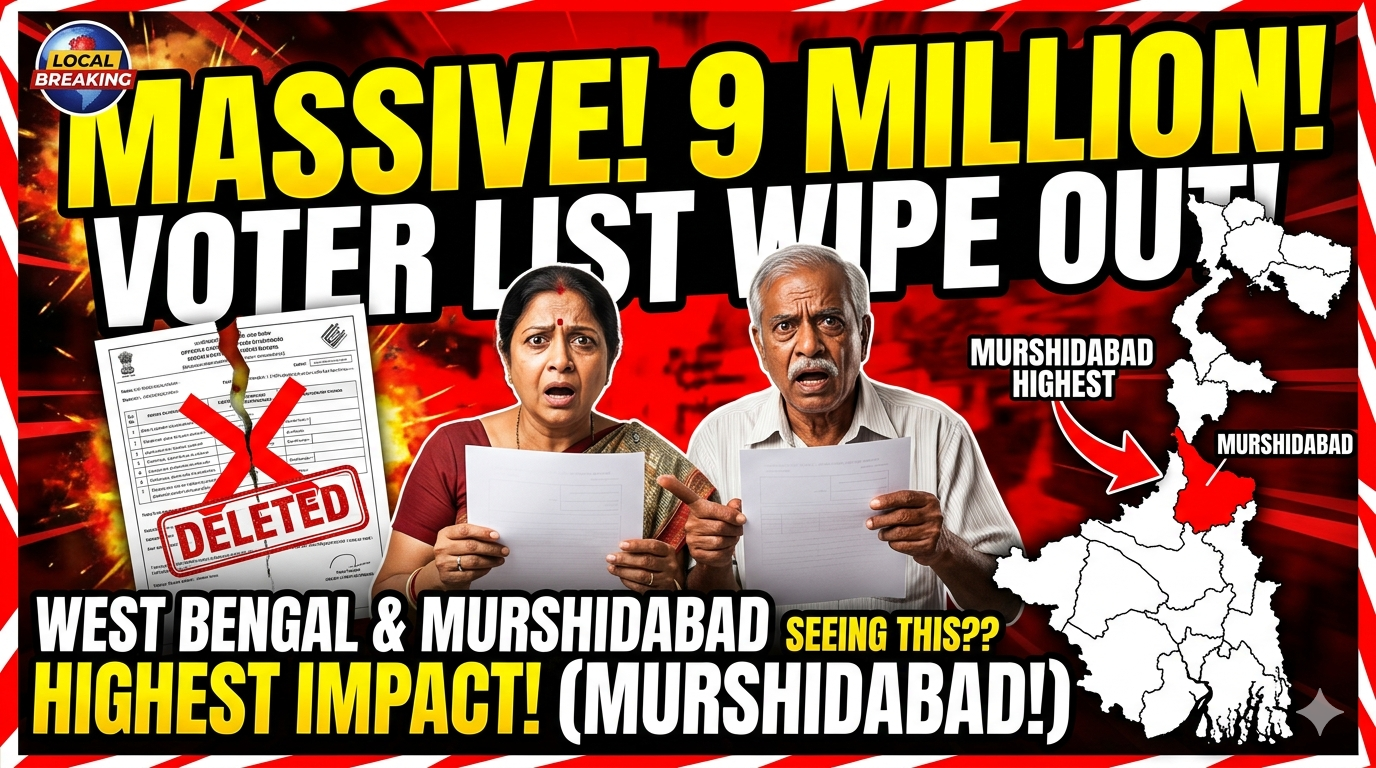
West Bengal Voter List Revision: 9 Million Names Deleted, Murshidabad Sees Highest Impact
In a major electoral development ahead of upcoming polls, the Election Commission of India has confirmed that nearly 9 million names have been removed from voter rolls in West Bengal following a Special Intensive Revision (SIR). The large-scale deletion—one of the most significant in recent years—has triggered political debate and raised concerns about voter participation.
Massive Deletions Ahead of Elections
According to official data, approximately 9.1 million names were removed from electoral rolls during the revision process. After accounting for new additions, the net reduction stands at around 8.9 million voters.
A significant portion of these deletions—around 2.71 million—came after adjudication under the controversial “logical discrepancy” category. These cases involved issues such as mismatched personal details, name inconsistencies, or age discrepancies.
What Is the ‘Logical Discrepancy’ Category?
During the revision exercise, nearly 6 million voter records were flagged for discrepancies and sent for adjudication. Judicial officers reviewed these cases, and about 45% were deemed ineligible, resulting in their removal from the voter list.
The process was carried out under judicial supervision following intervention by the Supreme Court of India, which stepped in amid disputes between the poll panel and the state government.
Murshidabad, Nadia Among Worst Affected
District-wise data reveals that Murshidabad recorded the highest number of deletions under the logical discrepancy category, with over 4.5 lakh names removed.
Other districts with high deletion numbers include:
- North 24 Parganas
- Malda
- South 24 Parganas
- Purba Bardhaman
In percentage terms, Nadia recorded the highest rejection rate at nearly 78%, followed by Hooghly and Kolkata North.
Border Districts and Vulnerable Communities Impacted
Several of the worst-affected districts are located along the India-Bangladesh border and have significant populations of minority and refugee communities. Regions like Murshidabad and Malda have large Muslim populations, while North 24 Parganas and Nadia are home to many members of the Matua community—historically displaced groups who migrated during and after Partition.
The scale and pattern of deletions in these areas have become a key point of political contention.
Timeline of the Revision Exercise
The SIR process in West Bengal began in November last year. Key milestones include:
- December 16, 2025: Draft roll published with 5.8 million deletions
- February 28, 2026: Final roll released with 6.36 million deletions
- Post-adjudication: Total deletions rose to approximately 9 million
The revision has resulted in the removal of around 11.6% of the state’s pre-SIR electorate, making it one of the highest among states where the process was conducted.
Impact on Upcoming Elections
The timing of the deletions—just weeks before polling—has added to the controversy. Voters whose names were removed in constituencies going to polls in the first phase will not be able to vote, as the rolls have already been frozen.
For second-phase voters, there remains a limited window to appeal through tribunals, though these bodies are not yet fully operational.
Tribunal Process Yet to Begin Fully
Affected individuals can challenge their deletion before special tribunals headed by former judges. However, these tribunals are still in the process of being set up.
The Supreme Court has directed the formation of a standardized procedure for these hearings, and a software system is expected to be developed to streamline the process. Authorities indicate that the tribunals will become functional soon.
Political Reactions Intensify
The issue has sparked sharp political reactions across party lines.
Chief Minister Mamata Banerjee alleged that voter names were selectively removed, particularly targeting vulnerable communities. She assured legal assistance to those seeking redress through tribunals.
On the other hand, BJP leaders defended the process. Union Minister Sukanta Majumdar stated that genuine Indian citizens who approach tribunals will be reinstated in the voter list.
Leader of Opposition Suvendu Adhikari criticized the state government, arguing that the revision was necessary to eliminate ineligible or duplicate voters.
A High-Stakes Electoral Issue
With millions of voters affected and elections around the corner, the voter roll revision has emerged as a critical political issue in West Bengal. Questions around transparency, fairness, and accessibility of the appeals process are likely to dominate the electoral discourse in the coming weeks.
Summary
The Election Commission of India has removed nearly 9 million names from West Bengal’s voter rolls during a Special Intensive Revision, with 2.71 million deletions resulting from adjudication under the “logical discrepancy” category. Murshidabad recorded the highest number of deletions, while Nadia saw the highest rejection rate. The move has sparked political controversy, with Mamata Banerjee alleging targeted deletions and BJP leaders defending the process. With elections approaching, many affected voters may miss the chance to vote, while tribunals for appeals are yet to become fully operational.
Disclaimer
This article is based on publicly available information, official statements, and media reports available at the time of publication. The content is intended solely for informational and educational purposes and should not be construed as investment advice.
While efforts have been made to ensure accuracy, the information presented may change as new developments emerge. Readers are advised to conduct their own research and consult financial advisors before making any investment decisions.
NoCap Times does not independently verify all claims or statements and shall not be held responsible for any inaccuracies or omissions.