

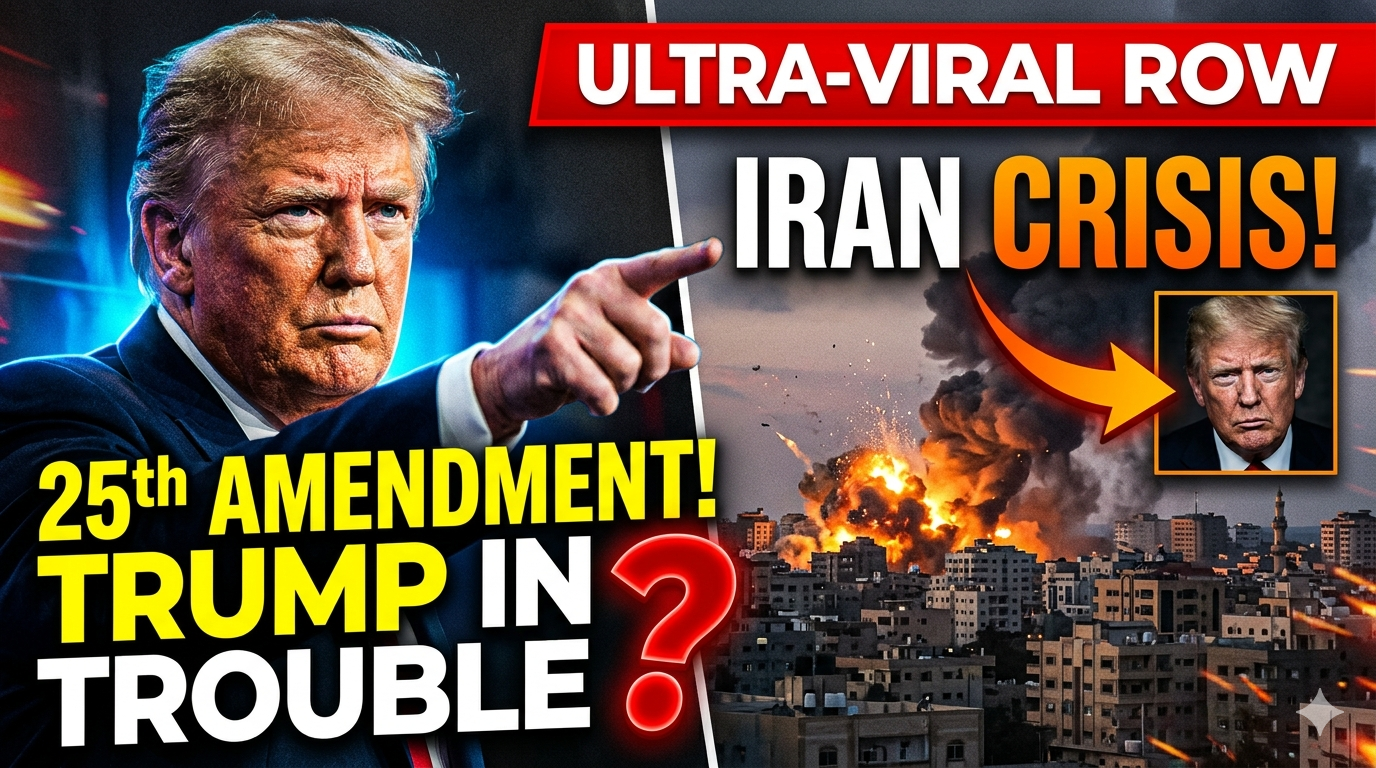
25th Amendment Row Intensifies: Why Donald Trump Is Facing Fresh Political Heat Amid Iran Crisis
Even as tensions in the Middle East appeared to ease slightly with a last-minute ceasefire announcement, the political storm surrounding Donald Trump is only getting stronger back home in Washington. What began as a geopolitical crisis involving Iran has now evolved into a domestic political flashpoint, with growing calls to remove the US President from office under the 25th Amendment to the United States Constitution.
Ceasefire Fails to Calm Political Turmoil
On Tuesday, Trump announced a temporary two-week ceasefire with Iran, narrowly meeting his own deadline. While the move was expected to cool tensions, it appears to have had the opposite effect politically. Instead of restoring stability, the situation has intensified scrutiny over Trump’s leadership and decision-making during the crisis.
Reports indicate that more than 85 Democratic lawmakers in the House of Representatives are now supporting efforts to either impeach Trump or invoke the 25th Amendment. This shift suggests that the controversy has moved beyond the Iran conflict itself and is now centered on Trump’s conduct and rhetoric.
What Sparked the Backlash?
The outrage stems largely from Trump’s aggressive statements during the crisis. His remarks reportedly included threats of large-scale destruction targeting Iranian infrastructure and warnings that entire populations could face devastating consequences.
Critics argue that such statements could be interpreted as endorsing collective punishment or even war crimes—an allegation that has raised serious concerns among lawmakers, analysts, and sections of the public.
Importantly, the criticism is no longer limited to political opponents. Some voices within Trump’s broader support base have also begun questioning his judgment, signaling cracks in what was once a largely unified front.
Understanding the 25th Amendment
At the center of this political storm is the 25th Amendment—a constitutional provision designed to address situations where a US President is unable to perform their duties.
The amendment outlines procedures for presidential succession in cases of death, resignation, or incapacity. However, the current debate is focused specifically on Section 4, which deals with removing a sitting president due to inability to discharge official responsibilities.
How Section 4 Works
Under Section 4 of the 25th Amendment:
- The Vice President and a majority of the Cabinet must declare that the President is unfit to serve.
- This declaration is submitted to Congress.
- The Vice President immediately assumes the role of Acting President.
If the President contests this decision, Congress must step in. To uphold the removal, a two-thirds majority in both the House and the Senate is required.
It’s important to note that this process does not permanently remove the President from office. Instead, it temporarily transfers power to the Vice President.
Has It Ever Been Used?
While parts of the 25th Amendment have been used in the past—mainly for temporary transfers of power during medical procedures—Section 4 has never been successfully invoked to sideline a sitting President.
This is largely due to the high political and procedural thresholds involved. The process requires cooperation from the President’s own Cabinet, making it extremely difficult to execute in practice.
Lawmakers Call for Action
In recent days, several prominent Democratic leaders have openly called for invoking the amendment.
- Ro Khanna urged immediate action, stating the amendment should be used to remove Trump.
- Ilhan Omar echoed the demand, calling for both impeachment and removal.
- JB Pritzker declared that the time for action had already passed.
- Robert Garcia described Trump as “out of control,” reinforcing calls for intervention.
Other lawmakers, including Julie Johnson, Bonnie Watson Coleman, Jimmy Gomez, and Mark Pocan, have also voiced similar concerns.
Unusual Signals from Allies
What makes the situation even more striking is that concern is not entirely confined to opposition ranks. Reports suggest that even some traditionally supportive figures have expressed unease.
For instance, Marjorie Taylor Greene, often considered a staunch Trump ally, reportedly criticized his behavior—an unusual and notable departure.
Outside the political sphere, public figures have also weighed in. Media personality Alex Jones and former White House communications director Anthony Scaramucci have both called for institutional checks on presidential power.
Why Removal Remains Unlikely
Despite the growing noise, experts caution that invoking the 25th Amendment remains highly unlikely. The process requires not just political will but also alignment within the President’s Cabinet—many of whom are appointed by and loyal to him.
Additionally, achieving a two-thirds majority in both houses of Congress presents a steep challenge, especially in a polarized political environment.
A Defining Political Moment
The current situation underscores a broader constitutional and political dilemma: how to balance executive authority with accountability during moments of crisis.
While critics argue that Trump’s conduct warrants immediate action, supporters maintain that such calls are politically motivated and undermine democratic processes.
As the Iran situation evolves, the debate over the 25th Amendment is likely to remain at the forefront of American politics, shaping both domestic discourse and global perceptions of US leadership.
Summary
US President Donald Trump is facing mounting political pressure despite announcing a temporary ceasefire with Iran. Over 85 Democratic lawmakers are pushing for his removal, citing concerns over his rhetoric and conduct during the crisis. The debate has brought renewed focus on the 25th Amendment, particularly Section 4, which allows a President to be declared unfit for office. While several leaders have demanded action, experts believe the high constitutional threshold and political realities make its invocation unlikely.
Disclaimer
This article is based on publicly available information, official statements, and media reports available at the time of publication. The content is intended solely for informational and educational purposes and should not be construed as investment advice.
While efforts have been made to ensure accuracy, the information presented may change as new developments emerge. Readers are advised to conduct their own research and consult financial advisors before making any investment decisions.
NoCap Times does not independently verify all claims or statements and shall not be held responsible for any inaccuracies or omissions.