

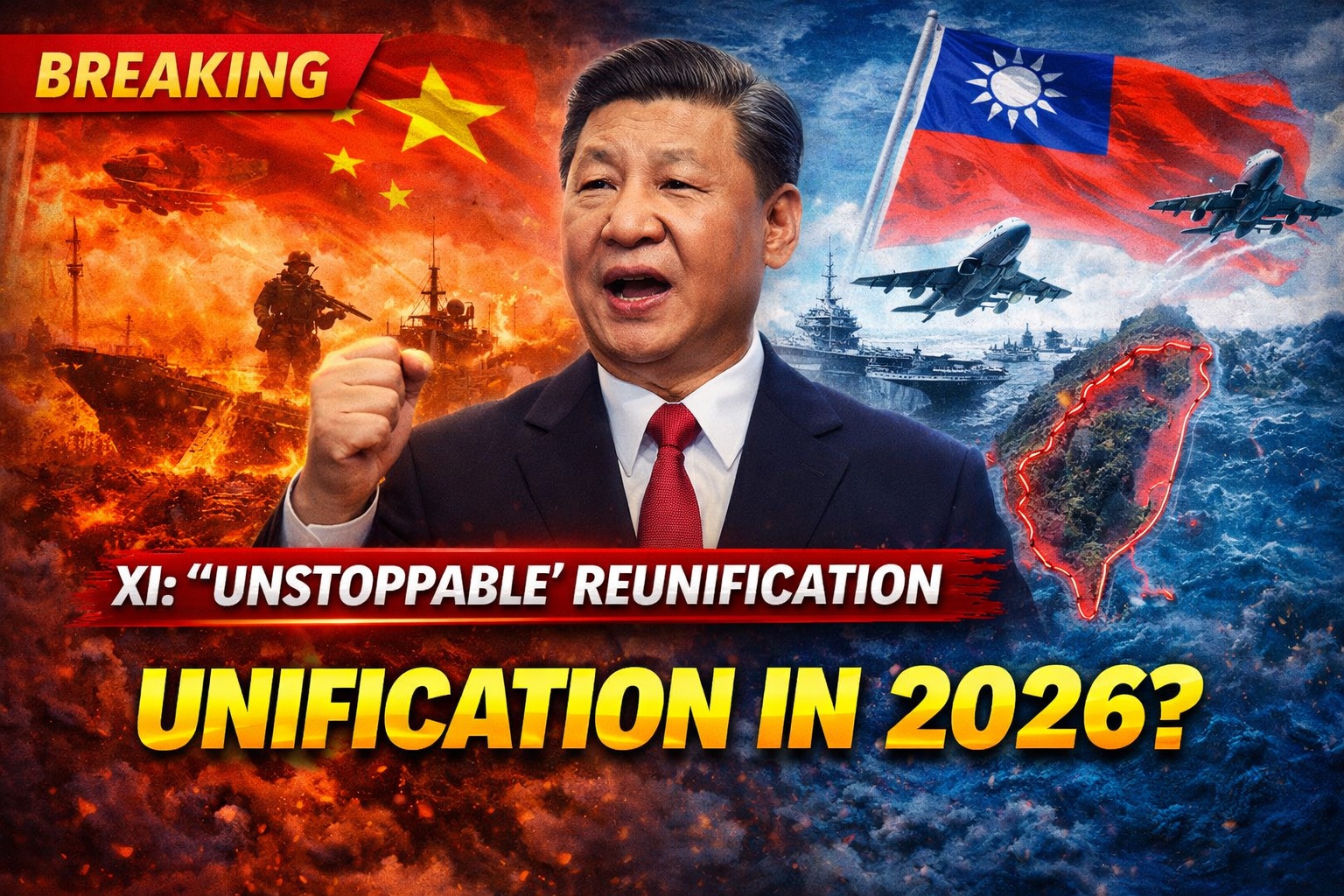
Xi Jinping Renews Vow for ‘Unstoppable’ Reunification with Taiwan in 2026 New Year Address Amid Heightened Cross-Strait Tensions
In a firm reaffirmation of Beijing’s long-standing position, Chinese President Xi Jinping declared that the reunification of China and Taiwan remains an “unstoppable” historical trend, delivering the message during his annual New Year’s Eve address broadcast on December 31, 2025. Speaking from Beijing as the world prepared to enter 2026, Xi emphasized the shared “blood and kinship” between people on both sides of the Taiwan Strait while hailing China’s technological and economic achievements. The remarks, which came just one day after the conclusion of large-scale Chinese military drills encircling Taiwan, have reignited global scrutiny over the volatile cross-strait relationship and its potential to reshape the Indo-Pacific security landscape.
Xi’s speech struck a familiar yet resolute tone. “We Chinese on both sides of the Taiwan Strait share a bond of blood and kinship,” he stated. “The reunification of our motherland, a trend of the times, is unstoppable.” He also highlighted the establishment of an annual “Taiwan Recovery Day” in 2025, commemorating the end of Japanese colonial rule over the island at the close of World War II. The address blended domestic pride in advancements in artificial intelligence, semiconductors, space exploration, and military modernization with a clear geopolitical signal: Beijing views Taiwan as an inalienable part of China and will pursue “national reunification” as a core objective of the Communist Party.
This latest vow arrives against a backdrop of sustained military, diplomatic, and economic pressure on Taiwan. In late December 2025, the People’s Liberation Army (PLA) conducted “Justice Mission 2025” joint exercises involving air, naval, and rocket forces that simulated blockade and encirclement scenarios. Taiwanese defense officials reported heightened activity, including sorties by fighter jets and deployments of warships around the island. While Beijing described the drills as routine training to safeguard sovereignty, Taipei and its international partners viewed them as coercive signaling aimed at intimidating the democratically elected government of President Lai Ching-te.
Taiwan’s Response and Domestic Resilience
Taiwan has consistently rejected Beijing’s sovereignty claims, asserting its status as a sovereign democracy with its own elected government, military, and vibrant economy. In the immediate aftermath of Xi’s address, President Lai pledged to defend national sovereignty and called on the international community to support peace and stability in the Taiwan Strait. “The coming year, 2026, will be a crucial one for Taiwan,” Lai noted, urging preparations for potential challenges while expressing hope for dialogue based on equality and dignity.
Taiwanese society has shown remarkable resilience. Public opinion polls consistently indicate that a vast majority of citizens identify as Taiwanese rather than Chinese and oppose unification under the “one country, two systems” model once offered to Hong Kong. Defense spending has risen steadily, with investments in asymmetric warfare capabilities, indigenous submarines, anti-ship missiles, and enhanced cyber defenses. The island’s semiconductor industry—dominating global supply chains for advanced chips—remains a strategic asset, giving Taiwan significant leverage even as Beijing attempts economic coercion through trade restrictions and gray-zone tactics.
Military Dynamics and Coercive Tactics in Early 2026
As of March 2026, the PLA continues gray-zone operations designed to erode Taiwan’s threat perception and normalize military presence near the island. Activity in Taiwan’s Air Defense Identification Zone (ADIZ) saw an unusual lull during China’s annual “Two Sessions” political meetings in early March, with some days recording zero incursions—a departure from the near-daily pattern observed since 2023. However, large-scale flights resumed mid-March, with Taiwan’s Ministry of National Defense detecting dozens of PLA aircraft and naval vessels crossing the median line of the Taiwan Strait.
Analysts note that while monthly ADIZ incursions have declined from peaks above 300 to below 200 in early 2026, the PLA has not abandoned its modernization drive. New Type 055 destroyers have entered service, enhancing air defense and anti-submarine capabilities that could support future amphibious operations. High-altitude balloon incursions and China Coast Guard patrols near Taiwan’s outlying islands, including Kinmen and Pratas, persist as low-intensity tools to assert jurisdiction claims without triggering full-scale conflict.
US intelligence assessments released in March 2026 indicate that Chinese leaders currently have no fixed timeline or concrete plans for a full-scale invasion of Taiwan in 2027 or the immediate future. Beijing still prefers “peaceful reunification,” though it has never ruled out the use of force. The report underscores ongoing PLA buildup but highlights internal challenges, including economic headwinds and the complexities of a high-intensity amphibious assault across the 100-mile-wide strait.
Diplomatic and International Dimensions
The Taiwan issue remains the most sensitive flashpoint in US-China relations. During a February 2026 phone call, Xi told US President Donald Trump that Taiwan is the “most important” matter in bilateral ties and urged Washington to handle arms sales with “prudence.” Trump has at times downplayed immediate invasion risks, citing personal assurances from Xi, yet the administration continues to advance defense support for Taipei, including a potential record $14 billion arms package featuring advanced missiles.
Allies in the Indo-Pacific, including Japan, Australia, and the Philippines, have expressed growing concern. Joint military exercises involving the US and partners have increased, focusing on interoperability and deterrence in the event of a Taiwan contingency. The European Union and NATO have also voiced support for maintaining stability in the strait, viewing any disruption as a threat to global trade and semiconductor supplies.
China, meanwhile, has sought to isolate Taiwan diplomatically by peeling away its remaining formal allies and promoting “patriotic pro-reunification forces” on the island. Senior officials have pledged firm support for unification advocates while vowing to “resolutely strike” against perceived separatist activities.
Economic Stakes and Global Ripple Effects
Any escalation over Taiwan would carry catastrophic economic consequences. Taiwan produces over 90% of the world’s most advanced semiconductors, and a conflict could paralyze global technology supply chains, from smartphones and automobiles to military systems. Estimates suggest trillions of dollars in losses, alongside disruptions to shipping lanes vital for energy and goods trade.
Beijing has occasionally linked energy security to reunification rhetoric, suggesting that “peaceful reunification” could alleviate Taiwan’s reliance on volatile global markets. Taipei has firmly rejected such overtures, emphasizing diversified import strategies and domestic resilience measures, including potential nuclear restarts and renewable energy expansion.
Domestically, Xi’s leadership continues to tie reunification to the “Chinese Dream” of national rejuvenation by the 2049 centenary of the People’s Republic. Yet analysts caution that 2026 is unlikely to see outright military action. Beijing appears focused on a long-term strategy of coercion, economic leverage, and political warfare to weaken Taiwan’s resolve while building PLA capabilities for a range of scenarios—from blockade to limited conflict or full invasion.
Outlook for 2026 and Beyond
As spring 2026 unfolds, the Taiwan Strait remains calm on the surface but charged with underlying tension. Reduced ADIZ activity may reflect operational fatigue, seasonal patterns, or a deliberate shift toward higher-quality joint training. However, any perceived provocation—such as high-level US-Taiwan visits, major arms announcements, or Taiwanese constitutional moves—could prompt renewed surges in PLA operations.
For Xi Jinping, reunification represents a historic mission that would cement his legacy. For Taiwan, preserving de facto independence and democratic freedoms is existential. The international community faces a delicate balancing act: deterring aggression without provoking escalation, while supporting Taiwan’s right to self-determination.
The coming months will test whether diplomatic channels—potentially including a Trump-Xi summit—can manage differences or if gray-zone pressure will intensify. One certainty endures: Xi’s vow of “unstoppable” reunification ensures the Taiwan issue will dominate headlines and strategic calculations throughout 2026 and beyond, demanding vigilant diplomacy, robust deterrence, and unwavering commitment to peace in one of the world’s most critical regions.
Disclaimer:
This article is based on publicly available information, official statements, and media reports available at the time of publication. The content is intended solely for informational and educational purposes.
While efforts have been made to ensure accuracy, NoCap Times does not independently verify all claims, statements, or allegations made by individuals, witnesses, or investigative sources mentioned in the report.
NoCap Times shall not be held responsible for any inaccuracies, omissions, or changes that may arise as new verified information becomes available.