

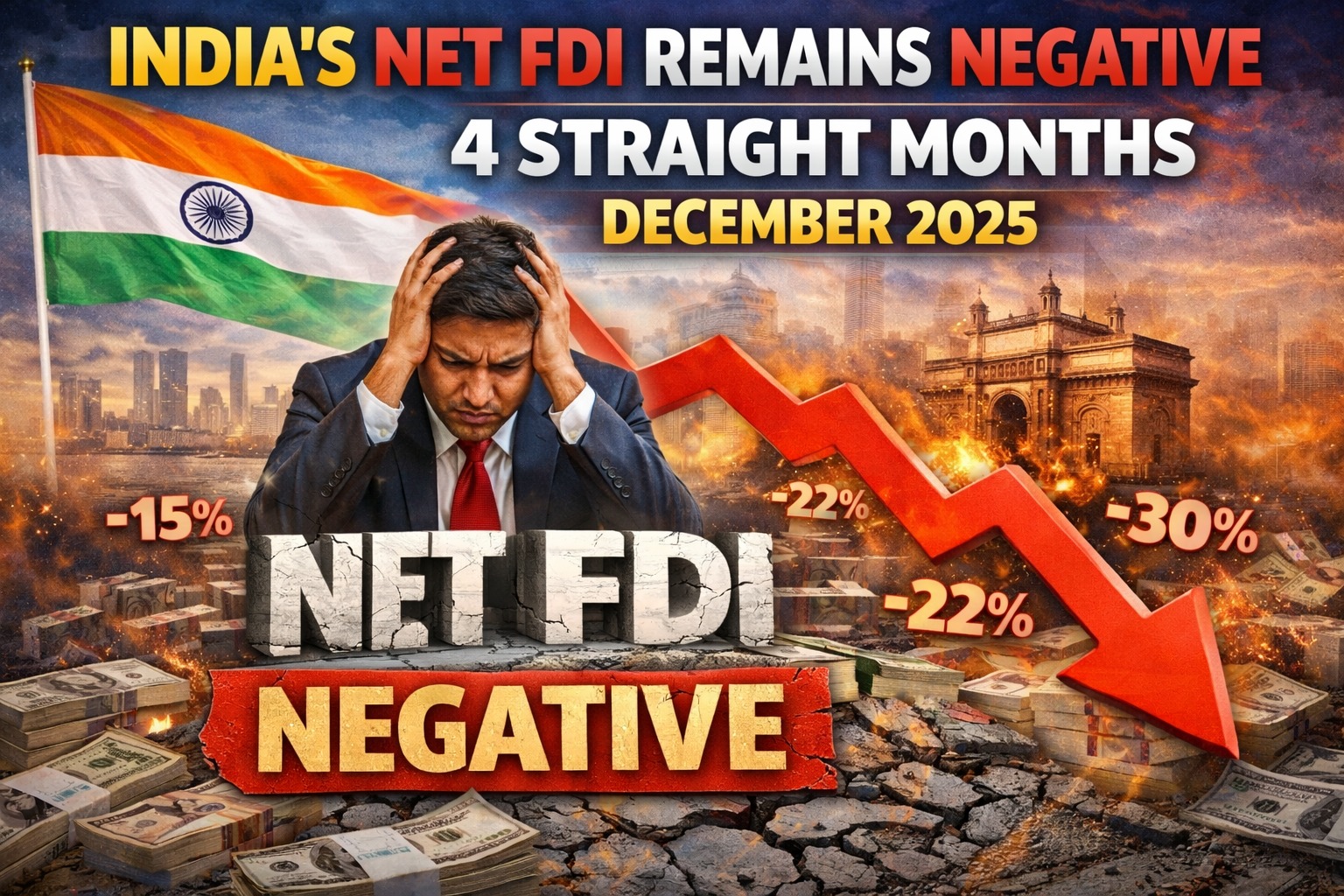
India’s Net FDI Remains in Negative Territory for Fourth Straight Month in December 2025
India recorded a net Foreign Direct Investment (FDI) outflow of approximately $1.6 billion in December 2025, marking the fourth consecutive month of negative net inflows, according to the latest bulletin released by the Reserve Bank of India (RBI). The trend highlights a widening gap between fresh foreign investments entering the country and capital being withdrawn or redirected abroad.
December’s negative figure follows similar net outflows in September (-$1.7 billion), October (-$1.7 billion), and November (-$0.475 billion). The sustained reversal is largely attributed to record-high repatriation of profits and equity disinvestments by foreign companies operating in India, alongside a notable rise in overseas investments by Indian firms.
Key Highlights from RBI’s Latest Data
Gross FDI Inflows Show Resilience
Despite the negative net figure, gross FDI inflows rose to around $8.6 billion in December 2025, a five-month high and a 17.2% increase compared to December 2024. This indicates that foreign investors continue to deploy capital into India, particularly in sectors such as services, technology, and manufacturing.
The rise in gross inflows suggests that India remains an attractive destination for fresh investment. However, the impact of these inflows is being offset by capital outflows.
Record-High Repatriation and Disinvestment
Repatriation of profits, dividends, and equity sales by foreign investors surged to approximately $7.5 billion in December, nearly 40% higher year-on-year. This marks the highest level of repatriation since comparable RBI records began in January 2021.
Such large-scale withdrawals indicate that foreign firms are either booking profits from earlier investments or reallocating capital to other global markets amid changing economic conditions.
Outward FDI by Indian Companies Climbs
Indian corporations also significantly increased their overseas investments. Outward FDI rose by 30.5% year-on-year to $2.74 billion in December 2025. Many of these investments were routed through financial hubs such as Singapore, Mauritius, and the UAE.
The combination of strong repatriation and rising outward FDI meant that total capital outflows exceeded fresh inflows, resulting in the net negative figure of -$1.61 billion—worse than the -$0.189 billion recorded in December 2024.
Broader Fiscal Year Trends (April–December 2025)
On a cumulative basis, net FDI for the first nine months of FY 2025–26 stood at roughly $4 billion, an improvement compared to $0.6 billion in the same period last fiscal year. However, this remains significantly below historical highs, such as over $30 billion annually in earlier years and a peak of $43.9 billion in FY21.
Notably, repatriation during April–December 2025 reached $44.45 billion, reflecting a 10% annual increase. While gross inflows in recent years have hovered around or above $80 billion, elevated capital withdrawals continue to weigh heavily on the net figures.
What Is Driving the Negative Trend?
- Surge in Capital Repatriation
Foreign investors appear to be withdrawing profits aggressively, possibly due to maturing investment cycles, global portfolio rebalancing, or seeking higher returns elsewhere amid economic uncertainty.
- Rising Overseas Expansion by Indian Firms
Indian companies are increasingly investing abroad for diversification, strategic expansion, and tax optimization, contributing to outward capital movement.
- External and Domestic Pressures
Several macroeconomic factors are influencing investor behavior:
- Trade uncertainties, including elevated U.S. tariff measures in 2025, have dampened export outlook and investor sentiment.
- Rupee depreciation, with the currency crossing ₹90–₹91 per U.S. dollar, has added pressure to capital flows and import costs.
- Foreign Portfolio Investor (FPI) outflows, amounting to nearly $19 billion in 2025, have intensified external sector stress.
- Nature of FDI inflows, which are often market-seeking and profit-driven rather than efficiency-driven and long-term anchored, making them more susceptible to quick exits.
Implications for the Indian Economy
Persistent net FDI outflows can exert downward pressure on the rupee and widen the current account deficit by increasing the cost of imports, particularly crude oil. While gross inflows reflect continued global interest in India’s growth story, repeated net outflows raise concerns about long-term capital retention and competitiveness among emerging markets.
At the same time, analysts describe the situation as a “paradox”—robust gross investment activity overshadowed by equally strong exits—rather than a collapse in investor confidence.
Recent policy measures, including interim trade understandings with key partners and government initiatives to boost manufacturing, artificial intelligence, and supply-chain diversification, may help stabilize capital flows in the coming quarters.
Summary
India’s net FDI remained negative for the fourth straight month in December 2025, with a net outflow of about $1.6 billion. Although gross inflows climbed to a five-month high of $8.6 billion, record repatriation and rising outward investments by Indian firms outweighed fresh capital inflows. For FY 2025–26 so far, cumulative net FDI stands at around $4 billion—better than last year but still far below historical peaks. Analysts view the trend as a capital reallocation phase rather than a loss of India’s economic appeal, though currency pressure and external risks remain key concerns.