

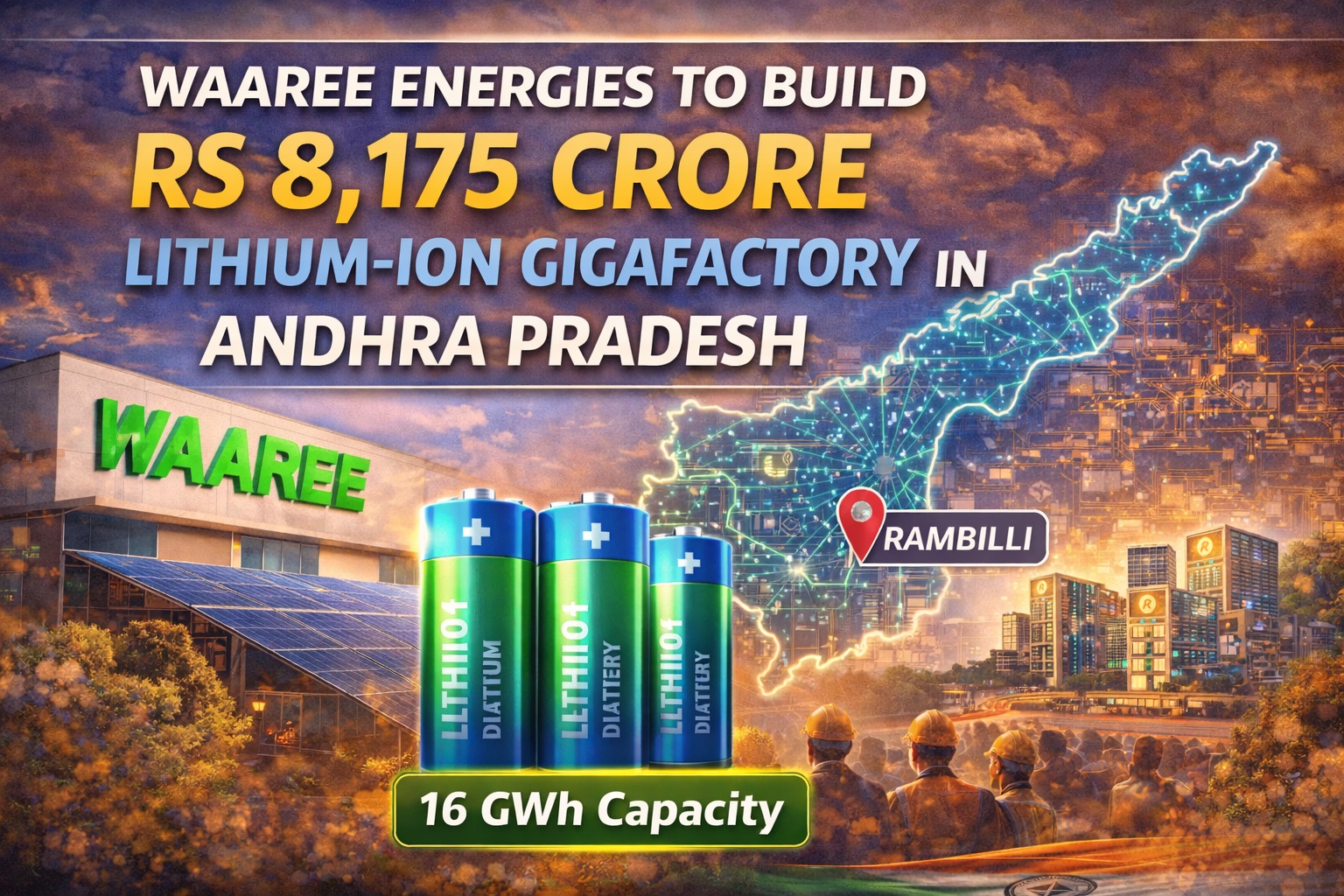
Waaree Energies to Invest ₹8,175 Crore in 16 GWh Lithium-Ion Gigafactory in Andhra Pradesh
In a major stride toward strengthening India’s clean energy and storage ecosystem, Waaree Energies has unveiled plans to establish a large-scale lithium-ion battery gigafactory in Andhra Pradesh with a proposed investment of ₹8,175 crore (approximately US$897 million). The ambitious project marks one of the most significant investments in India’s advanced battery manufacturing space and underscores the country’s accelerating transition toward renewable energy and energy storage solutions.
The upcoming facility will be located in Rambilli, in the Anakapalli district of Andhra Pradesh. The proposal has already received in-principle approval from the Andhra Pradesh State Investment Promotion Board, clearing the way for the next stages of development. Once operational, the plant is expected to play a pivotal role in enhancing India’s domestic battery manufacturing capabilities and reducing reliance on imports in a strategically critical sector.
Designed as a fully integrated battery manufacturing hub, the gigafactory will span the entire lithium-ion value chain. It will produce lithium-ion cells, battery packs, and Battery Energy Storage Systems (BESS), enabling end-to-end solutions for a variety of applications, including renewable energy integration, electric mobility, grid stabilization, and industrial energy storage. With a planned production capacity of 16 gigawatt-hours (GWh), the facility will rank among the largest battery manufacturing units in the country.
The development comes at a time when India is witnessing rapid growth in renewable energy capacity, particularly in solar and wind power. As renewable generation increases, the need for efficient and scalable energy storage systems has become critical to ensure grid stability and round-the-clock power availability. By investing in large-scale lithium-ion production, Waaree Energies aims to address this gap and contribute meaningfully to India’s clean energy ambitions.
For Waaree Energies, traditionally known as a major player in the solar manufacturing segment, the gigafactory represents a strategic diversification into energy storage. The move signals the company’s intention to evolve into a comprehensive clean energy solutions provider, integrating solar generation with advanced storage technologies. This vertical expansion is expected to enhance the company’s competitiveness in both domestic and international markets.
The project is also poised to deliver substantial economic benefits to the region. The proposed facility is expected to generate employment for around 3,000 people, providing a significant boost to local livelihoods and skill development. Beyond direct jobs, the plant is likely to stimulate ancillary industries, logistics, and supply chain networks, further strengthening the industrial ecosystem in the region.
For Andhra Pradesh, the investment reinforces its emerging status as a key destination for clean energy and advanced manufacturing projects. The state has been actively working to attract investments in renewable energy, electronics, and high-technology sectors. The establishment of a large-scale lithium-ion battery manufacturing facility will help position Andhra Pradesh as a major hub for energy storage production in India.
At the national level, the project aligns closely with India’s broader clean energy and manufacturing goals, including efforts to promote domestic production under various policy initiatives and reduce dependence on imported battery components. As India expands its electric vehicle ecosystem and renewable power capacity, large-scale battery manufacturing will be critical to achieving energy security and sustainability targets.
With a 16 GWh production capacity and a comprehensive manufacturing scope, Waaree Energies’ proposed gigafactory is set to become a cornerstone of India’s growing energy storage landscape. If executed as planned, the project will not only strengthen the country’s renewable energy infrastructure but also accelerate its journey toward a more resilient, self-reliant, and sustainable energy future.
When did the project start? and When did the project completing?