

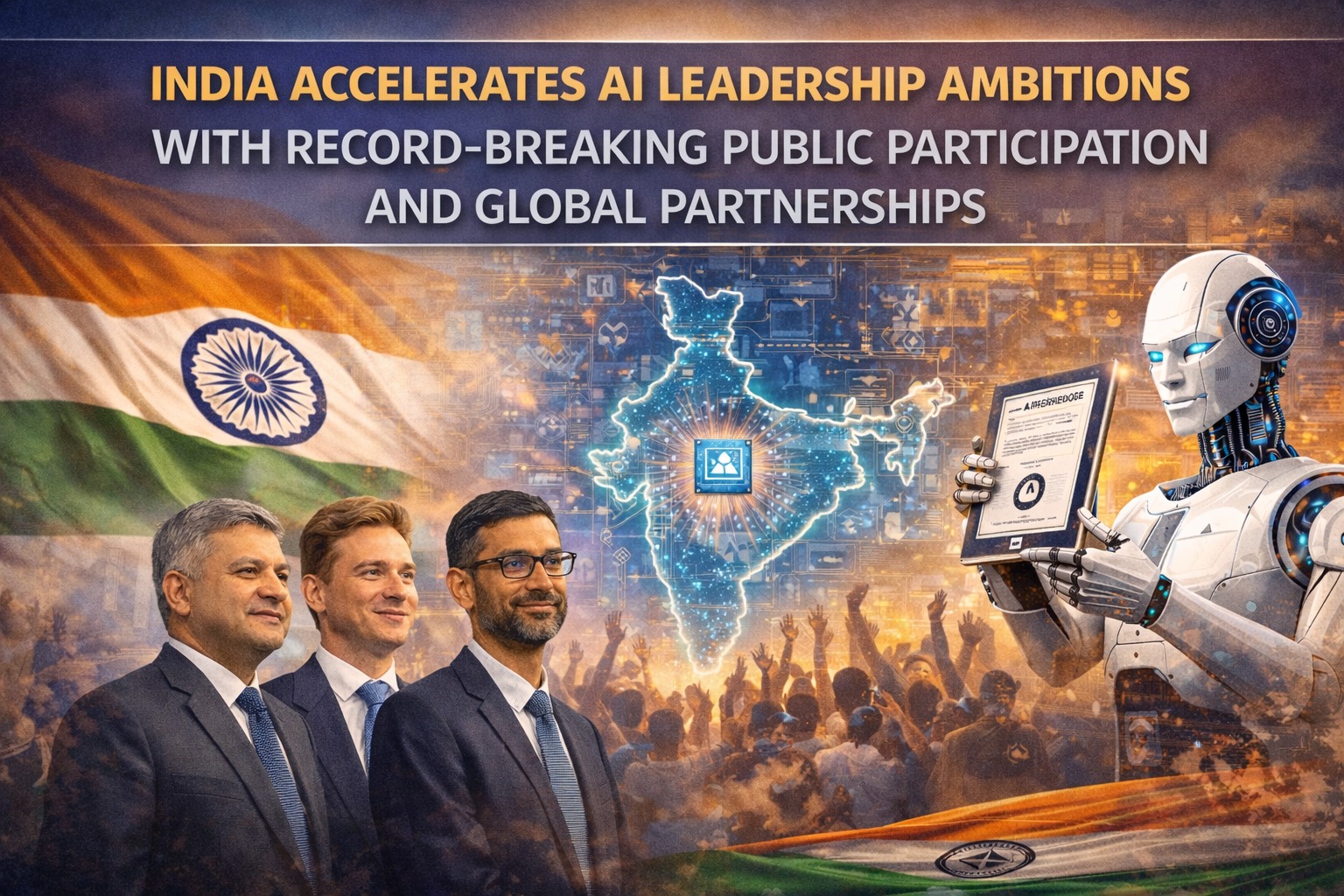
India Accelerates AI Leadership Ambitions with Record-Breaking Public Participation and Global Partnerships
India has taken a decisive step toward establishing itself as a global powerhouse in artificial intelligence, with Prime Minister Narendra Modi outlining a bold objective: securing a place among the world’s top three AI superpowers by 2047. The target aligns with India’s broader vision of becoming a developed nation by its centenary year of independence, focusing not merely on adopting AI technologies but on building and exporting homegrown innovation powered by domestic talent and digital infrastructure.
This momentum was clearly visible at the India AI Impact Summit 2026, hosted at Bharat Mandapam in New Delhi from February 16 to 20. As the first large-scale global AI gathering in the Global South, the summit convened policymakers, technology leaders, startups, academics, and international stakeholders to deliberate on building AI systems that are ethical, inclusive, and socially beneficial.
One of the summit’s most remarkable milestones was India’s entry into the Guinness World Records for the highest number of pledges received for an AI responsibility campaign within 24 hours. Between February 16 and 17, a total of 250,946 verified pledges were recorded—far exceeding the initial goal of 5,000. The initiative, launched under the IndiaAI Mission in collaboration with Intel India, invited citizens to commit to responsible and transparent AI practices through a dedicated online platform. The achievement was formally confirmed by Guinness World Records adjudicator Pravin Patel and announced by Union Minister for Electronics and Information Technology Ashwini Vaishnaw.
The overwhelming response reflected rising public awareness about the ethical dimensions of AI and reinforced India’s commitment to human-centric technological advancement. Prime Minister Modi has consistently advocated for AI that strengthens human capabilities rather than replaces them, stressing the importance of safeguards that ensure technology serves the broader public good.
The summit also marked a significant diplomatic development with the signing of the Pax Silica Declaration between India and the United States. The agreement aims to enhance collaboration in semiconductors, AI infrastructure, critical minerals, supply chains, and other frontier technologies. Designed to promote secure and resilient technology ecosystems, the partnership seeks to reduce global supply chain vulnerabilities while encouraging innovation among trusted allies.
The declaration was signed in the presence of Union Minister Ashwini Vaishnaw and senior U.S. officials, including Under Secretary of State for Economic Affairs Jacob Helberg and U.S. Ambassador to India Sergio Gor. Google CEO Sundar Pichai, delivering a keynote address, emphasized the importance of secure supply chains and deeper commercial cooperation. Minister Vaishnaw described the pact as a crucial step toward strengthening India’s semiconductor and electronics manufacturing ecosystem.
Across multiple sessions, the summit addressed AI governance, agricultural innovation, healthcare transformation, economic growth strategies, and global cooperation frameworks. Participants from around the world acknowledged India’s growing influence in shaping the conversation around responsible AI.
Supported by forward-looking policies, expanding digital public infrastructure, substantial industry investments, and deepening international partnerships, India is rapidly advancing toward its ambition of becoming an AI superpower—while ensuring that technological progress remains ethical, inclusive, and aligned with societal well-being.