

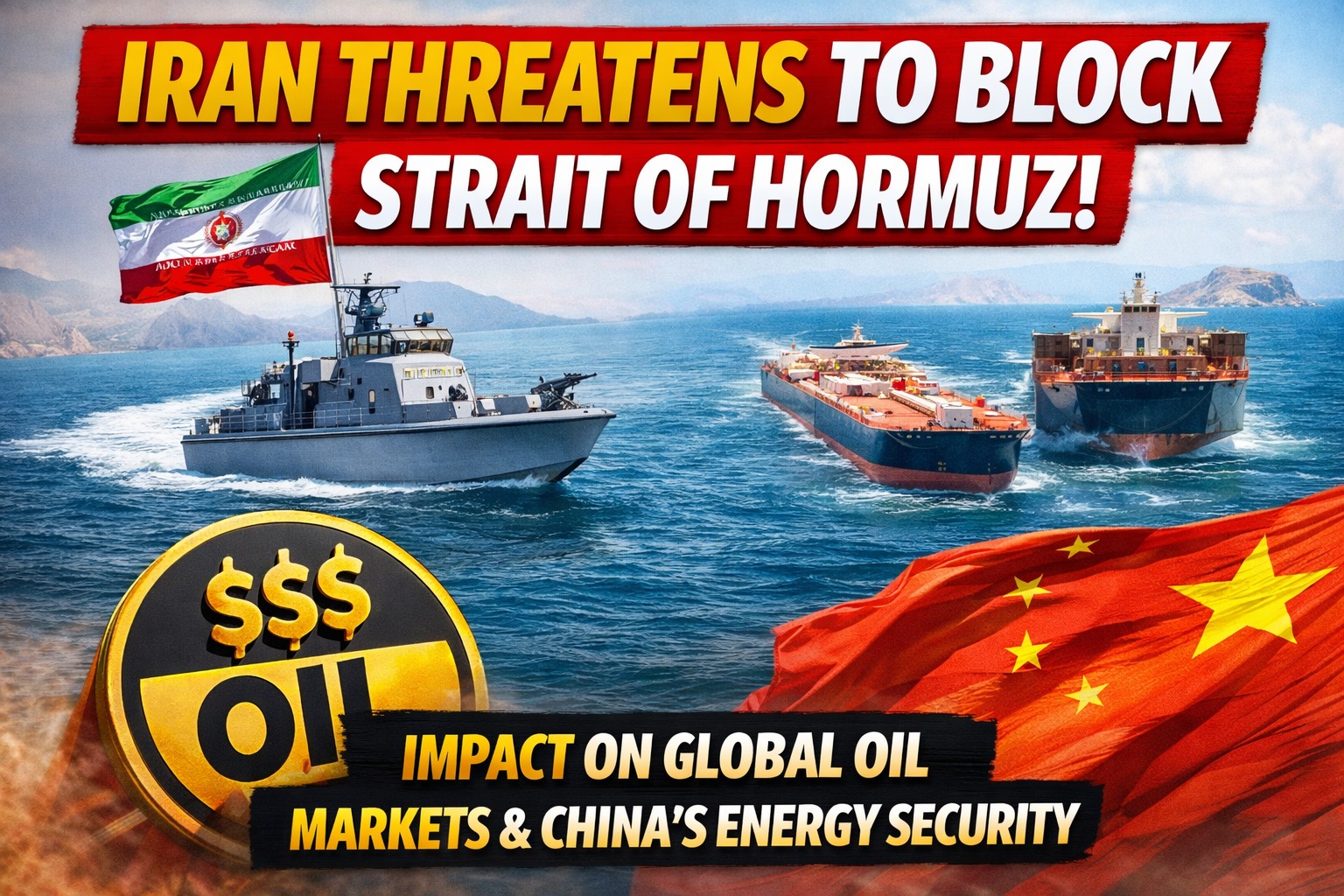
Iran Threatens to Block Strait of Hormuz: Impact on Global Oil Markets and China’s Energy Security
Rising tensions following reported US and Israeli military action against Iran have reignited fears over the security of the Strait of Hormuz — one of the world’s most critical oil transit routes. Iran’s Islamic Revolutionary Guard Corps (IRGC) has reportedly warned that vessels may be barred from passing through the strategic waterway, intensifying uncertainty across global energy markets.
According to international reports, ships operating in the region received radio communications indicating restrictions on movement through the Strait. The development has raised alarm among oil-importing nations and energy traders worldwide.
Why the Strait of Hormuz Matters
The Strait of Hormuz links major Gulf oil producers — including Saudi Arabia, Iraq, the United Arab Emirates, and Iran — to global markets via the Gulf of Oman and the Arabian Sea. Roughly 20 million barrels of crude oil and petroleum products per day pass through the narrow corridor, accounting for nearly one-fifth of global oil consumption.
Any disruption to shipping in this chokepoint could trigger sharp increases in oil prices, disrupt supply chains, and strain economies heavily reliant on energy imports.
Despite repeated threats over the years, Iran has never fully closed the Strait. A complete blockade would not only affect global markets but also halt Iran’s own oil exports, cutting off a major source of revenue for Tehran.
Global Oil Supply and Strategic Reserves
Energy analysts note that countries vulnerable to supply shocks could draw from strategic petroleum reserves if necessary. Members of the International Energy Agency (IEA) are required to maintain emergency stockpiles equivalent to at least 90 days of net oil imports.
Such reserves are designed to cushion temporary disruptions, but prolonged instability in Hormuz could still have significant consequences for global energy security.
China’s Heavy Dependence on Iranian Crude
For China — the world’s largest crude oil importer — developments in the Strait of Hormuz carry particular significance.
China is currently the biggest buyer of Iranian oil, purchasing the majority of Tehran’s exported crude despite ongoing US sanctions. Industry data from 2025 indicate that China imports more than 80% of Iran’s seaborne oil shipments.
Last year, China reportedly imported an average of 1.38 million barrels per day (bpd) of Iranian crude, representing over 13% of its total seaborne oil imports.
Role of Independent “Teapot” Refineries
Much of Iran’s oil exports to China are purchased by independent refiners, commonly known as “teapots,” primarily located in Shandong province. These refiners account for roughly a quarter of China’s total refining capacity and are attracted by the steep discounts offered on sanctioned Iranian crude.
However, these smaller refiners often operate on thin profit margins and have recently faced pressure from sluggish domestic fuel demand.
In contrast, China’s large state-owned oil companies have largely avoided Iranian crude purchases since 2018–2019 due to sanctions-related risks.
Shifting Trade Flows: Russia Replaces Venezuela and Iran
Even before the latest escalation, China had begun adjusting its oil import mix.
Recent trade data suggest that Chinese refiners have reduced Iranian crude intake in recent weeks. February figures show a decline in Iranian oil arrivals compared with January levels. At the same time, imports of Russian crude have increased significantly.
Russia has emerged as a key alternative supplier, with shipments rising sharply this month. The increase in Russian volumes closely matches the decline in Venezuelan exports to China earlier this year, indicating a near one-for-one replacement strategy.
Interestingly, the drop in Iranian crude imports occurred despite Tehran offering deeper price discounts — reportedly $10–11 per barrel below benchmark rates — comparable to Russian pricing.
What a Hormuz Disruption Could Mean for China
If the Strait of Hormuz were partially or fully blocked:
- Chinese refiners dependent on Iranian crude could face immediate supply disruptions.
- Global oil prices would likely spike, increasing import costs.
- China may further pivot toward Russian crude or tap into strategic reserves.
- Smaller “teapot” refiners could experience severe operational strain.
China’s diversification strategy — including increased imports from Russia and other suppliers — may help mitigate short-term risks. However, sustained instability in the Gulf would test Beijing’s long-term energy security framework.
Broader Global Implications
A shutdown of the Strait of Hormuz would reverberate far beyond China. Major Asian economies including India, Japan, and South Korea rely heavily on Gulf oil flows. European markets could also face price shocks.
While a total blockade remains unlikely due to mutual economic costs, even limited disruptions or heightened military presence in the region can push oil markets into volatility.
As geopolitical tensions intensify, global energy security once again hinges on the stability of one of the world’s most strategic maritime chokepoints.
Summary
Iran’s warning over restricting passage through the Strait of Hormuz has heightened fears of a global oil supply disruption. Nearly 20% of the world’s oil flows through the waterway, making it a vital artery for global energy trade. China, the largest importer of Iranian crude, could face supply challenges, although recent increases in Russian oil imports suggest diversification efforts are underway. Any prolonged disruption would likely trigger price volatility and strain global energy markets.
Disclaimer
This report is based on official statements and publicly available sources. Developments in conflict zones are fluid and subject to change. The publication does not independently verify battlefield claims made by either side.