

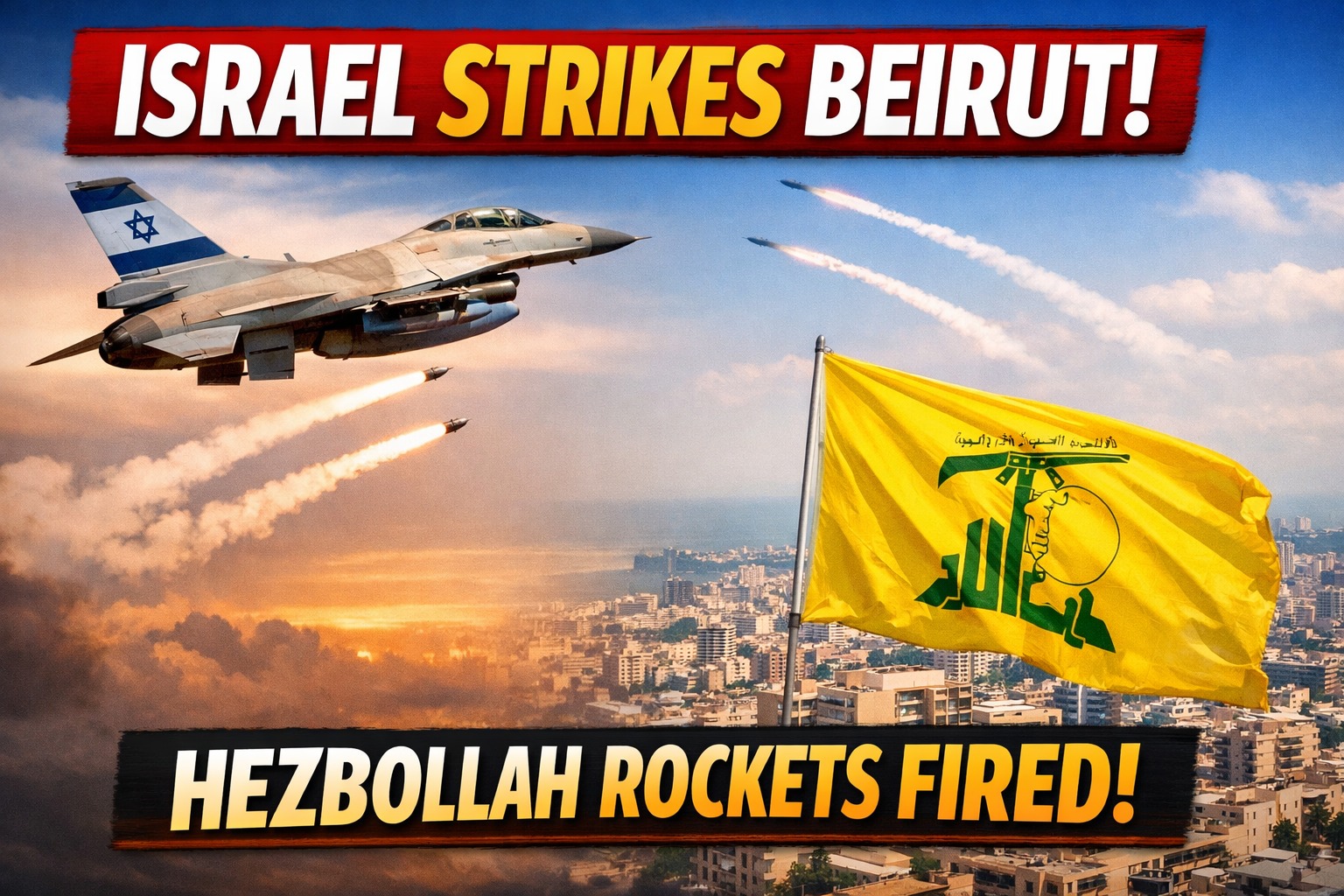
Israel Launches Airstrikes on Beirut After Hezbollah Rocket Fire Toward Haifa
Israel carried out targeted airstrikes in Beirut and southern Lebanon on Monday (March 2) following a rocket attack claimed by Hezbollah on northern Israel. The escalation marks a significant flare-up in tensions along the Israel-Lebanon border months after a ceasefire agreement.
The Israeli military confirmed that it struck senior Hezbollah figures in Beirut, along with what it described as a “key operative” in southern Lebanon. According to the Israel Defense Forces (IDF), the operation was conducted with precision targeting against members of the Iran-backed armed group.
In an official statement posted on social media platform X, the IDF said it had “struck senior terrorists from the Hezbollah terror organisation in the Beirut area” and also hit a central operative in southern Lebanon.
Evacuation Orders and Civilian Movement
Following the strikes, the Israeli military issued evacuation advisories for dozens of villages in southern Lebanon, including the town of Bint Jbeil. Residents were urged to maintain a distance of at least one kilometre from specified buildings amid fears of further strikes.
Lebanon’s state-run National News Agency reported large-scale displacement from Beirut’s southern suburbs, particularly the Dahiyeh area, a known Hezbollah stronghold. Videos circulating online showed congested roads and families fleeing affected areas as tensions intensified.
Hezbollah Claims Rocket Attack
The airstrikes came shortly after Hezbollah claimed responsibility for firing rockets toward northern Israel, including areas near Haifa. The group described the attack as retaliation linked to Iranian Supreme Leader Ayatollah Ali Khamenei, referring to it as an act of “revenge.”
Hezbollah stated that it targeted a missile defence installation south of Haifa and warned that continued Israeli military operations in Lebanon would prompt further responses. The group accused Israel of prolonged aggression and demanded withdrawal from what it described as occupied Lebanese territory.
The Israeli military, however, said it intercepted at least one rocket launched from Lebanon toward northern Israel, preventing significant damage.
Ceasefire Under Strain
The latest exchange of fire represents the most serious breach since the November 2024 ceasefire between Israel and Hezbollah. Cross-border hostilities had largely subsided in recent months, but tensions have resurged amid broader regional instability involving Iran and its allied groups.
Hezbollah, widely regarded as an Iran-backed proxy, has maintained strong rhetoric against Israel as regional dynamics continue to shift.
Regional Implications
The renewed violence raises concerns about a potential widening of conflict across West Asia. Analysts warn that continued strikes and retaliatory rocket fire could destabilize the fragile ceasefire and draw in additional regional actors.
Israel has maintained that it will respond decisively to any attacks on its territory, while Hezbollah has indicated it will not remain passive in the face of Israeli military action.
The situation remains fluid, with international observers closely monitoring developments along the volatile Israel-Lebanon frontier.
Summary
Israel conducted targeted airstrikes in Beirut and southern Lebanon after Hezbollah claimed responsibility for firing rockets toward northern Israel near Haifa. The Israeli military said it struck senior Hezbollah figures and issued evacuation warnings in southern Lebanese towns. Hezbollah described the rocket attack as retaliation linked to Iran’s Supreme Leader. The escalation threatens the fragile ceasefire agreed upon in November 2024 and raises fears of broader regional conflict.
Disclaimer
This article is based on publicly available information and official statements. The content is intended for informational purposes only. The publication does not independently verify third-party claims or geopolitical assertions mentioned in international developments.