

Zero Defect, Zero Effect’ to Drive India’s $35 Trillion Dream: Piyush Goyal Calls for Quality-Led Manufacturing Push
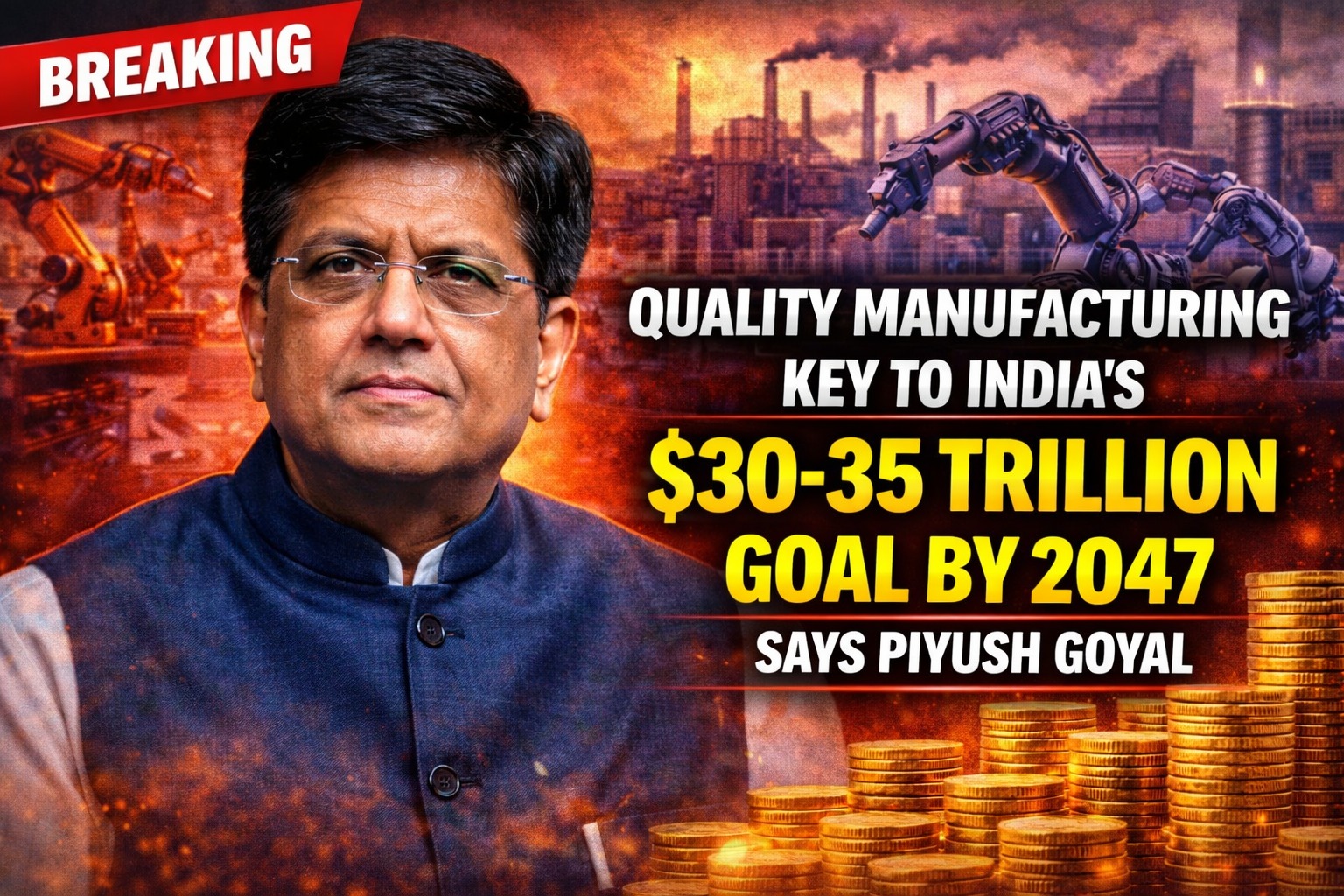
Quality Manufacturing Key to India’s $30–35 Trillion Goal by 2047, Says Piyush Goyal
Union Minister of Commerce and Industry Piyush Goyal has emphasized that quality must form the backbone of India’s manufacturing and export growth strategy if the country is to achieve its long-term economic ambitions. Speaking at the National Quality Conclave organized by the Department for Promotion of Industry and Internal Trade (DPIIT) in collaboration with the Quality Council of India (QCI), Goyal underlined that Prime Minister Narendra Modi’s “Zero Defect, Zero Effect” vision remains central to India’s industrial roadmap.
According to the minister, India’s aspiration to become a ₹2,490–2,905 lakh crore (approximately US$ 30–35 trillion) economy by 2047 will depend significantly on producing globally competitive, high-quality goods and services while ensuring environmentally responsible growth.
‘Brand India’ Built on Quality and Reliability
Goyal stressed that the development of “Brand India” must rest on three core pillars: quality, reliability, and competitiveness. He noted that Indian manufacturers and service providers must consistently align with international benchmarks to enhance global trust and expand market share.
Highlighting export ambitions, the minister pointed to the national target of ₹166 lakh crore (around US$ 2 trillion) in exports. Achieving this milestone, he said, will require balanced growth across both merchandise and services sectors. Such expansion, he added, is feasible only if India strengthens compliance with global quality standards.
Leveraging Free Trade Agreements
India currently has nine Free Trade Agreements (FTAs) covering 38 developed nations. Goyal described these agreements as significant opportunities to boost exports but cautioned that their full potential can only be realized if domestic industries deliver products and services that meet global expectations.
He called for closer coordination between industry stakeholders, regulatory bodies, and government institutions to embed quality standards throughout the manufacturing ecosystem. Institutionalizing such practices, he said, would reinforce India’s position as a reliable global production hub and sustain long-term economic growth.
Towards Inclusive and Sustainable Growth
The minister also linked quality manufacturing to inclusive development, emphasizing that sustained economic expansion must benefit diverse sections of society. By adhering to the “Zero Defect, Zero Effect” principle — which promotes error-free production with minimal environmental impact — India can strengthen its competitiveness while maintaining sustainability.
The remarks reflect the government’s broader strategy of positioning India as a trusted manufacturing and export powerhouse in the decades leading up to the centenary of independence in 2047.
Summary
Union Commerce Minister Piyush Goyal reiterated that achieving India’s target of becoming a US$ 30–35 trillion economy by 2047 depends on high-quality, globally competitive manufacturing and exports. Emphasizing Prime Minister Narendra Modi’s “Zero Defect, Zero Effect” vision, he called for coordinated efforts between industry, regulators, and government to strengthen Brand India and maximize opportunities under existing Free Trade Agreements.
Disclaimer
This article is based on official statements delivered at the National Quality Conclave and publicly available reports. Economic projections and targets mentioned are part of government policy objectives and may be subject to change based on evolving domestic and global economic conditions.