

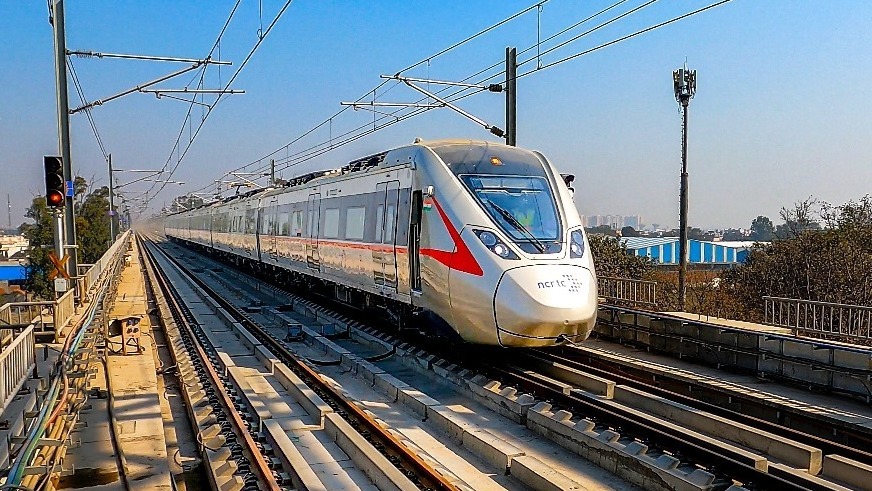
PM Modi Flags Off Meerut Metro & Namo Bharat RRTS; Full 82-Km Delhi–Meerut Corridor Goes Live
Prime Minister Narendra Modi is set to inaugurate two major rail projects in Meerut today — the Meerut Metro and the Namo Bharat Regional Rapid Transit System (RRTS). The launch coincides with the dedication of development projects worth approximately ₹12,930 crore in the city.
The event at Shatabdi Nagar marks the complete operationalisation of the 82-km Delhi–Meerut Namo Bharat corridor, alongside the rollout of intra-city Meerut Metro services. After the inauguration, the Prime Minister is scheduled to take a metro ride to Meerut South station and address a public gathering.
Delhi–Meerut Namo Bharat Corridor Fully Operational
The launch completes the full stretch of the Delhi–Meerut Namo Bharat Corridor, India’s first regional rapid rail network designed for high-speed intercity travel.
Key Highlights of Namo Bharat RRTS
Faster Connectivity Across NCR
The corridor sharply reduces travel time between Meerut, Ghaziabad and Delhi, transforming daily commuting patterns in the National Capital Region (NCR). Professionals can now live in Meerut or Ghaziabad while working in Delhi or Noida, cutting travel stress and costs.
Travel Time Comparison
- Sarai Kale Khan to Modipuram – 58 minutes
- Sarai Kale Khan to Begumpul – 54 minutes
- Sarai Kale Khan to Shatabdi Nagar – 50 minutes
By road, the same journey can take around 90 minutes or more, depending on traffic congestion.
High-Speed Design
The system is engineered for a top speed of 180 kmph, with an operational speed of 160 kmph — setting a new benchmark for intercity rail travel in India.
Route Coverage
The 82-km corridor includes:
- A 5-km stretch between Sarai Kale Khan and New Ashok Nagar in Delhi
- A 21-km stretch between Meerut South and Modipuram in Uttar Pradesh
Major Stations
Sarai Kale Khan serves as a multi-modal transit hub, offering seamless connectivity to Hazrat Nizamuddin Railway Station, the Delhi Metro Pink Line, Veer Haqeeqat Rai ISBT and Ring Road. Newly commissioned stations in Meerut include Shatabdi Nagar, Begumpul and Modipuram.
Meerut Metro: India’s Fastest Metro System
Alongside the RRTS, the Prime Minister will also inaugurate the Meerut Metro, which will operate on the same infrastructure as the Namo Bharat corridor — a first-of-its-kind model in India.
What Makes Meerut Metro Unique?
Shared Infrastructure Model
The Meerut Metro will run on tracks shared with the Namo Bharat RRTS. This integrated approach allows high-speed regional trains and urban metro services to operate efficiently on the same corridor.
Travel Time
The 21-km Meerut South–Modipuram stretch will be covered in approximately 30 minutes, including all stops.
Speed
With an operational speed of around 120 kmph, Meerut Metro becomes India’s fastest metro system.
Modern Train Features
- Fully air-conditioned three-coach trains
- Lightweight stainless-steel trainsets
- Energy-efficient regenerative braking system
- Automatic Train Protection (ATP) and Automatic Train Operation (ATO) compatibility
- CCTV surveillance
- USB charging ports
- Luggage racks
Each train can carry over 700 passengers, including 173 seated commuters. Reserved seating is available for women, senior citizens and differently-abled passengers.
How the Projects Will Benefit Commuters
- Significant reduction in daily travel time
- Improved work-life balance for NCR professionals
- Boost to regional economic activity
- Easier access for students and entrepreneurs
- Reduced road congestion
- Lower vehicular carbon emissions
The integrated transport model is expected to reshape mobility in western Uttar Pradesh and the broader NCR region by enabling seamless intercity and intra-city travel.
Summary
Prime Minister Narendra Modi has inaugurated the Meerut Metro and the fully operational 82-km Delhi–Meerut Namo Bharat RRTS corridor. The high-speed regional rail system cuts travel time between Delhi and Meerut to under an hour, while the Meerut Metro offers rapid intra-city connectivity on shared infrastructure. With top speeds of up to 160 kmph (RRTS) and 120 kmph (Metro), the integrated network aims to reduce congestion, lower emissions and transform commuting across the NCR.