
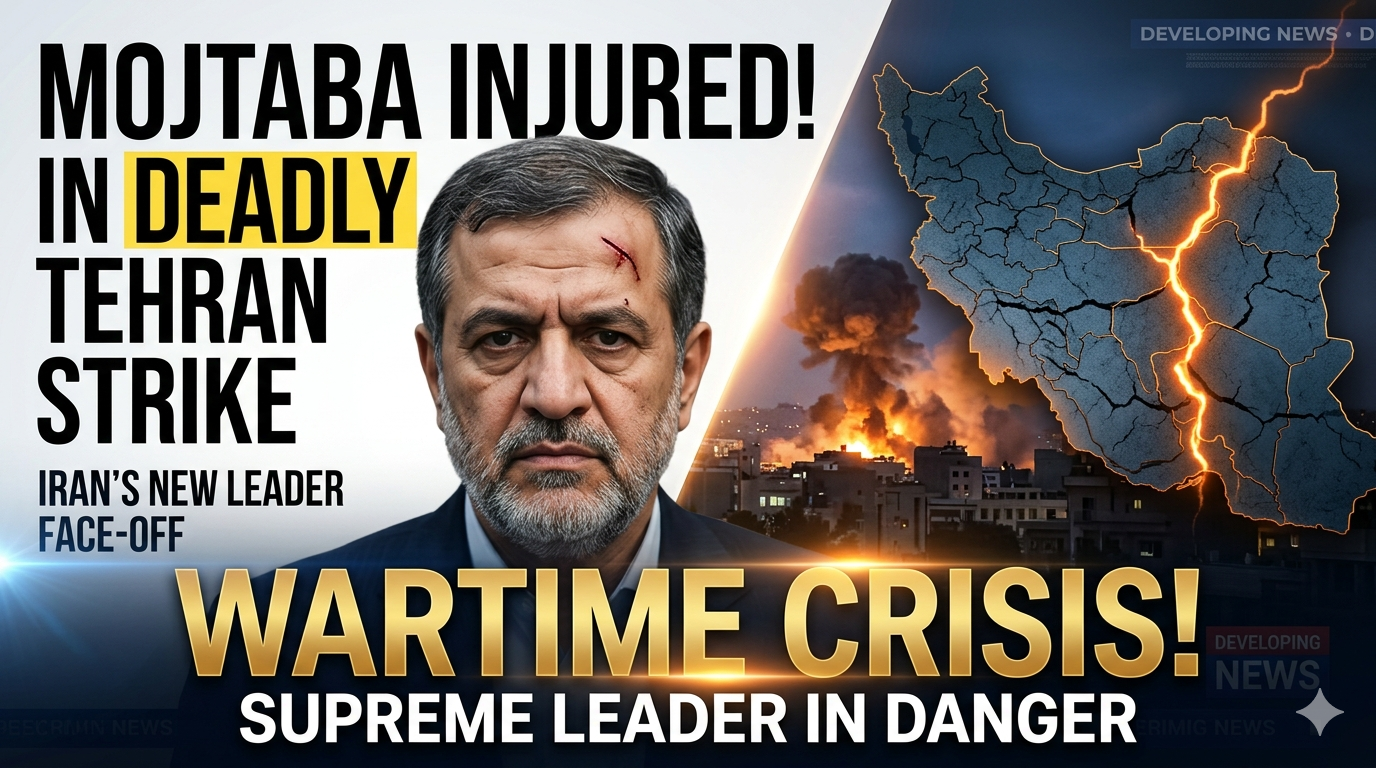
Mojtaba Khamenei Injured: Iran’s New Supreme Leader Faces Wartime Crisis After Deadly Tehran Strike
Mojtaba Khamenei’s Injury Raises Global Concerns Amid Ongoing War
In a dramatic and highly sensitive development, Mojtaba Khamenei, Iran’s newly appointed Supreme Leader, is reportedly recovering from severe and potentially life-altering injuries sustained during a devastating airstrike in Tehran.
According to multiple sources close to Iran’s inner leadership circle, the 56-year-old cleric suffered significant facial disfigurement and critical leg injuries during the February 28, 2026 strike that targeted the supreme leader’s compound. The attack not only injured Mojtaba but also killed his father, Ali Khamenei, along with several close family members.
This revelation comes at a crucial moment as Iran remains locked in a high-stakes geopolitical conflict with the United States and Israel, while fragile diplomatic efforts have recently collapsed.
The Airstrike That Changed Iran’s Power Structure
The conflict erupted on February 28, 2026, when coordinated airstrikes by US and Israeli forces targeted Iranian nuclear facilities, military infrastructure, and key leadership sites.
One of the most consequential strikes hit the Supreme Leader’s residence in central Tehran. The attack resulted in the death of Ali Khamenei, who had ruled Iran for over three decades since succeeding Ruhollah Khomeini in 1989.
Mojtaba Khamenei, who had long been considered a powerful but behind-the-scenes figure, survived the strike but with severe injuries. Within just days, he was elevated to Iran’s highest position by the Assembly of Experts on March 8, 2026.
His rapid appointment under wartime conditions was widely interpreted as an attempt to ensure continuity and prevent instability at the top of Iran’s political hierarchy.
Extent of Injuries: Disfigurement and Mobility Challenges
Sources familiar with the situation have painted a troubling picture of Mojtaba Khamenei’s physical condition:
- Severe facial injuries reportedly caused by blast and shrapnel impact
- Significant damage to one or both legs, with some intelligence assessments suggesting possible amputation
- Extended recovery period, limiting his physical mobility and public engagement
A source connected to US intelligence suggested that Mojtaba may have lost a leg, although agencies such as the Central Intelligence Agency have declined to confirm these reports officially.
Earlier, US Defense Secretary Pete Hegseth publicly stated that the Iranian leader was “wounded and likely disfigured,” further intensifying global attention on his condition.
Despite these reports, insiders maintain that Mojtaba remains mentally sharp, alert, and actively involved in decision-making, participating through secure audio communications.
Absence from Public View Fuels Speculation
One of the most striking aspects of Mojtaba Khamenei’s leadership so far has been his complete absence from public appearances.
Unlike his predecessors, who frequently appeared in carefully orchestrated public events to project authority, Mojtaba has remained out of sight since his appointment.
Iranian state media has:
- Avoided showing recent visuals of the leader
- Broadcast only audio messages or pre-recorded statements
- Provided no official updates on his health
This lack of visibility has fueled widespread speculation, both داخل Iran and internationally, about the severity of his injuries and his ability to lead effectively during wartime.
Power Dynamics: Rising Role of the IRGC
With the Supreme Leader operating remotely, the Islamic Revolutionary Guard Corps (IRGC) has reportedly taken on a more prominent role in governance and military strategy.
The IRGC already wields significant power in Iran’s political and military structure, but current conditions have amplified its influence:
- Greater control over military operations
- Increased involvement in strategic decision-making
- Stronger presence in internal security and intelligence
Some analysts suggest that Iran may currently be functioning under a quasi-collective leadership model, where multiple power centers are working together in the absence of a fully visible Supreme Leader.
Leadership Legitimacy Under Question
Mojtaba Khamenei’s rise to power has not been without controversy.
Unlike his father, who had established religious and political authority over decades, Mojtaba was often viewed as a behind-the-scenes operator with influence over security forces, including ties to the Basij militia.
His appointment has raised several concerns:
- Dynastic succession within a revolutionary system
- Limited public religious credentials compared to predecessors
- Now compounded by physical incapacity and lack of visibility
In Iran’s political system, the Supreme Leader is not just a political figure but also a symbol of strength and religious authority. Any perceived weakness—physical or political—can have significant implications.
Timing: Collapse of Diplomacy and Rising Tensions
The reports about Mojtaba Khamenei’s condition come at a particularly volatile moment.
Recent peace talks between Iran and the United States in Islamabad collapsed after more than 21 hours of negotiations, eliminating hopes of a near-term diplomatic resolution.
Following the collapse:
- The US announced a naval blockade targeting Iranian oil exports
- Military presence increased near the Strait of Hormuz
- Iran warned of potential retaliation
The Strait of Hormuz remains one of the most critical global energy chokepoints, handling nearly 20% of the world’s oil supply. Any instability here directly impacts global markets.
Global Implications: Markets, Security, and Strategy
Mojtaba Khamenei’s health is no longer just a domestic issue—it has global consequences.
- Energy Markets
Uncertainty around Iran’s leadership has already contributed to rising oil prices and volatility.
Countries like India, which rely heavily on oil imports, could face inflationary pressure.
- Military Calculations
Adversaries may perceive weakened leadership as an opportunity—or a risk—depending on how Iran responds.
- Diplomatic Uncertainty
Negotiations become more complex when the top decision-maker is not publicly visible or physically active.
- Regional Stability
The Middle East remains on edge, with any miscalculation potentially triggering wider conflict.
Domestic Reaction and Information Control
Inside Iran, information about Mojtaba Khamenei’s condition is tightly controlled.
However:
- Reports have spread through informal and digital channels
- Public reactions range from concern to skepticism
- Opposition groups have questioned the legitimacy of a “wounded leader”
Iranian authorities have chosen to maintain silence, focusing instead on projecting stability through official messaging.
Can Mojtaba Khamenei Effectively Lead Iran?
This is the central question now facing analysts and policymakers worldwide.
While sources insist he remains mentally capable, leadership in Iran requires more than decision-making:
- Symbolic authority
- Public visibility
- Direct engagement with political and military elites
If Mojtaba is unable to fully resume these roles, Iran could face:
- Internal power struggles
- Increased reliance on military leadership
- Potential shifts in long-term governance structure
What Happens Next? Possible Scenarios
Several scenarios could unfold in the coming weeks:
- Gradual Recovery and Public Return
If Mojtaba recovers sufficiently, he may reappear publicly, restoring confidence in leadership.
- Continued Remote Leadership
Iran may adapt to a system where the Supreme Leader governs largely through secure communication channels.
- Power Consolidation by IRGC
The military establishment could gain lasting influence, reshaping Iran’s political balance.
- Renewed Conflict
If tensions escalate, leadership strength—both physical and strategic—will be tested under extreme conditions.
Conclusion: A Defining Moment for Iran’s Future
The reported injuries of Mojtaba Khamenei add a deeply human dimension to a rapidly evolving geopolitical crisis.
At a time when Iran faces external military pressure, economic strain, and internal uncertainty, the condition of its Supreme Leader could become a निर्णायक factor in shaping the nation’s future.
Whether Mojtaba Khamenei can overcome his injuries and assert visible authority will not only determine his own leadership but may also define the trajectory of the conflict and the stability of the Islamic Republic itself.
Disclaimer
This article is based on publicly available information, official statements, and media reports available at the time of publication. The content is intended for informational purposes only and should not be considered financial or policy advice. Readers are encouraged to refer to official sources for the latest updates.
While efforts have been made to ensure accuracy, the information presented may change as new developments emerge. Readers are advised to conduct their own research and consult financial advisors before making any investment decisions.
NoCap Times does not independently verify all claims or statements and shall not be held responsible for any inaccuracies or omissions.