

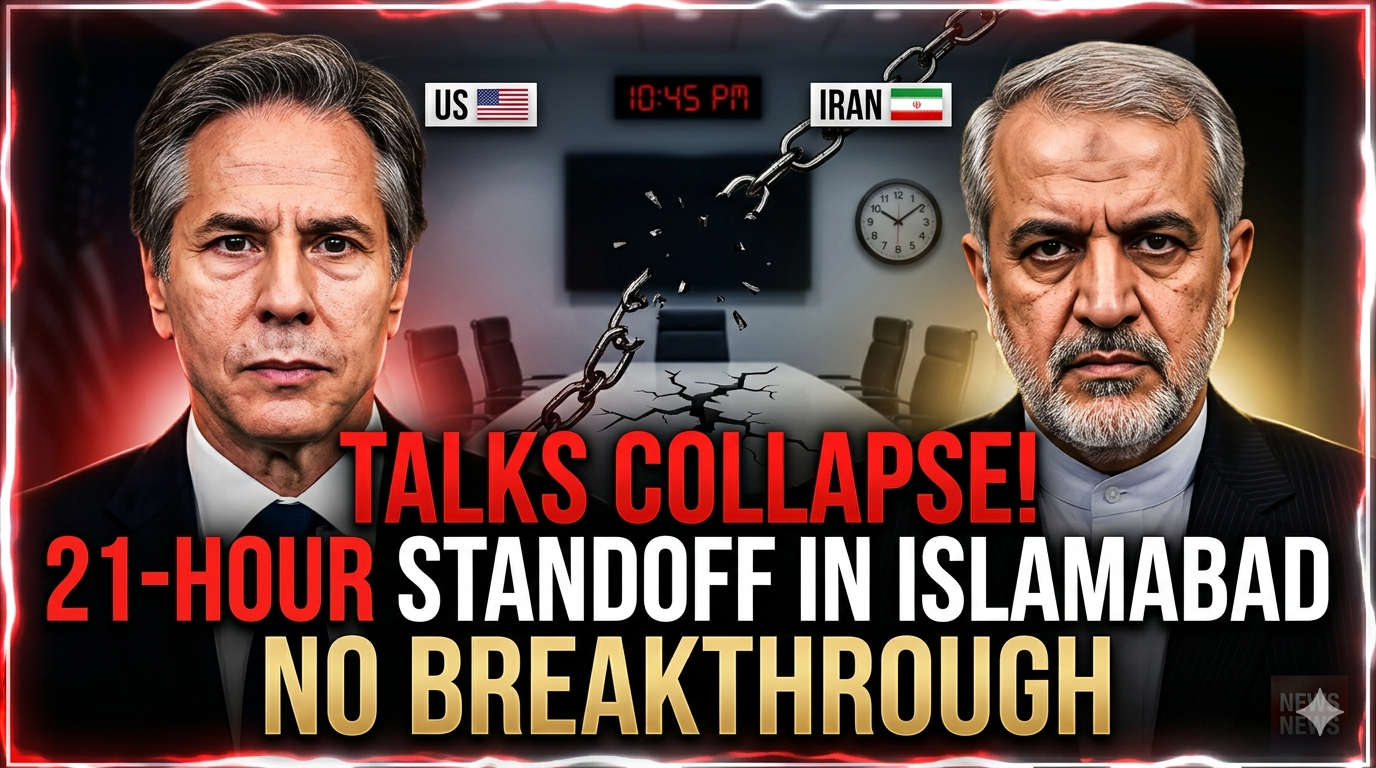
Iran-US Talks Collapse in Islamabad: 21-Hour Negotiations End Without Breakthrough
Iran-US Talks Collapse After Marathon Session in Islamabad
The Iran-US talks collapse has marked a major setback in global diplomacy, intensifying fears of renewed conflict in the Middle East. After more than 21 hours of continuous negotiations in Islamabad, officials from United States and Iran failed to reach any agreement.
This high-stakes diplomatic effort was seen as a crucial opportunity to end the ongoing six-week conflict involving Iran, Israel, and the United States. However, the breakdown of talks has already triggered escalatory developments, including a US decision to impose a naval blockade targeting Iranian ports near the Strait of Hormuz.
What Happened During the Iran-US Talks in Islamabad?
The Iran-US talks collapse followed intense, face-to-face discussions between top officials from both nations. The US delegation was led by Vice President JD Vance, marking one of the highest-level direct engagements between the two countries in decades.
Speaking after the talks, Vance stated that the US had presented its “final and best offer,” but Iran chose not to accept it. On the other side, Iranian negotiators, led by Mohammad Bagher Ghalibaf, accused the US of making unrealistic demands and failing to build trust.
Despite moments where both sides appeared close to agreement, fundamental differences ultimately led to the breakdown.
Historic Yet Unsuccessful Diplomatic Engagement
The Iran-US talks collapse is particularly significant because it represented the first direct, high-level meeting between the two nations since the Iranian Revolution.
Pakistan played a key mediating role, leveraging its diplomatic ties with both Washington and Tehran. While the outcome was disappointing, the very occurrence of such talks indicates a potential, albeit fragile, opening for future diplomacy.
Background: Conflict, Ceasefire, and Rising Tensions
The talks were held amid a fragile ceasefire that began on April 7, 2026, following weeks of military escalation in the region.
The conflict, which started in February 2026, has:
- Disrupted regional stability
- Impacted global oil supply chains
- Raised geopolitical tensions worldwide
A major flashpoint has been the Strait of Hormuz, through which nearly one-fifth of the world’s oil supply passes.
Key Reasons Behind the Iran-US Talks Collapse
Several critical disagreements led to the Iran-US talks collapse, making a breakthrough impossible during this round.
- Iran’s Nuclear Program
The United States demanded a complete halt to uranium enrichment and dismantling of nuclear facilities. Iran refused, insisting that its nuclear program is for peaceful purposes and is a matter of national sovereignty.
- Regional Influence and Proxy Groups
Washington pushed for Iran to stop supporting groups like Hezbollah and other regional militias. Tehran rejected this demand, viewing it as interference in its strategic interests.
- Strait of Hormuz Dispute
Control and access to the Strait of Hormuz became a major sticking point. The US demanded free navigation, while Iran opposed restrictions on its regional presence.
- Sanctions Relief
Iran sought immediate and significant economic relief from US sanctions. However, the US insisted on verifiable compliance before offering concessions.
- Deep Trust Deficit
Decades of hostility and past disagreements, including the collapse of earlier agreements, have created a severe lack of trust between the two nations.
Immediate Aftermath: US Announces Naval Blockade
Following the Iran-US talks collapse, Donald Trump signaled a return to aggressive pressure tactics.
Soon after, the United States Central Command announced a naval blockade targeting Iranian ports. The move aims to restrict Iran’s oil exports while allowing limited global shipping through the Strait of Hormuz.
This development has significantly increased the risk of further escalation.
Iran’s Reaction and Warning of Retaliation
Officials in Iran strongly condemned the blockade, calling it a violation of the ceasefire agreement.
Iran has warned that:
- Any enforcement action could trigger retaliation
- Military responses remain an option
- Diplomatic talks may continue only under revised conditions
Despite the tensions, Tehran has left the door open for future negotiations.
Global Reactions to the Iran-US Talks Collapse
The Iran-US talks collapse has drawn reactions from across the world:
United States
Leaders emphasized that the failure reflects Iran’s unwillingness to compromise.
Iran
Officials accused the US of acting in bad faith and making excessive demands.
Pakistan
As the host nation, Pakistan expressed disappointment but highlighted the importance of dialogue.
Israel
Israel continues to monitor developments closely, particularly regarding Iran’s nuclear ambitions.
Global Powers
Countries like China and European nations have called for restraint and renewed diplomacy.
Impact on Global Economy and Energy Markets
The Iran-US talks collapse has already begun affecting global markets:
- Oil prices have surged amid supply concerns
- Shipping costs are rising due to increased risk
- Stock markets have shown volatility
Countries heavily dependent on oil imports, including India, may face inflationary pressure and economic challenges.
What Happens Next? Possible Scenarios
The aftermath of the Iran-US talks collapse could unfold in several ways:
- Renewed Diplomacy
Both sides may return to negotiations with revised terms and mediators.
- Military Escalation
Increased naval activity and potential confrontations could lead to broader conflict.
- Economic Fallout
Continued instability in the Strait of Hormuz could disrupt global energy supply.
- Political Pressure
Domestic political dynamics in both countries may influence future decisions.
Conclusion: A Fragile Moment in Global Diplomacy
The Iran-US talks collapse underscores the complexity of resolving long-standing geopolitical conflicts. While the failure is a setback, it also highlights the importance of continued dialogue.
With rising tensions, economic uncertainty, and military risks, the coming days will be critical. Whether this moment leads to renewed negotiations or deeper conflict remains to be seen.
For now, the world watches closely as developments unfold in one of the most strategically important regions on the planet.
Disclaimer
This article is based on publicly available information, official statements, and media reports available at the time of publication. The content is intended for informational purposes only and should not be considered financial or policy advice. Readers are encouraged to refer to official sources for the latest updates.
While efforts have been made to ensure accuracy, the information presented may change as new developments emerge. Readers are advised to conduct their own research and consult financial advisors before making any investment decisions.
NoCap Times does not independently verify all claims or statements and shall not be held responsible for any inaccuracies or omissions.