

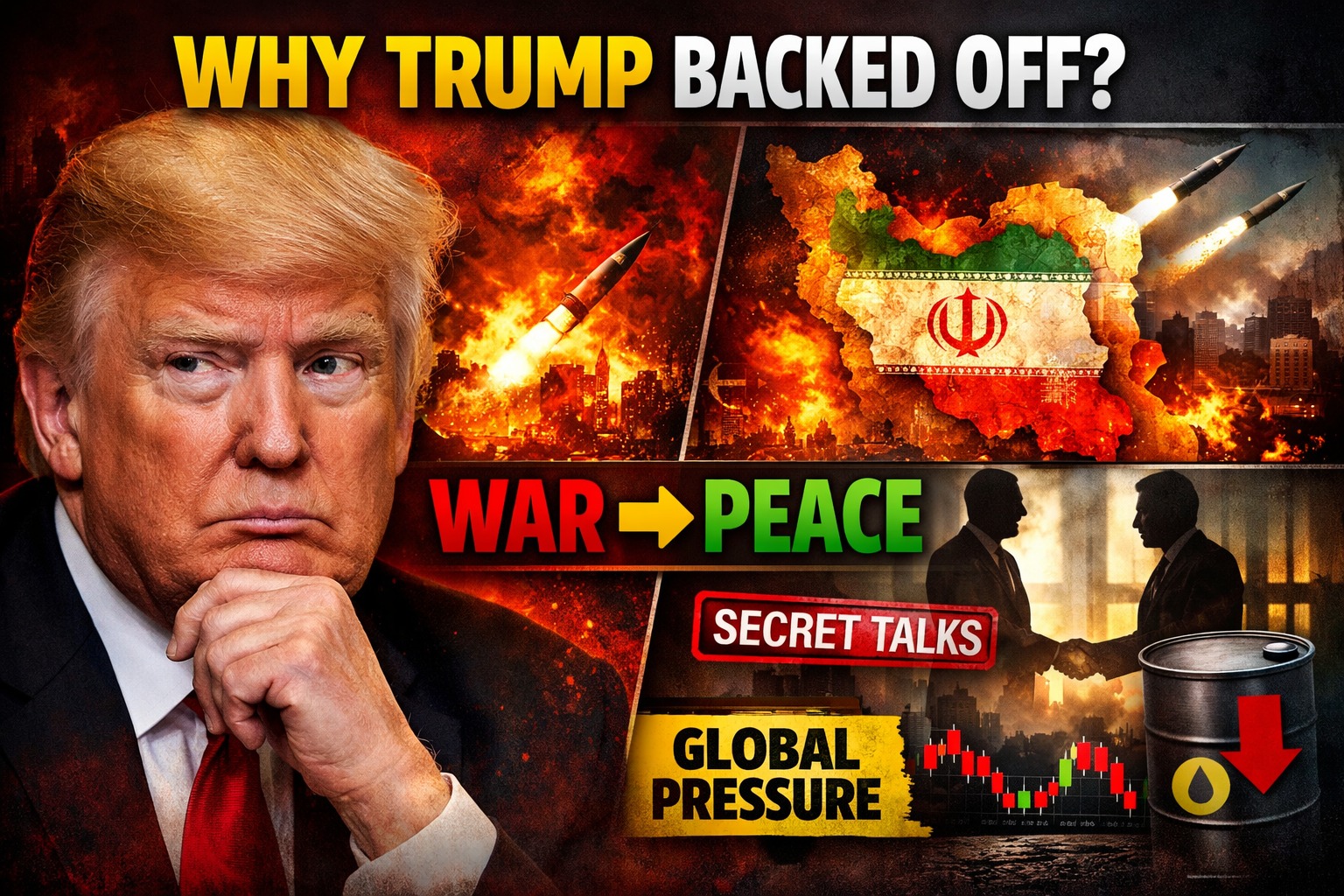
What Led to Trump’s Sudden U-Turn on Iran War: Backchannel Diplomacy, Global Pressure, and Strategic Calculations
A sudden shift in stance by Donald Trump on the escalating conflict with Iran has drawn global attention, raising questions about what prompted the United States to pause military action despite rising tensions.
From issuing ultimatums to announcing a five-day halt on strikes, the rapid change in Washington’s approach reflects a complex interplay of diplomacy, intelligence efforts, and geopolitical pressure.
From Escalation to De-escalation
Just days before announcing the pause, Trump had taken a hardline stance, warning Iran to reopen the Strait of Hormuz within 48 hours or face severe military action targeting its energy infrastructure.
However, this aggressive posture gave way to a more conciliatory tone, with Trump later describing ongoing engagements as “constructive” and signaling openness to negotiations.
This abrupt shift left global observers and markets grappling with uncertainty.
Role of Backchannel Diplomacy
One of the most significant factors behind the U-turn appears to be a series of closed-door diplomatic efforts involving key regional players.
According to reports, foreign ministers from several countries—including:
- Egypt
- Turkey
- Saudi Arabia
- Pakistan
held a high-level meeting in Riyadh to explore ways to de-escalate the crisis.
These discussions focused on creating a diplomatic pathway that could prevent further military escalation while opening channels for dialogue.
Egyptian Intelligence and the IRGC Backchannel
A key breakthrough reportedly came when Egyptian intelligence agencies established a backchannel with Iran’s powerful Islamic Revolutionary Guard Corps.
This development was crucial because:
- Direct communication between the US and Iran was limited
- Iran lacked a clearly identified negotiator after recent leadership disruptions
- Trust between both sides remained fragile
Through this backchannel, a proposal for a five-day halt in hostilities was put forward as a confidence-building measure.
This proposal eventually aligned with Trump’s announcement, suggesting that diplomatic groundwork had already been laid before the public declaration.
Impact of Leadership Vacuum in Iran
The diplomatic process faced an early setback due to the reported killing of Ali Larijani in Israeli strikes.
Larijani had been viewed as a potential interlocutor capable of engaging with Western powers.
His absence created:
- A leadership vacuum in negotiations
- Increased uncertainty in diplomatic channels
- Delays in establishing credible communication
This made the role of intermediaries, such as Egypt, even more critical.
Influence of Regional Powers
The involvement of Gulf and regional nations highlights the broader geopolitical stakes.
Countries like Saudi Arabia and Pakistan have strong interests in:
- Preventing a wider regional conflict
- Maintaining stability in energy markets
- Protecting strategic and economic interests
Their intervention underscores how regional actors are actively shaping the trajectory of the conflict.
White House Response: “A Fluid Situation”
The White House described the situation as “fluid,” cautioning against drawing conclusions from unconfirmed reports.
Press Secretary Karoline Leavitt emphasized that sensitive diplomatic discussions are not conducted publicly and that any developments should be considered tentative until officially confirmed.
This statement reflects the complexity and uncertainty surrounding ongoing negotiations.
Key Sticking Points in Negotiations
Despite the progress made through backchannel diplomacy, several critical issues remain unresolved.
- Security Guarantees
Iran is demanding assurances against future attacks by the US and its allies.
- Nuclear Program
The US continues to push for:
- Dismantling of Iran’s nuclear capabilities
- Limits on uranium enrichment
- Restrictions on ballistic missile development
- Regional Influence
Washington has called for Iran to end support for proxy groups across the region.
- Strait of Hormuz Control
The future of the Strait of Hormuz remains a major flashpoint.
While some Arab nations have suggested neutral oversight, Iran has proposed levying transit fees—an idea strongly opposed by Gulf states.
Strategic Importance of the Strait of Hormuz
The Strait of Hormuz is one of the world’s most critical energy chokepoints, with nearly 20% of global oil supply passing through it.
Any disruption in this region can lead to:
- Sharp increases in oil prices
- Supply chain disruptions
- Global economic instability
This makes control and access to the strait a central issue in the conflict.
Market Reactions and Global Uncertainty
The rapid shifts in US policy have triggered volatility in global markets.
Investors reacted to:
- Initial escalation signals with caution
- Sudden de-escalation with uncertainty
Such fluctuations highlight how geopolitical developments directly influence financial markets and investor sentiment.
Possibility of Direct Talks
Backchannel momentum has opened the possibility of direct talks between US and Iranian officials.
Reports suggest that potential meeting locations could include:
- Pakistan
- Turkey
Possible US representatives may include:
- Steve Witkoff
- Jared Kushner
- JD Vance
Iran may be represented by Abbas Araghchi, although Tehran has shown hesitation regarding formal negotiations.
Trump’s Optimism on Diplomacy
Despite the challenges, Trump has expressed cautious optimism about the prospects of engagement.
He described Iranian counterparts as “reasonable” and suggested that ongoing discussions could lead to a breakthrough.
This marks a notable shift from earlier rhetoric, indicating a willingness to pursue diplomatic solutions.
Broader Geopolitical Implications
The developments surrounding Trump’s U-turn have broader implications for global geopolitics.
- Shift Toward Multilateral Diplomacy
The involvement of multiple countries suggests a move away from unilateral action.
- Regional Power Dynamics
The role of Gulf nations highlights their growing influence in shaping outcomes.
- US Foreign Policy Approach
The shift reflects a balance between military pressure and diplomatic engagement.
Challenges Ahead
Despite the diplomatic progress, significant hurdles remain:
- Deep mistrust between the US and Iran
- Conflicting strategic objectives
- Domestic political pressures in both countries
- Complex regional alliances
These factors make the path to a lasting resolution uncertain.
The Road Ahead
The five-day pause represents a critical window for diplomacy.
Key developments to watch include:
- Whether backchannel talks translate into formal negotiations
- Responses from regional and global stakeholders
- Any confidence-building measures announced by either side
The outcome of these efforts will likely shape the future trajectory of the conflict.
Summary
US President Donald Trump’s sudden decision to pause military strikes on Iran appears to have been influenced by backchannel diplomacy involving Egypt, Saudi Arabia, Pakistan, and Turkey. Egyptian intelligence reportedly established communication with Iran’s IRGC, leading to a proposal for a five-day halt in hostilities.
While the pause has opened the door for negotiations, major differences remain over issues such as nuclear policy, regional influence, and control of the Strait of Hormuz. The situation remains fluid, with the potential for either diplomatic resolution or renewed escalation.
Disclaimer
This article is based on publicly available media reports and sources at the time of publication. The situation described is rapidly evolving, and new developments may alter the context or accuracy of the information presented.
The content is intended for informational purposes only and should not be interpreted as official policy or diplomatic communication. Readers are advised to consult verified sources for confirmed updates.
NoCap Times does not independently verify all claims and shall not be held responsible for any inaccuracies or omissions.