

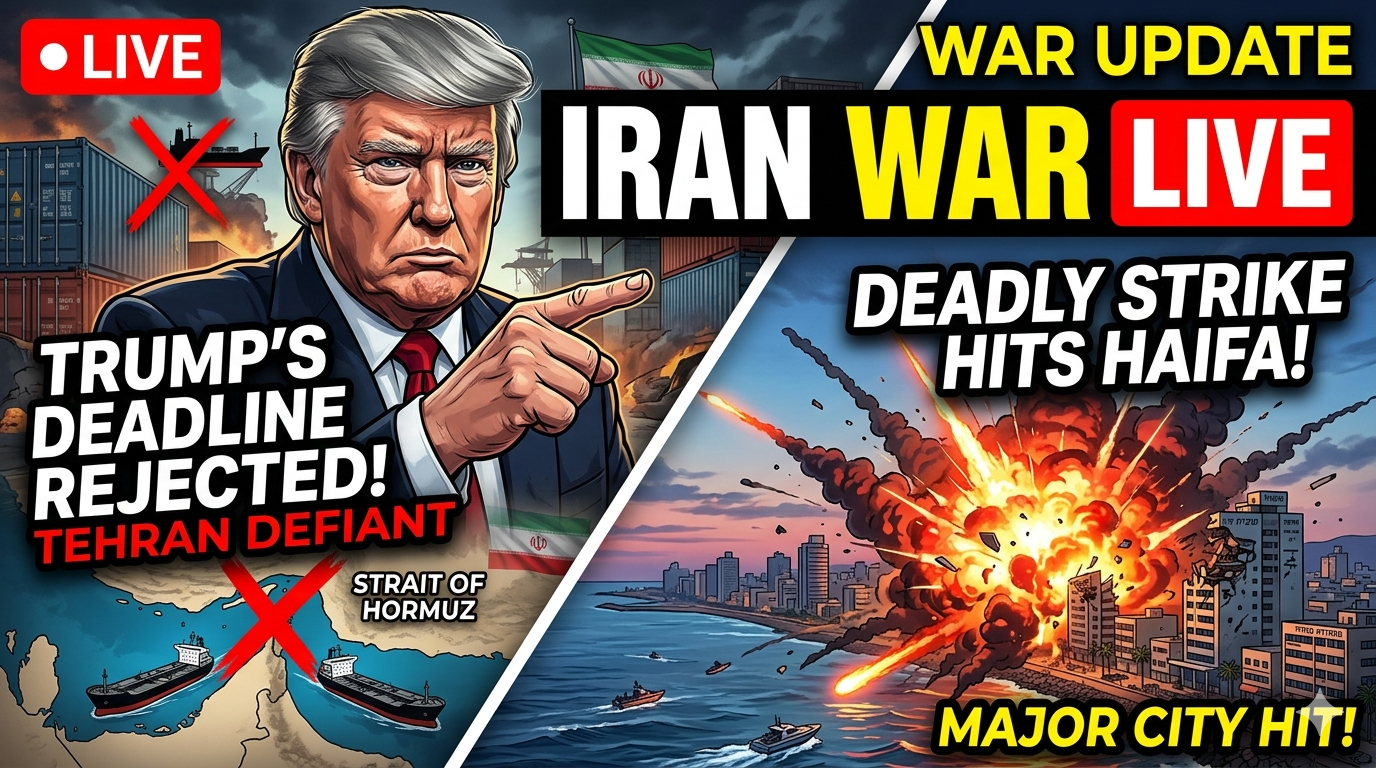
Iran War Live: Tehran Rejects Trump’s Hormuz Deadline; Deadly Strike Hits Haifa
The ongoing conflict in the Middle East has entered a dangerous new phase, with tensions escalating sharply between Iran, the United States, and Israel. A fresh wave of military threats, retaliatory strikes, and diplomatic deadlock has heightened fears of a broader regional war, while civilian casualties continue to mount.
Hormuz Standoff Deepens
At the center of the latest escalation is the strategic Strait of Hormuz — a narrow but critical maritime corridor through which a significant portion of the world’s oil supply passes. The United States, led by President Donald Trump, has issued a stern ultimatum to Iran, demanding that it reopen the strait or face severe military consequences.
However, Tehran has firmly rejected the deadline, responding with defiance and dismissing the demand outright. Iranian officials have signaled that they will not bow to external pressure, even as the threat of large-scale attacks looms.
The standoff over Hormuz is not just a regional issue—it has global implications. The disruption of shipping routes has already rattled energy markets, pushing oil prices higher and raising concerns about supply shortages. Reports suggest that maritime traffic through the strait has dropped significantly compared to normal levels, underscoring the severity of the crisis.
Rising Military Tensions
The conflict, which began with joint U.S.-Israeli strikes on Iranian targets in late February, has since expanded into a multi-front confrontation. Iran has responded with missile and drone attacks targeting Israeli cities and key infrastructure across the Gulf region.
One of the most alarming developments came with missile strikes on Israeli territory, including the port city of Haifa. According to reports, at least two people were killed in the attack, with several others injured and buildings damaged. Emergency teams rushed to the scene as rescue operations continued amid fears of additional strikes.
Meanwhile, airstrikes on Iranian cities have also intensified, resulting in significant casualties and widespread destruction. Civilian infrastructure, including power plants and bridges, has been severely impacted, raising concerns among international observers about the humanitarian cost of the conflict.
War Expands Across the Region
The conflict is no longer confined to Iran and Israel. It has spread across multiple countries in the Middle East, with attacks reported in Bahrain, Kuwait, and the United Arab Emirates. Iran has targeted economic and strategic assets linked to its adversaries, while allied groups in the region have also joined the confrontation.
The scale of the conflict is alarming. Thousands of casualties have been reported across different countries, and the situation continues to deteriorate. Military activity has increased in key zones, with both sides showing little willingness to de-escalate.
Diplomatic Efforts Amid Chaos
Despite the rising violence, there are ongoing efforts to find a diplomatic solution. Reports indicate that the United States, Iran, and regional mediators are exploring the possibility of a temporary ceasefire, potentially lasting 45 days.
Such a ceasefire, if agreed upon, could provide a window for negotiations and help prevent further escalation. However, the prospects remain uncertain, given the deep mistrust between the parties and the continued exchange of threats.
Trump has hinted that a deal is still possible, even as he warns of “massive retaliation” if Iran fails to comply with U.S. demands. Iran, on the other hand, has shown little interest in negotiating under pressure, insisting on its sovereignty and strategic interests.
Global Impact and Economic Shockwaves
The war’s impact is being felt far beyond the Middle East. The disruption of oil supplies has triggered volatility in global energy markets, with prices rising sharply. Countries heavily dependent on oil imports are particularly vulnerable, facing increased costs and potential shortages.
Financial markets have also reacted nervously, with investors closely monitoring developments. The uncertainty surrounding the Strait of Hormuz has become a key risk factor for the global economy, with analysts warning of prolonged instability if the conflict continues.
What Lies Ahead
As the situation stands, the Iran war shows no signs of immediate resolution. The rejection of the Hormuz deadline, continued missile strikes, and rising civilian casualties point to a prolonged and volatile conflict.
The coming days will be critical. Whether through diplomacy or further escalation, the decisions made now could shape the future of the region—and potentially the global economy—for months or even years to come.
For now, the world watches anxiously as tensions rise, hoping that dialogue prevails over destruction.
Disclaimer
This article is based on official statements and publicly available information at the time of publication. The global energy situation is dynamic and may change with evolving geopolitical developments.
The content is intended for informational purposes only and should not be considered financial or policy advice. Readers are encouraged to refer to official sources for the latest updates.
NoCap Times does not independently verify all claims and shall not be held responsible for any inaccuracies or omissions.