

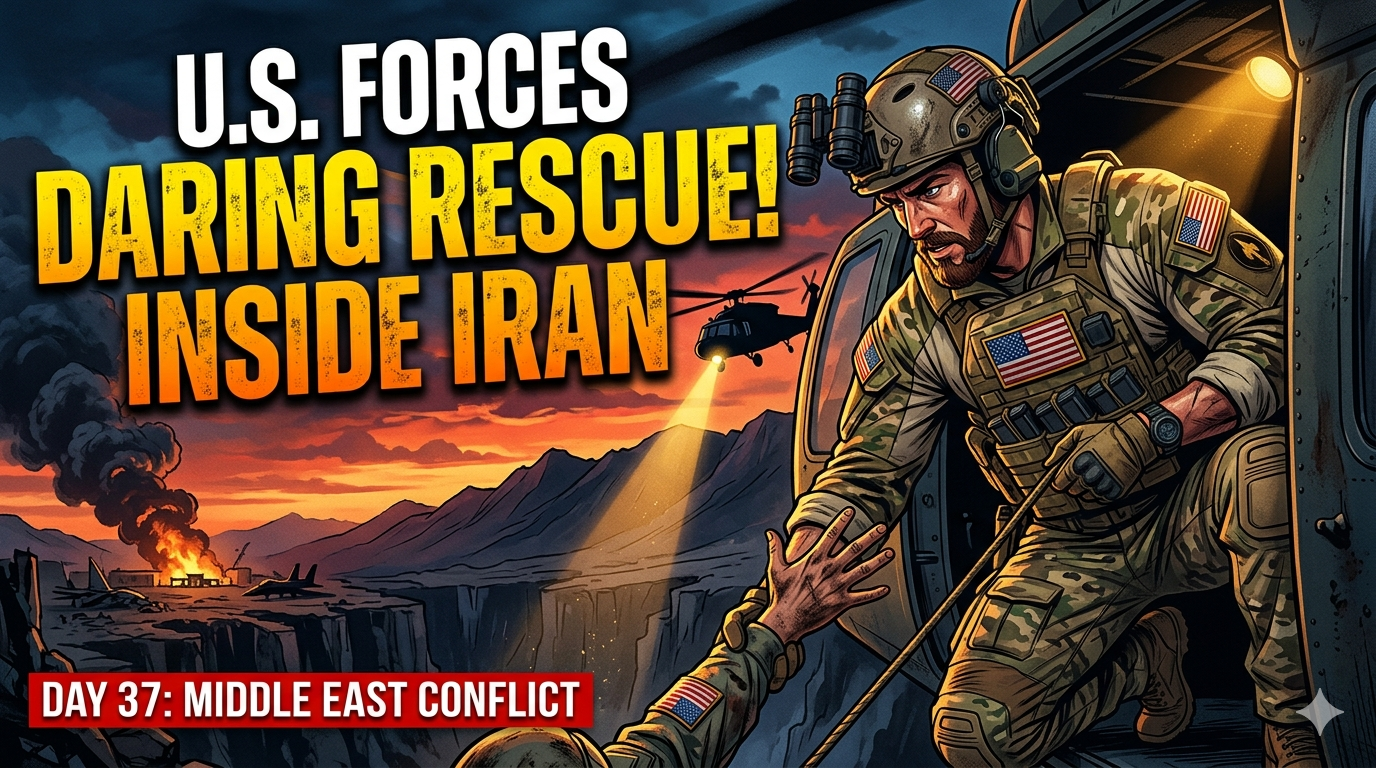
Day 37 of Middle East Conflict: US Forces Execute Daring Rescue of F-15 Crew Member Inside Iran
The Middle East conflict has entered its 37th day, with tensions escalating sharply as the United States carried out one of its most complex and high-risk rescue missions in recent history. In a dramatic turn of events, U.S. special forces successfully rescued a crew member from a downed F-15 fighter jet deep inside Iranian territory, marking a significant moment in the ongoing war.
F-15 Shot Down Over Hostile Territory
The incident began when a U.S. Air Force F-15E Strike Eagle was shot down over Iran during active combat operations. The aircraft, part of ongoing military engagements in the region, was forced to eject its two crew members after being hit by Iranian air defenses.
While one crew member—the pilot—was rescued within hours of the crash, the second crew member, a weapons systems officer, remained stranded behind enemy lines. His survival quickly became a race against time, as Iranian forces launched a search operation to capture him.
Stranded and Hunted
For more than 24 hours, the downed airman evaded capture in rugged mountainous terrain in southwestern Iran. Despite being injured, he managed to move across difficult terrain and hide from pursuing forces, demonstrating remarkable resilience and survival skills.
Reports suggest that Iranian forces, including elements of the Islamic Revolutionary Guard Corps (IRGC), were actively searching for him, raising fears that he could be taken prisoner and used as leverage in the conflict.
The situation posed a nightmare scenario for the U.S. military, as the capture of an American service member inside Iran would have had major strategic and political consequences.
High-Risk Rescue Operation
In response, the United States launched a massive search-and-rescue mission involving special forces, advanced surveillance systems, and multiple aircraft. The operation reportedly included drones, helicopters, and transport planes, all coordinated to locate and extract the stranded airman.
The rescue mission was anything but straightforward. U.S. officials revealed that intelligence teams employed deception tactics to mislead Iranian forces about the airman’s location, buying critical time for the extraction.
In a bold move, U.S. commandos entered Iranian territory under heavy risk, navigating both hostile terrain and enemy presence. The operation involved intense coordination and, in some instances, direct engagement with opposing forces.
According to reports, the airman was eventually located hiding in a mountainous area. He was wounded but alive and able to communicate with rescuers. The extraction was carried out under heavy pressure, with U.S. forces ensuring that he was safely evacuated before Iranian units could reach the area.
Mission Success Amid Rising Tensions
The successful rescue of the second crew member marked the conclusion of a tense and dangerous operation. Both airmen from the downed F-15 are now safe, though the rescued officer reportedly sustained injuries and is receiving medical care.
U.S. President Donald Trump described the mission as “one of the most daring search-and-rescue operations in U.S. history,” highlighting the risks involved and the coordination required to execute it successfully.
However, the mission also came at a cost. Reports indicate that several aircraft involved in the operation were damaged or destroyed, and the risk of escalation with Iran has increased further.
Conflict Intensifies Across the Region
The downing of the F-15 and the subsequent rescue mission underscore the intensifying nature of the conflict. It marks one of the first confirmed instances of a U.S. manned aircraft being shot down inside Iranian territory during the ongoing war.
The broader conflict continues to expand, with missile strikes, air raids, and military engagements reported across multiple countries in the region. Both sides appear unwilling to back down, raising concerns about a prolonged and potentially wider war.
Global Implications
Beyond the battlefield, the incident has far-reaching implications. The ability of Iranian defenses to down a U.S. fighter jet signals a significant escalation in military capability and confrontation. At the same time, the U.S. rescue operation demonstrates its commitment to retrieving personnel, even in the most hostile environments.
For global observers, the situation remains highly volatile. The combination of direct U.S.-Iran confrontation, regional instability, and strategic risks—such as disruptions to oil supply routes—continues to weigh heavily on international markets and geopolitical stability.
What Comes Next
As the conflict moves beyond its fifth week, the stakes are higher than ever. The successful rescue may boost morale for U.S. forces, but it also highlights the dangers of deeper military engagement.
With both sides escalating their actions and diplomatic solutions still uncertain, the coming days will be critical. Whether the conflict moves toward de-escalation or further intensifies will depend on decisions made at the highest levels of leadership.
For now, Day 37 stands as a stark reminder of the risks, resilience, and realities of modern warfare—where every mission carries consequences far beyond the battlefield.
Disclaimer
This article is based on official statements and publicly available information at the time of publication. The global energy situation is dynamic and may change with evolving geopolitical developments.
The content is intended for informational purposes only and should not be considered financial or policy advice. Readers are encouraged to refer to official sources for the latest updates.
NoCap Times does not independently verify all claims and shall not be held responsible for any inaccuracies or omissions.