

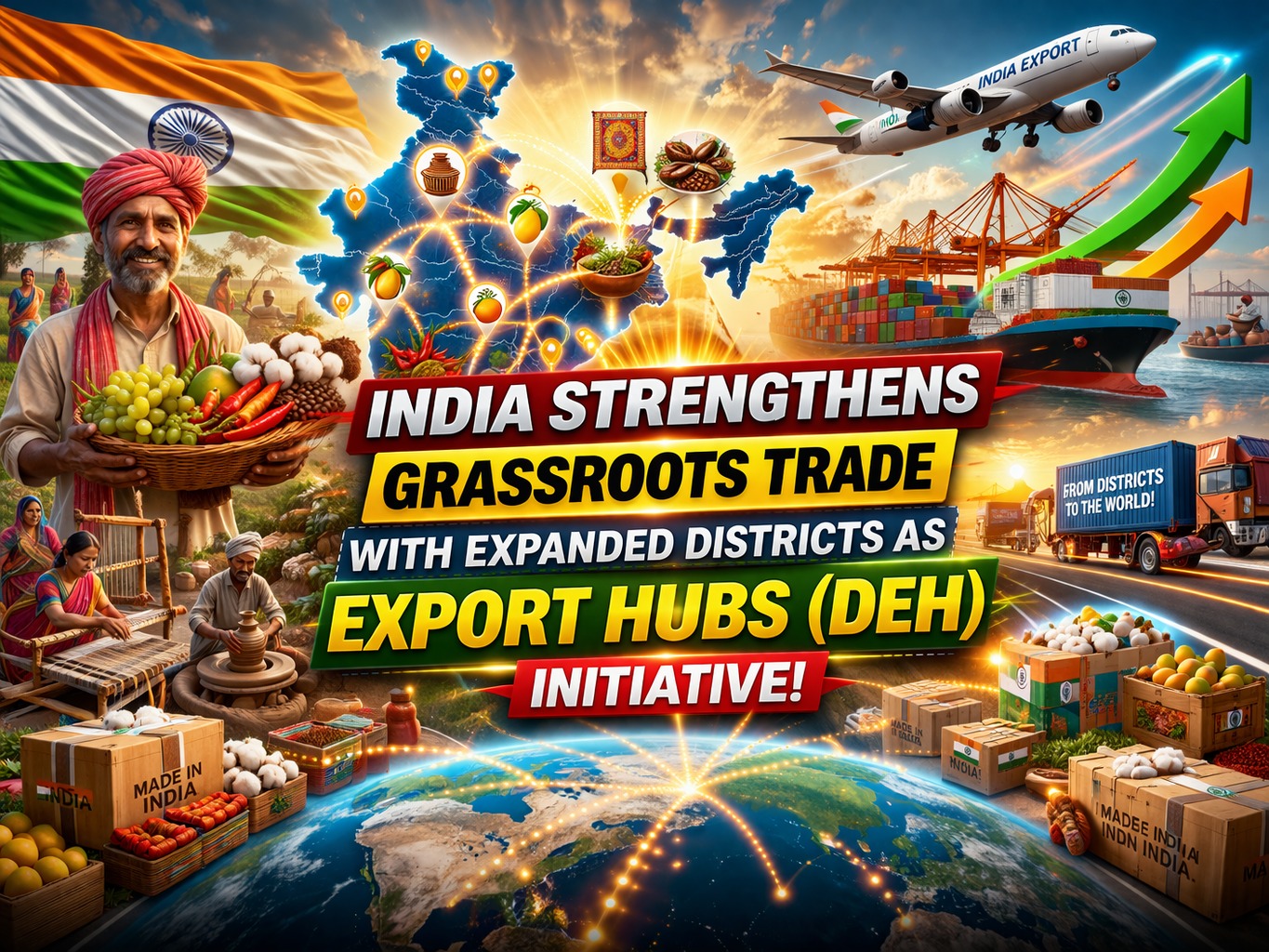
India Strengthens Grassroots Trade with Expanded Districts as Export Hubs (DEH) Initiative
In a significant move to deepen India’s export ecosystem and ensure inclusive economic growth, the Government of India has scaled up its ambitious Districts as Export Hubs (DEH) initiative. This strategic expansion aims to transform districts into dynamic centers of export activity by leveraging their unique strengths, boosting local industries, and integrating them into global value chains.
The initiative represents a paradigm shift in India’s export strategy—moving from a centralized, top-down approach to a more decentralized, district-driven model. By focusing on local potential and empowering grassroots stakeholders such as MSMEs, farmers, artisans, and small manufacturers, the government seeks to create a more balanced and resilient export framework.
A Decentralised Approach to Export Growth
Traditionally, India’s export growth has been concentrated in a few industrial clusters and metropolitan regions. However, the DEH initiative is designed to unlock the untapped potential of smaller districts across the country.
By identifying district-specific products and services with export potential, the initiative ensures that every region contributes to the nation’s trade performance. This localized approach not only enhances export competitiveness but also promotes equitable regional development.
The expansion of the DEH initiative reflects the government’s commitment to making exports a mass movement rather than limiting it to select industries or geographies. It aligns closely with India’s broader economic vision of inclusive growth and self-reliance.
Institutional Framework Driving the Initiative
To ensure effective implementation, the government has established a robust institutional mechanism across all 36 States and Union Territories. Two key bodies play a central role in this framework:
- State Export Promotion Committees (SEPCs)
- District Export Promotion Committees (DEPCs)
These committees act as coordinating bodies that bring together various stakeholders, including government departments, industry representatives, exporters, and financial institutions.
The SEPCs operate at the state level, overseeing policy alignment and strategic planning, while the DEPCs function at the district level, focusing on execution and local coordination. This multi-layered governance structure ensures that export promotion efforts are both strategic and ground-oriented.
Progress in District Export Action Plans
A key component of the DEH initiative is the preparation of District Export Action Plans (DEAPs). These plans serve as blueprints for identifying export opportunities, addressing challenges, and outlining actionable strategies for each district.
So far, draft DEAPs have been prepared for 590 districts across the country, demonstrating the scale and ambition of the initiative. Out of these, 249 plans have already been officially notified, marking steady progress in implementing decentralized export planning.
These action plans are tailored to the specific strengths and needs of each district. They focus on improving infrastructure, enhancing product quality, building capacity, and facilitating market access.
Showcasing India’s Diverse Export Potential
One of the most compelling aspects of the DEH initiative is its emphasis on showcasing India’s diverse export basket. By identifying unique products and services from each district, the initiative highlights the richness of India’s local economies.
For example:
- Jalgaon has been recognized for its agricultural exports, particularly bananas and brinjal.
- Aravalli in Gujarat is known for its ceramics and tiles industry.
- Districts in Chhattisgarh contribute significantly with products such as rice, mangoes, and traditional iron crafts.
In addition to these, many districts are promoting handicrafts, handlooms, and Geographical Indication (GI)-tagged products, which have strong demand in international markets.
This focus on diversity not only enhances export volumes but also strengthens India’s brand identity as a source of unique and high-quality products.
Empowering MSMEs and Local Producers
At the heart of the DEH initiative is the goal of empowering Micro, Small, and Medium Enterprises (MSMEs), along with farmers, artisans, and local manufacturers.
These stakeholders often face challenges such as limited access to international markets, lack of awareness about export procedures, and inadequate infrastructure. The DEH initiative addresses these issues by providing targeted support and creating an enabling environment for exports.
By connecting local producers to global markets, the initiative helps increase their income, improve livelihoods, and generate employment opportunities. It also encourages entrepreneurship at the grassroots level, contributing to the overall economic development of districts.
Leveraging Technology and Digital Platforms
In today’s digital age, technology plays a crucial role in facilitating exports. The DEH initiative leverages digital platforms to streamline processes, enhance transparency, and provide easy access to information.
Platforms such as the Niryat portal and the Directorate General of Commercial Intelligence and Statistics (DGCI&S) portal serve as valuable resources for exporters. They offer data, insights, and tools that help businesses understand market trends, identify opportunities, and make informed decisions.
Digital outreach programs and awareness campaigns are also being conducted to educate stakeholders about export procedures, compliance requirements, and available government support.
Addressing Bottlenecks and Building Capacity
Another important focus area of the DEH initiative is identifying and addressing bottlenecks that hinder export growth. These may include issues related to logistics, quality standards, certification, financing, and market access.
Through coordinated efforts by SEPCs and DEPCs, these challenges are being systematically addressed. Infrastructure improvements, skill development programs, and capacity-building initiatives are being implemented to strengthen the export ecosystem at the district level.
Training programs and workshops are conducted to enhance the capabilities of local producers, enabling them to meet international standards and compete effectively in global markets.
Enhancing Market Linkages
Creating strong market linkages is essential for sustaining export growth. The DEH initiative focuses on connecting local producers with international buyers through trade fairs, exhibitions, and business matchmaking events.
Efforts are also being made to promote e-commerce exports, allowing small businesses to reach global customers directly. This is particularly beneficial for sectors such as handicrafts and handlooms, where unique products can attract niche markets.
By expanding market access, the initiative ensures that district-level products gain visibility and recognition on the global stage.
Aligning with the Vision of Self-Reliance
The expansion of the DEH initiative is closely aligned with India’s vision of becoming self-reliant, often referred to as “Atmanirbhar Bharat.” By strengthening local production and promoting exports, the initiative reduces dependency on imports and enhances economic resilience.
Transforming districts into export hubs not only boosts local economies but also contributes to national growth. It creates a multiplier effect, where increased exports lead to higher production, employment, and income generation.
This decentralized approach ensures that the benefits of economic growth are distributed more evenly across the country, reducing regional disparities.
Future Outlook
The DEH initiative holds immense potential for transforming India’s export landscape. As more districts implement their action plans and strengthen their export capabilities, the overall impact on the economy is expected to be significant.
Going forward, continued focus on infrastructure development, digital integration, and policy support will be crucial. Collaboration between government agencies, industry stakeholders, and local communities will also play a key role in ensuring the success of the initiative.
With sustained efforts and strategic execution, India is well-positioned to emerge as a global export powerhouse, driven by the collective strength of its districts.
Conclusion
The expansion of the Districts as Export Hubs (DEH) initiative marks a transformative step in India’s journey toward becoming a globally competitive export-driven economy. By empowering districts, leveraging local strengths, and creating a supportive ecosystem, the initiative is redefining how exports are generated and sustained.
With strong institutional support, targeted interventions, and a focus on inclusivity, the DEH initiative is not just boosting exports—it is reshaping the economic landscape of the country from the ground up.
Summary
The Government of India has expanded the Districts as Export Hubs (DEH) initiative to enhance export competitiveness at the district level and promote balanced regional development. With institutional mechanisms like SEPCs and DEPCs in place across all states and UTs, and District Export Action Plans prepared for 590 districts (249 notified), the initiative is progressing steadily. By identifying district-specific export potential and supporting MSMEs, farmers, and local producers through digital platforms and targeted interventions, DEH aims to create new exporters, improve market access, and strengthen India’s overall export ecosystem.
Disclaimer
This article is based on official statements and publicly available information at the time of publication. The global energy situation is dynamic and may change with evolving geopolitical developments.
The content is intended for informational purposes only and should not be considered financial or policy advice. Readers are encouraged to refer to official sources for the latest updates.
NoCap Times does not independently verify all claims and shall not be held responsible for any inaccuracies or omissions.